
Shouting at the Giants: How Social Hierarchy Silences Dialogue in Twitter Conflicts
Cross-hierarchical communication in Twitter conflicts
This paper investigates how social hierarchy influences cross-ideological communication during Twitter conflicts (Israel-Palestine, US Politics, and Sports). Using follower counts as a proxy for status, the authors proposed three metrics—equality, diversity, and reciprocity—to quantify interactions. The study reveals that lower-status users frequently "attack" high-status adversaries but are rarely engaged in return.
TL;DR
In the digital coliseum of Twitter, does your "status" determine if your voice is heard or ignored? This study analyzes three major conflicts—geopolitical (PA-IL), political (US GOP-DEM), and athletic (El Clásico)—to show that while low-status users are the most eager to engage with their enemies, they are the most likely to be met with silence.
Background Positioning: This work bridges traditional sociology with computational social science, moving beyond simple sentiment analysis to uncover the structural power dynamics of online polarization.
The "Digital Hate" Problem
Online conflicts are often viewed through the lens of "echo chambers." However, people do talk across the aisle—often aggressively. The authors argue that we cannot understand these interactions without looking at Social Stratification. If Twitter were truly a flat "global village," status shouldn't matter; but in reality, the "follower count" creates a visible hierarchy that dictates the flow of digital vitriol.
Methodology: Measuring the Social Ladder
The researchers identified users' ideological leanings by tracking retweet signals (e.g., retweeting the IDF vs. Al Qassam) and validated these with 96.2% accuracy via crowdsourcing. They then split users into four tiers:
- The Elites (Top 1%): Influencers and leaders.
- The Upper Class (1-10%): Highly active nodes.
- The Middle Class (10-70%): The majority of active users.
- The Bottom Tier (70-100%): Users with minimal followers.
They measured three dimensions of communication:
- Equality: Who participates more?
- Diversity (E-I Ratio): Do you talk to friends or foes?
- Reciprocity: Does the person you mentioned actually reply?
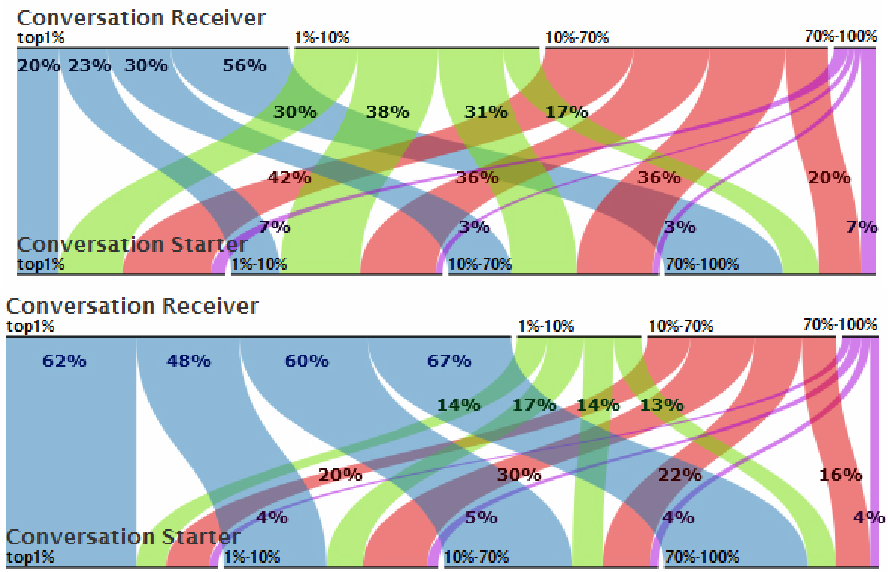 Figure 1: The Parallel Set visualization shows how mentions flow between hierarchies. Note the thick "ribbons" targeting the top 1%.
Core Insights: The "Attack the King" Phenomenon
The study’s findings provide a fascinating look at the "asymmetric" nature of Twitter warfare:
1. The Magnetism of Elites
Under inter-ideological contexts, users in the top-most hierarchy (1%) have the highest probability of being mentioned by their enemies. In fact, they receive more "adversarial mentions" than all other groups combined. People don't just want to argue; they want to argue with someone who matters.
2. High Diversity, Low Impact
The bottom 30% of users are actually the most "diverse" in their communication patterns (highest E-I ratio). They are far more likely to venture outside their echo chamber to mention a foe. However, this is not a sign of healthy dialogue—it is a sign of shouting into the void.
3. The Reciprocity Gap
The ANOVA tests revealed a harsh reality: starters from the bottom hierarchy had significantly shorter back-and-forth exchanges. While the elites are busy being mentioned, they rarely engage with the "lower classes," leading to a complete lack of reciprocity.
 Comparison of inter vs. intra interaction across the three conflict datasets.
Critical Analysis & Conclusion
Takeaway
The paper confirms that social hierarchy is a fundamental "filter" on social media. Twitter facilitates cross-hierarchical interaction (you can ping a Senator), but it does not enforce it (the Senator won't ping you back). This creates a cycle where the most marginalized voices in the network are also the most ignored, potentially fueling further frustration and "digital hate."
Limitations
- Follower Count as Proxy: Follower count is a "vanity metric" and doesn't always reflect real-world social status or intellectual authority.
- Contextual Differences: The study noted that sports conflicts (FCB-RM) behaved differently than political ones, suggesting that "status" might mean different things in different domains.
Future Outlook
Future research should look at the content of these mentions. Are low-status users more polite or more toxic when "punching up"? Understanding the linguistic nuances of cross-hierarchical hate could be the next step in mitigating online polarization.