
Crowd Modeling via Social Networks: A Graph-Based Approach to Anomaly Detection
CROWD MODELING USING SOCIAL NETWORKS 1
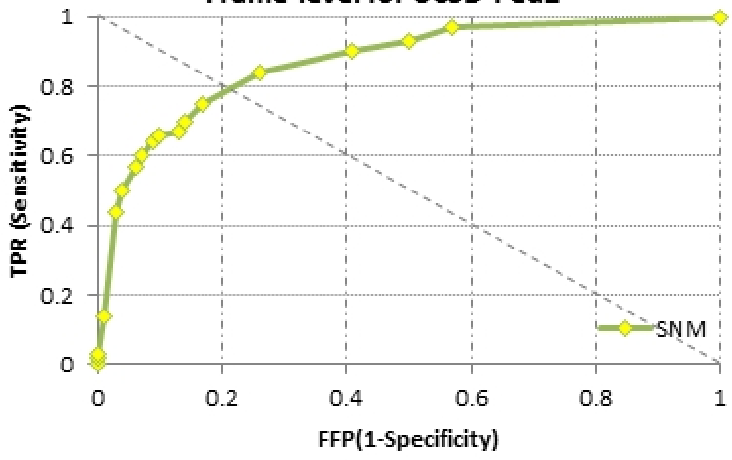
This paper proposes an unsupervised hierarchical social network model for anomaly detection in crowded scenes. By combining motion features (direction, magnitude, velocity) with graph-based centrality, the method constructs local and global social networks to identify outliers, achieving a 87.0% AUC on the UCSD Ped2 benchmark.
TL;DR
This research introduces a robust, unsupervised framework for detecting anomalies in crowded video scenes using a hierarchical Social Nerve Model. By treating moving entities as nodes in a graph and their behavioral similarities as edges, the system identifies "social outliers"—such as bikers in pedestrian zones—without requiring manual labels or perfect individual tracking.
Background & Positioning
Crowd analysis is a cornerstone of intelligent video surveillance. While early works attempted to track every person ("top-down") or used fluid dynamics ("bottom-up"), they often struggled with the "contextual anomaly" problem. This paper occupies a unique middle ground: it uses Tracklets to build a social graph, effectively capturing the structural relationship between individuals.
The Core Motivation: Moving Beyond Simple Tracking
The authors argue that traditional tracking is a "daunting task" in high-density scenes. Instead of asking "Where is this person going?", they ask "How does this person's movement relate to their neighbors?". Their insight is that social context—the tendency of groups to move with similar velocity and direction—is the most reliable signal for defining "normal" behavior.
Methodology: Hierarchical Social Networks
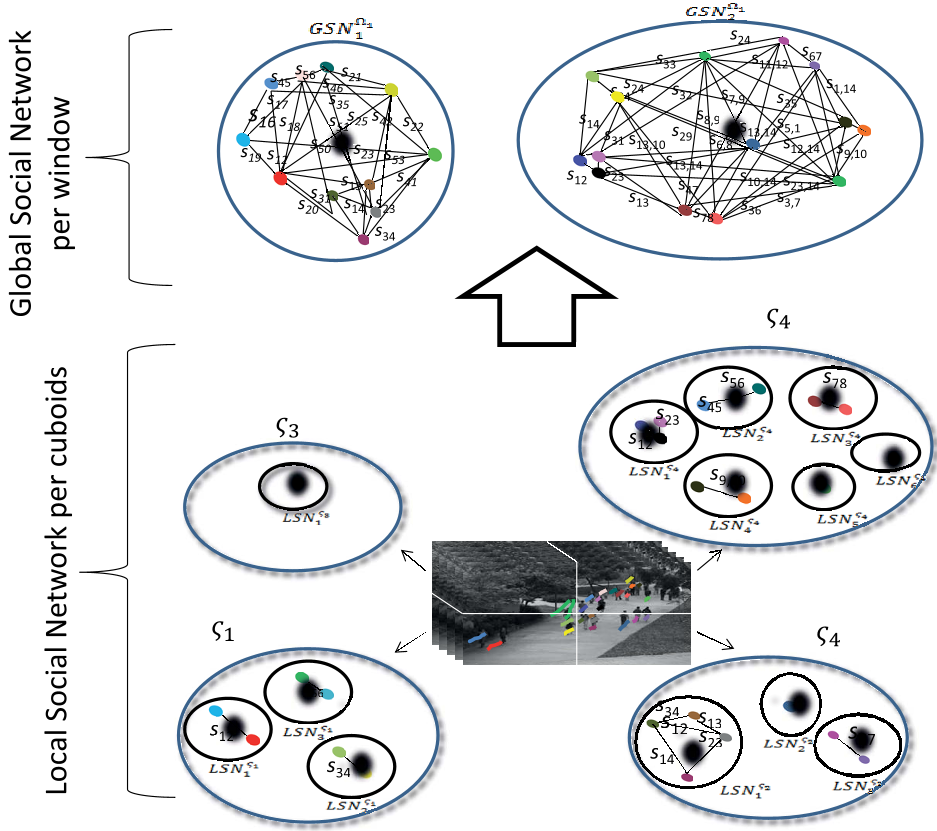
The system follows a four-step pipeline:
- Feature Extraction: Uses KLT trackers to generate short-term trajectories (tracklets).
- Spatio-Temporal Partitioning: Divides the video into cuboids to maintain spatial locality.
- Local Social Network (LSN): Within each cuboid, a graph is built. Nodes are tracklets; edges are weighted by a multi-factor similarity measure:
- Cosine Similarity: Directional alignment.
- Magnitude Similarity: Speed consistency.
- Dynamic Time Warping (DTW): Velocity profile over time.
- Global Social Network (GSN): Local clusters are merged using Hierarchical Agglomerative Clustering to represent scene-wide patterns.
Detecting the "Outlier"
Anomaly detection is performed by analyzing the relative size of the social network components. If a group of tracklets (a network component) is significantly smaller than the dominant "social" group in its neighborhood (defined by a threshold ), it is flagged as anomalous.
Experimental Validation
The model was tested on the UCSD Pedestrian Dataset, a standard benchmark featuring anomalies like golf carts, skaters, and bicycles.
SOTA Comparison
As shown in the table below, the proposed method achieves superior or competitive results compared to MDT (Mixture of Dynamic Textures) and SRC (Sparse Reconstruction Cost).

Visual Accuracy
A critical advantage of this method is its precision. While older models like MDT often produce "bloated" masks or miss small, fast-moving objects (like bikes), the social network approach correctly identifies them.
Critical Insight & Conclusion
The true value of this work lies in its unsupervised nature. It doesn't need to know what a "bicycle" looks like; it only needs to observe that the bicycle's motion doesn't "socialize" (match) with the surrounding pedestrian flow.
Limitations: While powerful, the method relies on KLT trackers which can still be noisy. Future iterations could benefit from replacing manual similarity weights () with learned embeddings from a Deep Graph Neural Network.
Takeaway: By reframing crowd movement as a social graph rather than a set of pixels, we move closer to "intent-aware" surveillance systems.