
CrowdCog: Routing the Crowd via the Architecture of the Human Mind
CrowdCog: A Cognitive Skill based System for Heterogeneous Task Assignment and Recommendation in Crowdsourcing
The paper introduces CrowdCog, a dynamic online system that leverages fast-paced cognitive skill tests to automate heterogeneous task assignment and recommendation in crowdsourcing. By mapping workers' executive brain functions to specific task requirements, it achieves a significant performance boost of 5% to 20% across Classification, Counting, Transcription, and Sentiment Analysis tasks on Amazon Mechanical Turk.
TL;DR
Matching the right person to the right task is the "Holy Grail" of crowdsourcing. CrowdCog is a novel framework that moves away from looking at what a worker has done (history) to how their brain works (cognitive skills). By using five rapid-fire cognitive tests, the system predicts worker performance across diverse tasks—boosting accuracy by up to 20% and making high-quality data collection faster and cheaper.
Background: The Limits of Reputation
In the current crowdsourcing landscape (platforms like MTurk or Prolific), requesters typically filter workers using two blunt instruments:
- Golden Questions: Hidden test questions that check if you're paying attention.
- Reputation Scores: Only allowing workers who have already completed thousands of tasks with high approval.
The Problem? This creates a "cold start" problem for new, potentially brilliant workers and fails to account for the specific mental demands of different tasks. Counting malaria cells (visual precision) requires a different cognitive "muscle" than sentiment analysis (linguistic nuance).
Methodology: Mapping the Mind to the Task
The core insight of CrowdCog is that every micro-task draws upon Executive Functions—the Command and Control center of the brain. The researchers selected five tests to measure three specific functions:
- Inhibition Control (Stroop & Flanker Tests): The ability to ignore distractions.
- Working Memory (N-Back & Pointing Tests): The ability to hold and manipulate information.
- Cognitive Flexibility (Task Switching): The ability to shift between different rules or concepts.
 Figure 1: The four heterogeneous tasks used: Classification, Counting, Sentiment Analysis, and Transcription.
The Engine
When a worker enters the system, they perform a few short cognitive trials. CrowdCog feeds these scores into a Random Forest model. If the model predicts the worker's accuracy will exceed a specific threshold (e.g., 50%), they are assigned to that task.
Experimental Results: Better, Faster, Fairer
The team deployed the system on MTurk, involving nearly 600 workers. The results were striking:
- SOTA Performance: CrowdCog-Assign significantly beat the baseline across the board. In "Counting" tasks, accuracy jumped from ~58% to nearly 73%.
- Zero-Shot Profiling: It performed as well as "History-based" methods. This means a new worker can prove their worth in 3 minutes of cognitive testing rather than waiting months to build a reputation.
- Efficiency and Cost: By matching the right workers to tasks, the system achieved higher accuracy with only 3 answers per question compared to the baseline requiring 9 answers. This 3x reduction in labeling needs completely offsets the cost of paying workers for the cognitive tests.
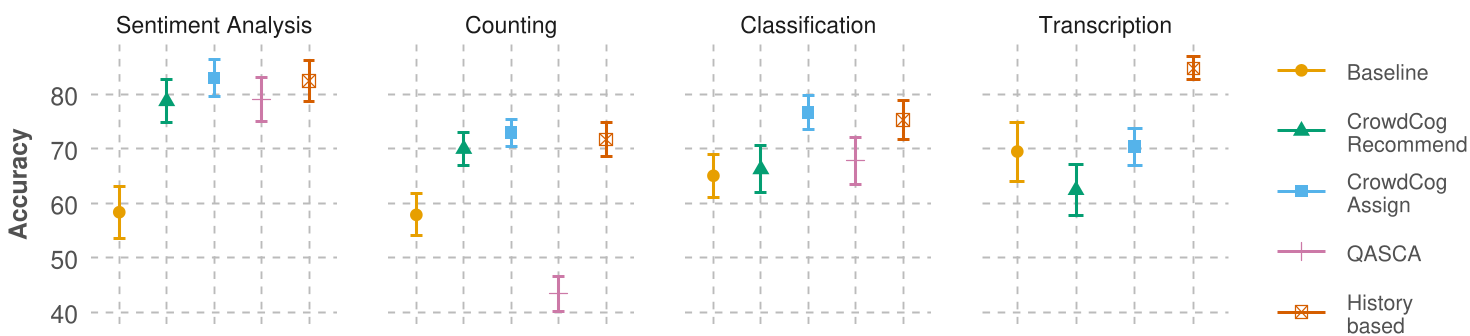 Figure 2: Accuracy comparison between Baseline, Recommendation, and Assignment modes.
Why It Works: The "Person-Job Fit"
The research confirms that tasks like Transcription are highly dependent on Cognitive Flexibility, while Counting relies heavily on Inhibition Control. By mathematically aligning these traits, CrowdCog ensures that workers aren't just "active," but "optimized."
Critical Insight & Limitations
The Takeaway: This work shifts the paradigm of "Quality Control" from surveillance (spotting cheaters) to empowerment (finding talents).
Limitations:
- Cognitive Drift: A worker's cognitive performance can change based on the time of day or fatigue.
- Worker Agency: Fully automated assignment (CrowdCog-Assign) performed best but removed worker choice. The "Recommend" version is a middle ground that maintains worker satisfaction but offers slightly lower gains.
Future Outlook
As AI training increases the demand for high-quality human-annotated data, systems like CrowdCog could become the standard "onboarding" layer for the global gig economy. Future versions might incorporate Longitudinal tracking—adjusting recommendations as a worker's skills evolve or as they become fatigued during a long session.