
CrowdColor: Solving the "Real Color" Crisis in Mobile Shopping via Crowdsourcing
CrowdColor: Crowdsourcing Color Perceptions Using Mobile Devices
The paper introduces CrowdColor, a mobile-based crowdsourcing system designed to capture and aggregate human color perceptions of physical products. By using a mobile color picker, it creates a representative "collective color" palette to solve color mismatch issues in online shopping, achieving high accuracy (ΔE as low as 2.0).
TL;DR
Ever bought a "navy blue" shirt online only to have a "dull purple" one arrive? CrowdColor addresses this classic e-commerce pain point by using the "wisdom of the crowd." Instead of relying on edited seller photos, it aggregates the actual visual perceptions of customers using a mobile color picker to create a unified, trustworthy digital color swatch.
Positioning: This work transitions color calibration from a purely algorithmic image-processing task to a Human-Computer Interaction (HCI) crowdsourcing task, proving that collective human eyes can rival professional sensors.
Problem: The Distortion Pipeline
The journey of a product's color from the factory to your screen is fraught with distortion:
- Capture: Lighting at the photo studio (Daylight vs. Studio lights).
- Editing: Sellers intentionally "beautify" photos.
- Display: Your iPhone (IPS) and your friend's Galaxy (AMOLED) render the same RGB value differently.
Current technical solutions (like Jain et al.'s Color Match) require users to hold physical color charts next to products—a friction-heavy process that most shoppers ignore.
Methodology: Human as the Sensor
The core insight of CrowdColor is that while one person's perception might be off, the average of the crowd tends toward the truth.
1. The Interface
The authors designed a simplified mobile color picker where the Hue control is independent of Saturation and Lightness. This reduces the mental load on the user, allowing for quick one-handed matching while holding the physical product in the other.
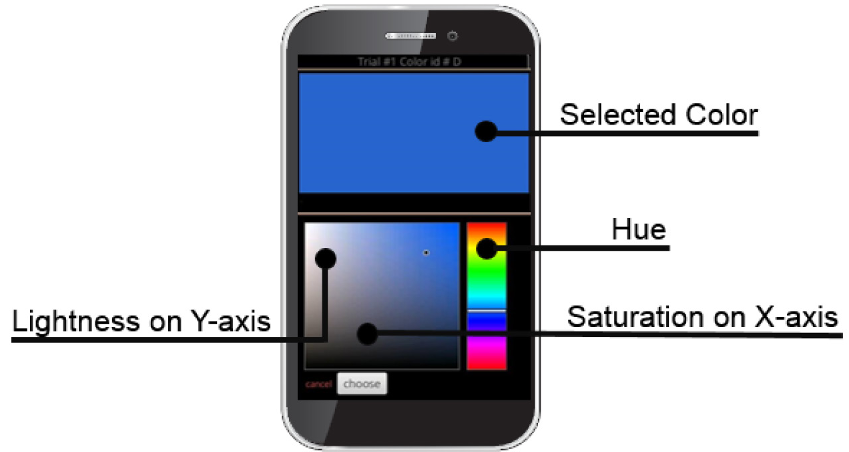 Figure 1: The CrowdColor picker interface designed for mobile ergonomics.
2. Adaptive Aggregation (ACC)
Color isn't just an RGB triple; it's a function of Device and Light. The system categorizes inputs based on:
- Display Panel: IPS (iPhone) vs. AMOLED (Galaxy), which have different color gamuts.
- Lighting: 5400K (Daylight) vs. 3800K (Fluorescent).
By only averaging inputs from similar environments (Adaptive CrowdColor), the system filters out the noise caused by environmental shifts.
Experimental Validation
The researchers conducted a 4×2×2 factorial study. They measured the "Color Distance" (ΔE) between the physical stimulus and the crowdsourced result using a professional spectrophotometer.
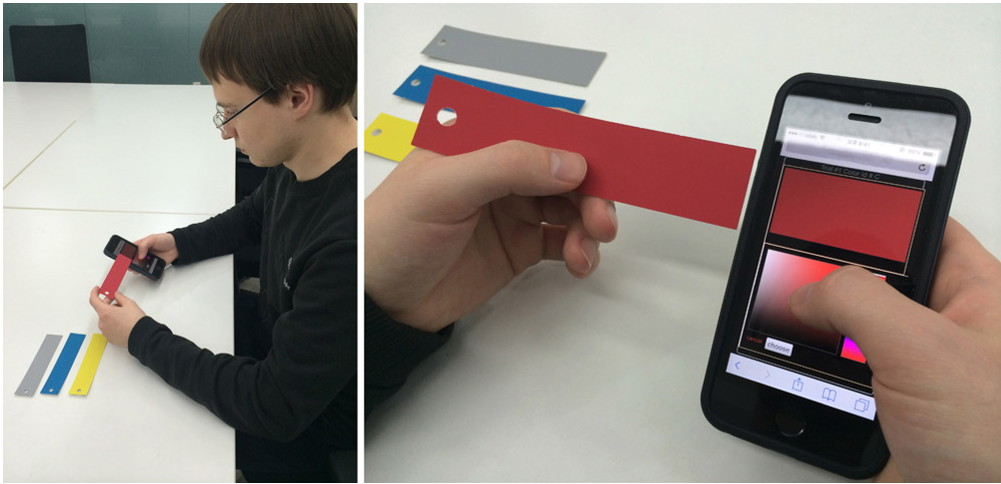 Figure 2: Lab setting to test color perception across different mobile panels and light temperatures.
Key Findings:
- The "Red" Success: For vivid colors like red, CrowdColor achieved a ΔE of 2.0. In the world of color science, any ΔE below 2.3 is considered indistinguishable to the human eye.
- The "Gray" Challenge: Neutral colors like gray were much harder for the crowd to match (ΔE ≈ 20), likely due to the "Chromatic Adaptation" of the human eye.
- Time Efficiency: The average input took less than 60 seconds, proving the method is viable for real-world reviews.
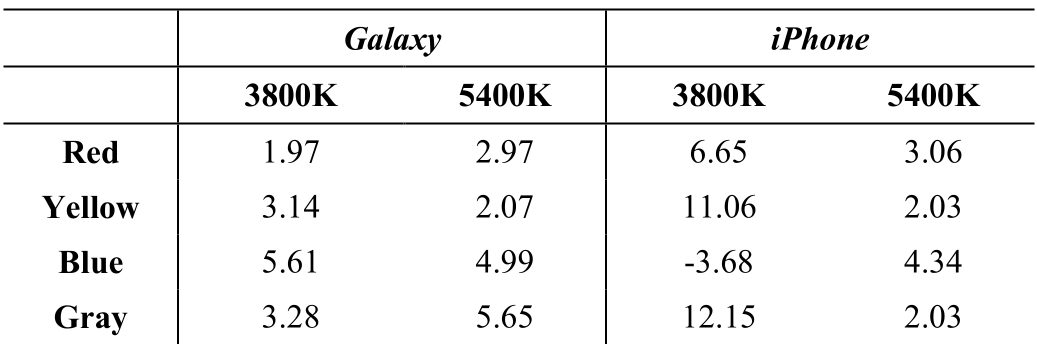 Table 1: Comparisons of ΔE across different conditions. Notice how Adaptive CrowdColor consistently outperforms non-adaptive versions.
Critical Analysis & Conclusion
Takeaway
CrowdColor proves that crowdsourcing is not just for labeling images or translating text; it can be used for nuanced graphical perception tasks. In e-commerce, this creates a "Trust Layer" that overrides the marketing-heavy photos of sellers.
Limitations
- Display Limits: If a mobile screen can't physically produce a certain high-saturation color (gamut limitation), no amount of crowdsourcing can fix the display gap.
- Materiality: The study used flat matte paper. Real-world products like silk or metallic gadgets have specular highlights that might confuse the "average color" input.
Future Outlook
The next step for this technology is Automated Environmental Detection. By using the front-facing camera's white-balance data and the phone's hardware ID, the system could automatically weight user inputs, creating a real-time, self-correcting color map for every product on the internet.