
CrowDIY: Optimizing Complex Crowdsourcing Workflows via Constraint Programming
CrowDIY: How to Design and Adapt Collaborative Crowdsourcing Workflows Under Budget Constraints
CrowDIY is a two-staged framework designed to optimize collaborative crowdsourcing workflows for complex tasks under budget and deadline constraints. It utilizes a constraint-programming approach (integrating solvers like Gurobi) to automate task attribute estimation and dynamic task publishing, effectively bridging the gap between workflow design and execution.
TL;DR
Managing complex crowdsourcing projects—like writing a collaborative essay or designing software—is notoriously difficult due to "trial-and-error" task planning. CrowDIY introduces a formal optimization framework that treats crowdsourcing as a constraint-satisfaction problem. By minimizing a newly defined "Overdue Risk" function, it automates the setting of rewards and deadlines, ensuring projects stay within budget while maximizing the probability of on-time completion.
Motivation: Beyond Microtasks
The first generation of crowdsourcing focused on independent microtasks (e.g., "Is there a dog in this image?"). However, complex work requires workflows: sequences of interdependent tasks where the output of a writer must be reviewed by an editor before being merged by a coordinator.
The current bottleneck is the Requester's Burden. Requesters must manually decide:
- How much reward is enough to attract a worker quickly?
- How much buffer time should be allowed before the next task fails?
- What happens if a worker drops out midway?
CrowDIY shifts this burden from the human requester to a mathematical solver.
Methodology: The Geometry of Overdue Risk
The authors represent a workflow as a Directed Acyclic Graph (DAG). The core innovation is the formalization of the Crowdsourcing Workflow Optimization (CWO) problem.
1. The Overdue Risk Function
Instead of just looking at binary success/failure, the authors propose a quadratic risk function: Where is the level of difficulty and is the buffer time. This penalizes late tasks exponentially, forcing the system to prioritize high-difficulty nodes.
2. Two-Stage Optimization
- Static Assignment: Occurs during the design phase. It estimates (latest booking time) and (time allotted) based on historical data.
- Dynamic Assignment: Occurs during execution. If a specific task finishes early or late, the system re-calculates the remaining workflow parameters to ensure the total cost and (Estimated Total Execution Time) remain within bounds.
 Figure 1: A sample workflow in CrowDIY for collaborative essay writing, illustrating the mix of QA, Choice, and Merge nodes.
Experiments and Results
The authors compared three major solvers: Gurobi, Cplex, and Choco.
Solver Performance
While Gurobi and Cplex showed similar accuracy in reducing overdue risk, Gurobi was significantly faster in execution time (#T), making it the ideal choice for dynamic, real-time workflow adjustments.
The "Sweet Spot" of Buffer Time
One of the most actionable insights from the paper is the relationship between Allotted Time and Buffer Time.
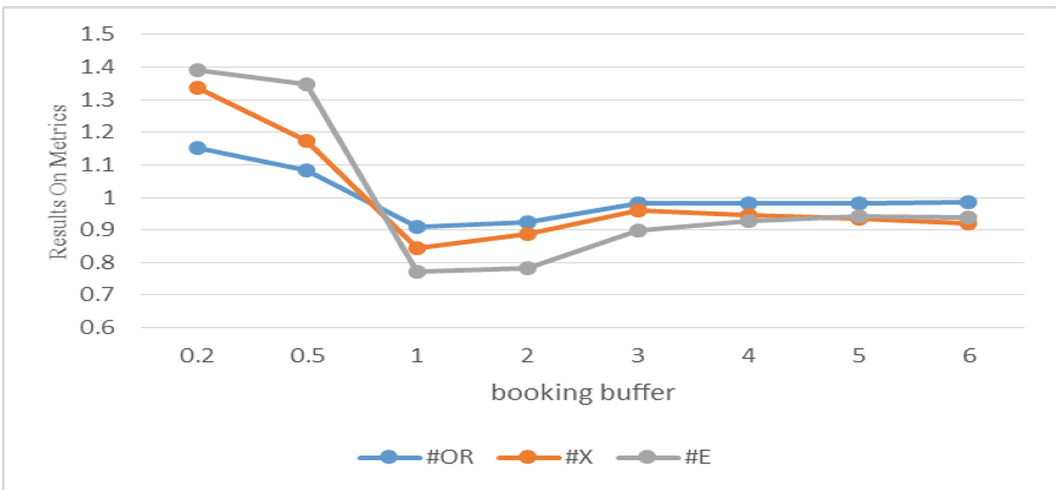 Figure 2: Performance metrics (#OR - Overdue Risk, #X - Time Extension) plotted against buffer time coefficients.
The data shows that when buffer time is too low (x < 0.5), the risk of "no solution" and "trial-and-error" (#E) spikes because workers cannot meet unrealistic deadlines. However, the optimal balance is achieved when the buffer time is roughly equal to the task's allotted time.
Critical Insight & Conclusion
CrowDIY demonstrates that crowdsourcing is essentially a stochastic scheduling problem. The paper’s contribution lies in "DIY" automation—allowing non-experts to design complex human-in-the-loop systems without needing a PhD in operations research.
Limitations: The model assumes that historical data is a reliable predictor of future worker behavior. In highly volatile markets or niche domains with few workers, the "Estimator" phase might require more sophisticated "Cold Start" strategies.
Future Outlook: As we move toward a hybrid workforce of humans and AI agents, frameworks like CrowDIY will be essential to manage the orchestration of "Machine Tasks" and "Human Reviews" under tight economic constraints.