
Crowdlet: Mastering the Art of Spontaneous Mobile Crowdsourcing
Crowdlet: Optimal worker recruitment for self-organized mobile crowdsourcing
The paper introduces Crowdlet, a self-organized mobile crowdsourcing framework that proactively recruits workers via opportunistic Device-to-Device (D2D) encounters. By formulating the process as an online multiple stopping problem, the authors derive an optimal threshold-based policy to maximize service quality in real-time.
TL;DR
Crowdlet is a novel paradigm that shifts crowdsourcing from passive online platforms to proactive, encounter-based recruitment. By modeling the recruitment process as an online multiple stopping problem, it enables a mobile requester to pick the best "encountered" workers at the right time. The result? A 30-40% boost in service quality and near-instant task response times.
The "Passive Platform" Bottleneck
If you post a task on Amazon Mechanical Turk (mTurk), you are at the mercy of the crowd. Statistics show that most tasks sit idle for over an hour. For a user looking for a parking spot nearby or needing a quick geotag of a local landmark, this delay is a dealbreaker.
The core challenge of moving this to a mobile, "on-the-go" model is unpredictability:
- Unknown Arrivals: You don't know when you'll bump into the next capable worker.
- Instant Decisions: Once you pass a worker, they are likely gone forever.
- Quality Variance: How do you know if an encountered stranger is actually good at the task?
Methodology: High-Stakes Optimal Stopping
The authors treat worker recruitment as an Online Multiple Stopping Problem. Imagine the "Secretary Problem" on steroids—where you need to hire workers and the value of your tasks decays over time.
1. The Service Quality Model
The value of recruiting a worker at time is defined by: Where is worker ability, is a decay function (reflecting urgency), and is the reward paid.
2. The Threshold Architecture
The secret sauce is the Threshold-based Policy. Using backward induction and the Bellman equation, the authors prove that for any given moment, there is a "Quality Threshold" ().
- If an encountered worker's quality , hire them.
- If not, wait.
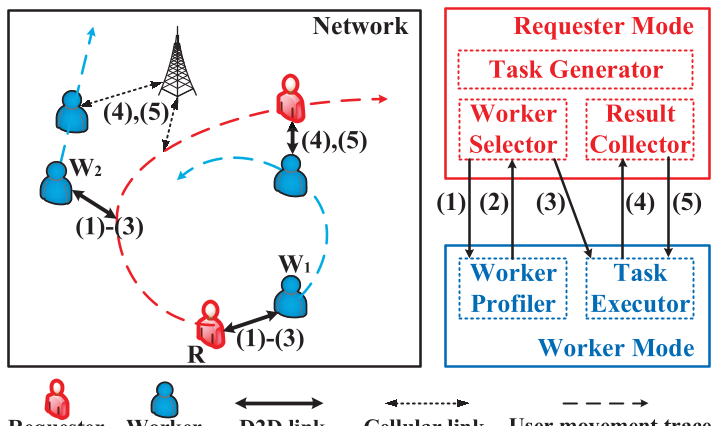
As time runs out, the threshold naturally drops (Lemma 2), reflecting the seeker's increasing desperation to finish the task. Conversely, if you still need many workers, you set a higher bar (Lemma 3).
From Data to Action: The Gamma Distribution Insight
To make this theoretical model work in the real world, the authors analyzed folksonomy datasets (like CiteLike and MovieLens). They discovered that human expertise across various "keywords" or "tags" consistently follows a Gamma Distribution. This allows the system to predict the probability of meeting a "high-quality" worker later, which is essential for calculating the current optimal threshold.
Performance & Prototype
The team didn't just stop at Math. They simulated the policy using real-world mobility traces (Infocom06 and MIT Reality) and built an Android prototype using WiFi-Direct.
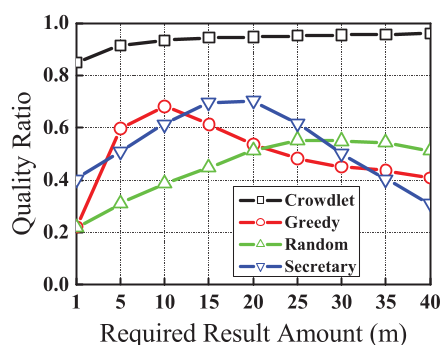
Key Findings:
- Quality Gains: Crowdlet outperformed the "Secretary Policy" and "Greedy Policy" by roughly 30%.
- Efficiency: The computational overhead is negligible. On a Xiaomi 4, calculating the optimal thresholds took only a few seconds and consumed minimal battery—less than 1% of total capacity for discovery and task delivery.
Critical Perspective
While Crowdlet is a leap forward for self-organized networks, its reliance on the Poisson arrival process assumes a certain level of mobility randomness. In highly structured environments (like an office with the same people), the "encounter" model might need to be adjusted for social stay-durations. Additionally, the Worker Profiler assumes workers are honest about their abilities—a reputation system would be a logical next-step integration.
Conclusion
Crowdlet provides the mathematical and systemic framework to turn our daily physical encounters into a powerful, real-time computational engine. By moving the intelligence to the "edge" of human movement, it solves the latency problem that has plagued crowdsourcing for a decade.