
CrowdR-FBC: Securing the Future of IoT Crowdsourcing with Fog-Blockchains
13577_CrowdR-FBC A Distributed Fog-Blockchains for Mobile Crowdsourcing Reputation Management.
This paper proposes CrowdR-FBC, a distributed reputation management framework for mobile crowdsourcing in IoT environments. It integrates fog computing and blockchain technology to ensure data trustworthiness, user privacy (via a cross-layer protection model), and tamper-resistant reputation storage through an adaptive node classification mechanism.
Executive Summary
TL;DR: The paper introduces CrowdR-FBC, a hierarchical framework that solves the triple challenge of privacy, security, and efficiency in mobile crowdsourcing. By leveraging fog nodes as mediators and a customized blockchain for reputation, it achieves a 95% detection rate of malicious actors while drastically reducing the computational overhead typically associated with distributed ledgers.
Academic Context: This work sits at the intersection of Edge Computing and Distributed Ledger Technology (DLT). It is a significant optimization of earlier decentralization attempts (like CrowdBC), focusing on the physical reality of heterogeneous IoT hardware.
Problem & Motivation: The Centralization Trap
Most mobile crowdsourcing platforms (e.g., traffic monitoring or environmental sensing) rely on a central server. This creates two critical fail points:
- Privacy Leakage: The platform knows who you are, where you are, and what data you are sending.
- Reputation Manipulation: Central databases are "honey pots" for hackers who can forge reputation scores to escape penalties or gain illicit rewards.
While blockchain can prevent tampering, a "pure" blockchain requires every device to mine and store everything—an impossible task for low-power edge routers and IoT sensors.
Methodology: The "Divide and Conquer" Strategy
1. Cross-Layer Privacy Protection
The authors propose a clever separation of concerns. The Crowdsourcing Platform decrypts and evaluates task results but only sees Pseudo-IDs. The Fog Nodes know the real identities but cannot see the encrypted task data. Neither party has the full picture, effectively neutralizing the "honest-but-curious" threat model.
2. Multifactor Reputation Evaluation
Instead of just checking if data is "correct" (accuracy), the system evaluates:
- Integrity: Is the data sequence complete?
- Timeliness: Was the task finished within the deadline?
- Historical Context: Does the user have a track record of reliability?
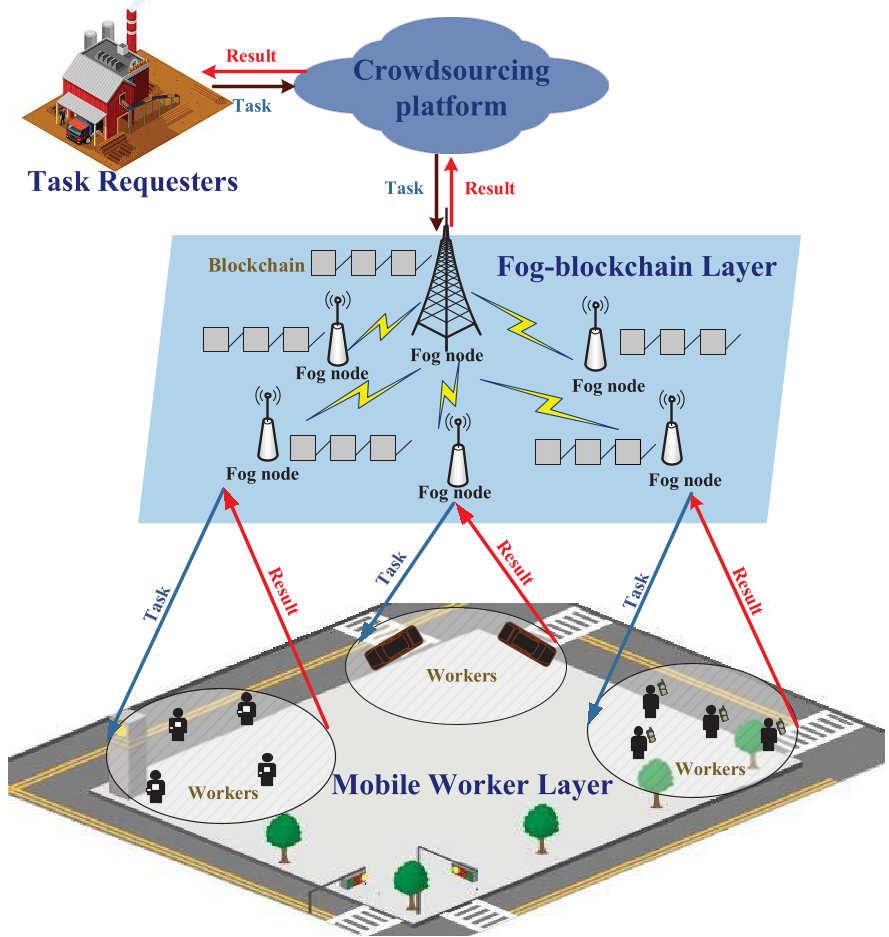 Figure 1: The hierarchical structure of CrowdR-FBC, showing the Fog-Blockchain layer between the platform and workers.
3. Adaptive Blockchain Storage
Not all fog nodes are created equal. The paper introduces an Adaptive Classification algorithm that segments nodes based on storage and CPU:
- Full Nodes: High-power nodes (e.g., Base Stations) that handle mining and block generation.
- Light Nodes: Verify and store blocks.
- Basic Nodes: Simply forward data and query records.
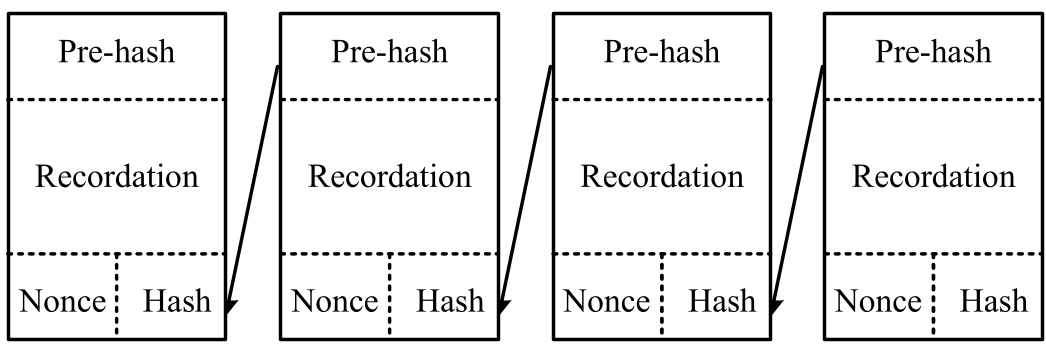 Figure 2: The logic for classifying fog nodes into Full, Light, and Basic categories to optimize network resources.
Experiments & Results: Precision Meets Efficiency
Malicious User Identification
The multifactor approach proves far more resilient than traditional single-index methods. In simulations with varying numbers of malicious users, CrowdR-FBC maintained a 95% accuracy rate and a false positive rate below 5%, whereas baselines suffered from false positives exceeding 50%.
Computational Savings
The adaptive mining strategy is the real game-changer. By limiting mining to "Full Nodes" selected via bridge connection coefficients and CPU metrics, the system avoids the "resource waste" seen in CrowdBC where all nodes compete simultaneously.
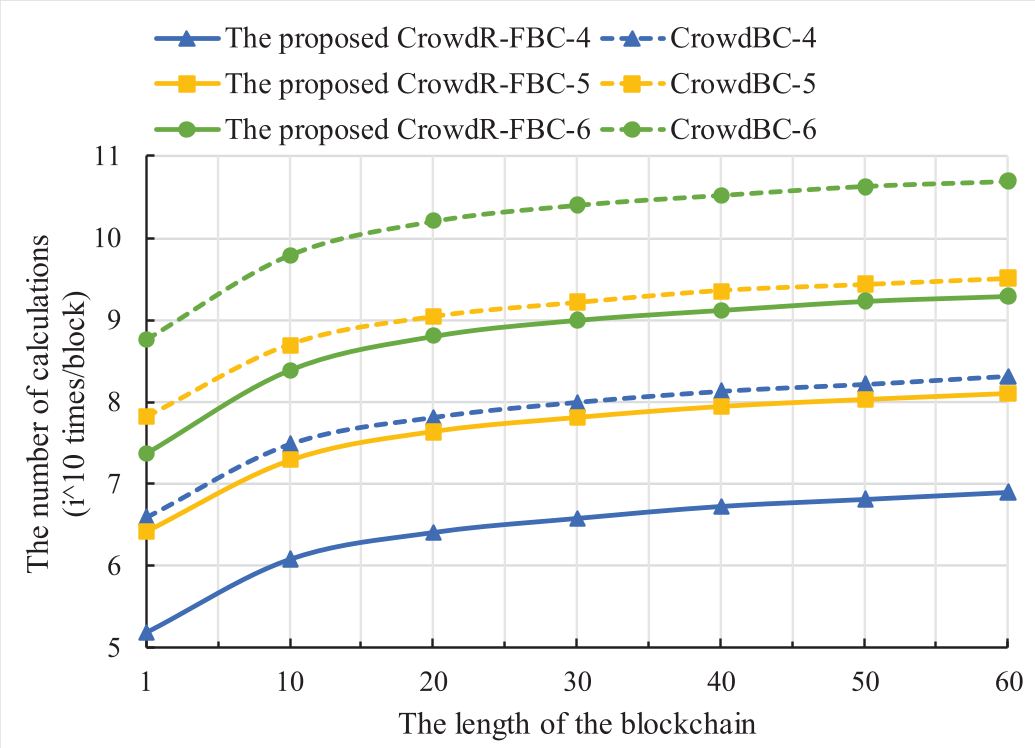 Figure 3: Comparison of calculation complexity between CrowdR-FBC and the baseline CrowdBC, showing significant resource savings.
Deep Insight: Why It Matters
The brilliance of CrowdR-FBC is its Inductive Bias toward hierarchy. In the real world, the "flat" P2P network is a myth; hardware is always hierarchical. By formalizing this hierarchy through the adaptive classification algorithm and the cross-layer privacy model, the authors have created a blueprint for Industrial IoT systems where trust must be established over unreliable, heterogeneous infrastructure.
Conclusion
CrowdR-FBC successfully transitions blockchain from a "heavyweight overhead" to a "lightweight enabler." While the reliance on Proof-of-Work (PoW) still presents some latency issues (up to 6 hours for high-complexity blocks), the adaptive nature of the system ensures that these delays are managed by the most capable nodes, securing the network without crushing the performance of edge devices.