
CrowdScape: Peering into the "Black Box" of Crowdworker Behavior
CrowdScape: interactively visualizing user behavior and output
CrowdScape is an interactive visualization system designed to enhance quality control in crowdsourcing for complex and creative tasks. By integrating worker behavioral traces (e.g., mouse movements, typing patterns) with final outputs through mixed-initiative machine learning, it achieves a high-fidelity understanding of worker performance beyond simple consensus-based algorithms.
TL;DR
Crowdsourcing is often treated as a "black box" where tasks go in and results come out. CrowdScape changes this by providing a high-tech "dashboard" that shows not just what workers produced, but how they did it. By combining interactive visualizations of mouse movements and typing with machine learning, it allows requesters to find the "hidden gems" in complex tasks like creative writing and translation.
Background: The Crisis of Quality in the Crowd
As crowdsourcing moves from simple image tagging to complex generative work, traditional quality control is breaking down. If you ask 50 people to write Einstein’s biography, you can't use "majority voting" because every version is unique. Existing behavioral tools can detect "cheaters" (who finish too fast), but they can't easily distinguish between a "slow but confused" worker and a "slow but meticulous" one.
The Core Insight: Behavior + Output = Truth
The researchers at Carnegie Mellon University realized that worker behavior (the process) and worker output (the product) are two sides of the same coin. By mapping them together in one interface, a requester can see that a worker who "copy-pasted" a translation likely used Google Translate, whereas a worker who "typed, paused, and scrolled back" was likely thinking through the grammar.
Methodology: The CrowdScape Architecture
CrowdScape utilizes two primary data streams to provide a holistic view of the workspace:
1. Visualizing the "How": Behavioral Traces
The system captures low-level events like clicks, scrolls, and browser focus changes. Instead of showing raw logs, it creates Abstract Visual Timelines.
- Vertical Red Lines: Represent typing bursts.
- Blue Flags: Represent clicks.
- Orange Curves: Represent scrolling patterns.
- Black Bars: Represent when the worker switched browser tabs (a sign of distraction or using third-party tools).
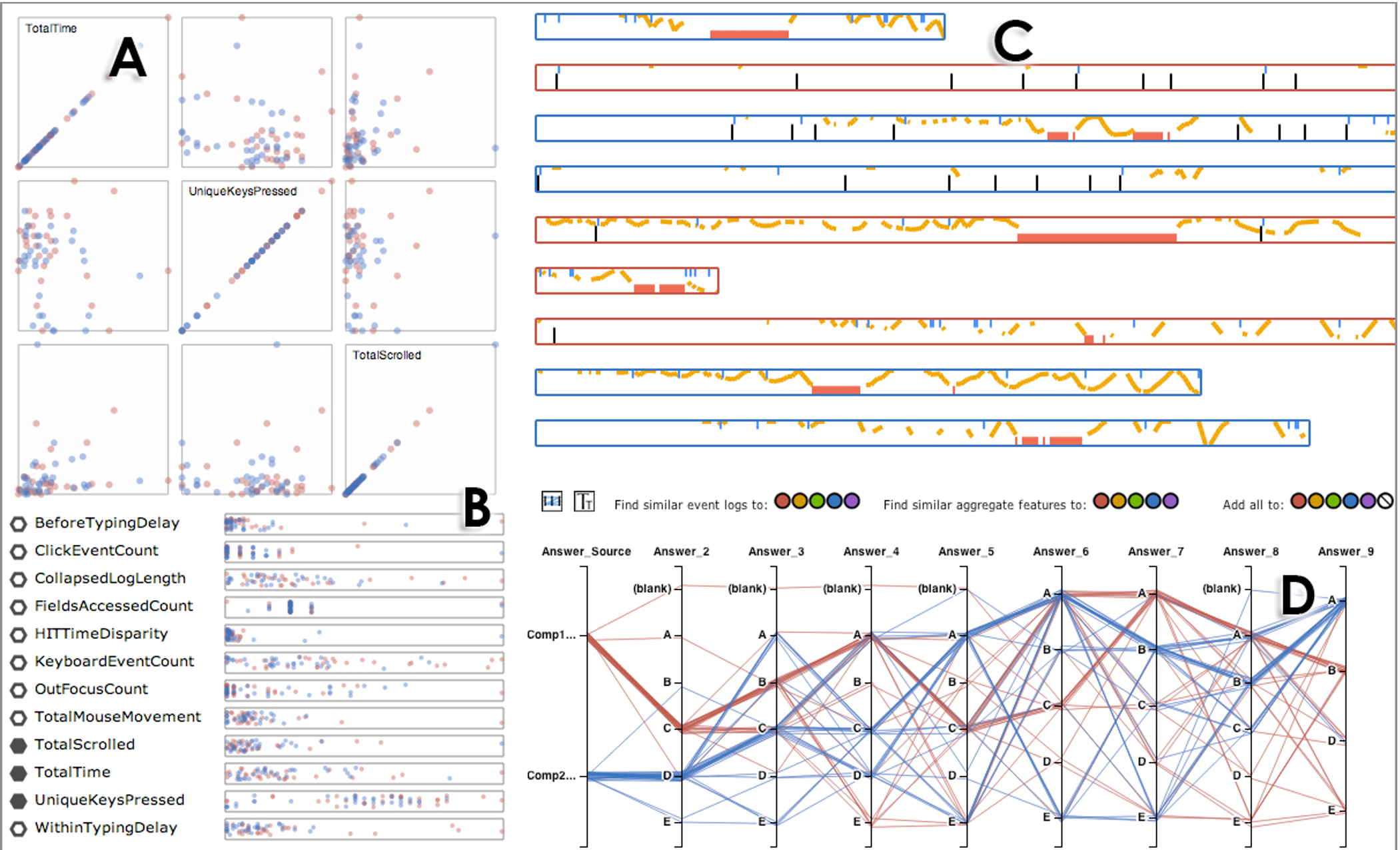 Figure 1: The CrowdScape interface, showing (A) Scatter plots of features, (C) Behavioral traces, and (D) Output patterns.
2. Mixed-Initiative Machine Learning
The system doesn't just display data; it learns from the user. If you find two workers you like, you can "color" them and ask the system to “find more like these.” The system calculates the Levenshtein distance between behavioral strings to reorder the entire list of workers, surfacing similar profiles instantly.
Experiments: Catching the "Smart" Cheaters
In a translation study (Japanese to English), the system was put to the test. Most workers used machine translation, which correctly handled simple phrases but failed on nuanced cultural references.
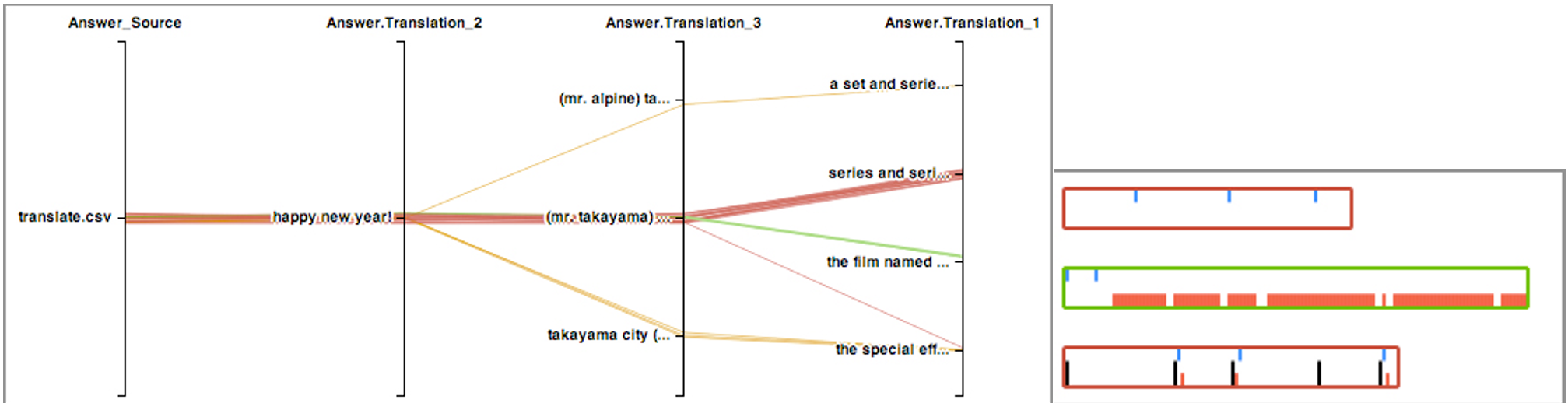 Figure 2: Parallel coordinates showing 21 workers. The green line represents the only successful manual translator, while the red/orange lines show "herds" of machine-translation users.
By looking at the behavioral traces, the researchers saw that the "bad" translators had many focus changes (switching to Google Translate) and copy-paste signatures. The one "good" translator had a clean, continuous trace filled with typing blocks, proving they were actually thinking.
Critical Analysis & Conclusion
Takeaway
CrowdScape proves that transparency into the creative process is the key to scaling quality control. By augmenting human intuition with interactive ML, we can manage tasks that were previously "un-manageable" at scale.
Limitations
- Privacy & Observation: Constant logging can be intrusive; there is a fine line between quality control and surveillance.
- Data Silos: The system requires Javascript injection, meaning it currently only works on web-based tasks where the requester has full script access.
- Offline Work: If a worker writes their draft in Microsoft Word and only pastes the result into the browser, the current system loses valuable "thinking time" data.
Future Outlook
This technology has massive implications for LLM (Large Language Model) Training. As we rely more on Reinforcement Learning from Human Feedback (RLHF), tools like CrowdScape will be essential to ensure that the humans training the models are actually providing high-reasoning effort rather than just clicking "approve."