
Enhancing Crowdsensing Integrity: A Collaborative Social-Trust Approach
Crowdsensing with Social Network-Aided Collaborative Trust Scores
2015-12-01
Summary
Problem
Method
Results
Takeaways
Abstract
This paper introduces a collaborative trust score framework for mobile crowdsensing that integrates social network theory with centralized reputation systems. By modeling participants as nodes in a dynamic social network based on common sensing tasks, the authors propose a combined trustworthiness metric to mitigate data manipulation in IoT applications.
## TL;DR
To combat the "strategic maliciousness" of nodes that build reputation only to sabotage data later, this paper presents a novel trust framework. It transforms mobile users into a dynamic social network where collective voting and statistical history merge to form a robust trust score, boosting platform utility by up to 800% while nearly eliminating successful data manipulation.
## The Vulnerability of Naive Trust
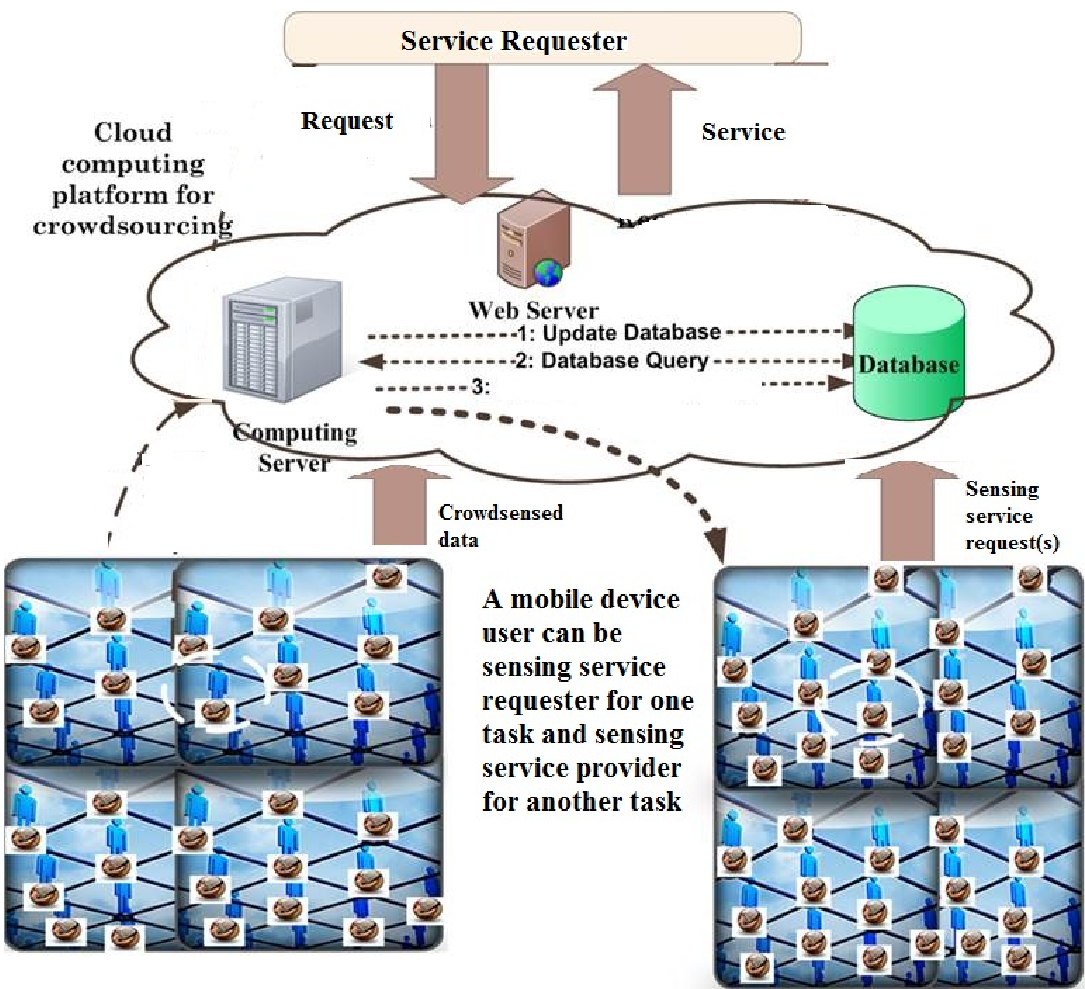
Mobile crowdsensing (MCS) is the backbone of smart cities, providing critical data for disaster management and traffic control. However, the system's "open" nature makes it a prime target for malicious actors.
Current SOTA (State Of The Art) methods often rely on **Statistical Reputation**: a simple ratio of an individual's accurate readings over time. The problem? Adversaries are smart. They play the "long game"—providing perfect data until their reputation hits a threshold (e.g., 0.8), then striking with disinformation. This study identifies that purely centralized, history-based scores are too slow to react to these "intermittent" attacks.
## Methodology: Social Theory Meets IoT
The authors pivot from individual metrics to **Social Network-Aided Collaborative Trust**. The core intuition is that users who work on the same sensing tasks develop a "social bond" that can be quantified.
### 1. Dynamic Social Graph
Instead of a static list, the platform maintains a graph where an edge $C_{ij}$ exists if two users contribute to common tasks. This graph evolves in real-time as tasks arrive.
### 2. The Voting Mechanism
Taking a leaf from **Sybil Defense** literature, the system allows "neighbor" nodes to vote on each other's credibility.
- **Vote Capacity ($\omega$):** Not all votes are equal. A node's voting power is derived from its own historical accuracy and the capacity of its neighbors (echoing the logic of PageRank).
- **Trust Fusion:** The final trust score $\Re_i(t)$ is a weighted combination:
$$\Re_i(t) = \sigma \Re_i(t^-) + (1 - \sigma) \cdot [(1 - \delta) \cdot \Re_i^{stat} + \delta \cdot \Re_i^{voted}]$$
Where $\delta$ represents the weight of the social community's opinion.
## Experimental Validation
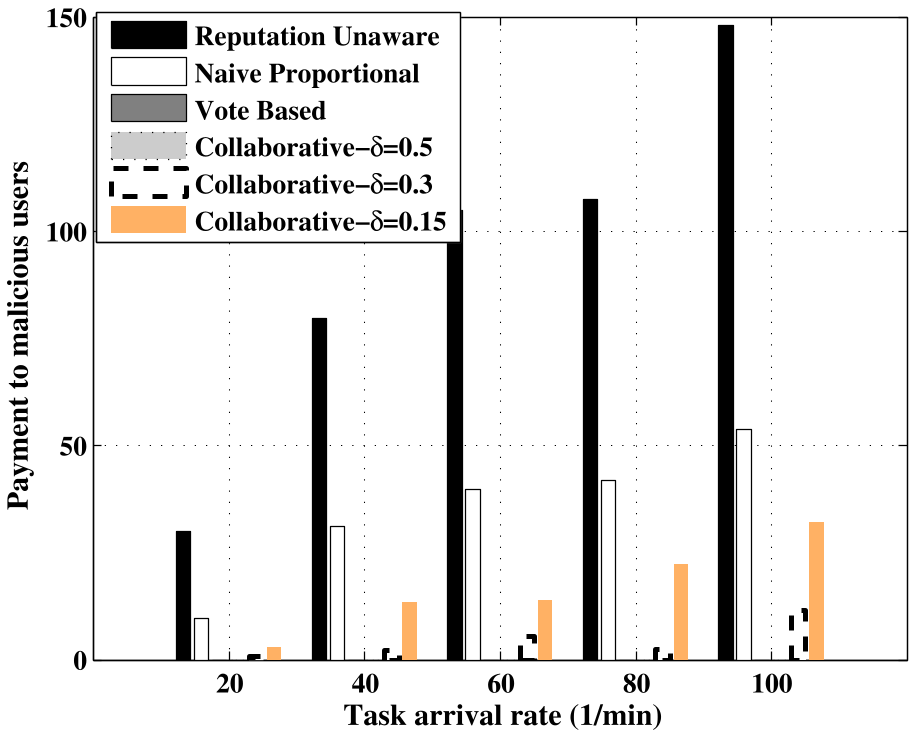
The team simulated a 1000-user terrain. They discovered a critical "Golden Ratio" for trust: **$\delta = 0.15$**.
If you rely too much on social votes ($\delta > 0.5$), malicious nodes can form "collusion circles" to artificially inflate scores. However, at $\delta = 0.15$, the platform achieves the best of both worlds:
- **Platform Utility:** Huge gains (2x to 8x) because the platform effectively filters out malicious bids.
- **Manipulation Probability:** Dropped to nearly zero (0.3%).
## Professional Insight: Why This Works
The brilliance of this work lies in its **Incentive Alignment**. By scaling the payment in an auction-based system by the trust score, malicious nodes find it economically non-viable to attack. If their "social neighbors" flag them, their "Reputable Marginal Value" plummets, and they lose the auction for future tasks.
## Critical Analysis & Conclusion
**Takeaway:** Trust is not just a historical log; it’s a community consensus. Incorporating social interaction values transforms passive monitoring into active peer-policing.
**Limitations:**
- **Over-Connectivity:** In long-term sensing, the social graph might become "too dense" (everyone connected to everyone), potentially diluting the value of local social context.
- **Communication Overhead:** Continual updates to the social graph require robust cloud synchronization.
**Future Work:** The authors hint at exploring ways to prune the social graph to prevent high-connectivity saturation, likely through "forgetting" mechanisms or temporal decay functions for social edges.