
CrowdSheet: Democratizing Complex Crowdsourcing via the Spreadsheet Paradigm
CrowdSheet: An Easy-To-Use One-Stop Tool for Writing and Executing Complex Crowdsourcing
This paper introduces CrowdSheet, a one-stop tool that utilizes a spreadsheet interface to enable non-experts to write and execute complex crowdsourcing applications. By extending standard spreadsheets with only two new types of functions—Task Invocation (TI) and Conditional (C) functions—it allows users to orchestrate multi-step dataflows involving human workers as easily as writing formulas.
TL;DR
CrowdSheet turns regular spreadsheets into powerful command centers for "complex crowdsourcing"—tasks where human answers flow into subsequent human actions. By adding just two specialized functions to the familiar Excel environment, the researchers enabled non-programmers to build multi-stage workflows in minutes that previously required custom code and manual data handling.
The "Instruction Gap" in Crowdsourcing
Crowdsourcing has evolved from simple image labeling into "complex crowdsourcing," involving sophisticated data flows. Imagine estimating conference attendance: you first need to ask workers for "room capacity," then ask others to "upload photos," and finally have a third group "estimate attendance" based on both the photo and the capacity.
Currently, a requester must:
- Manually submit Task A.
- Download results and clean data.
- Write a script or use a tool to trigger Task B based on Task A's results.
- Repeat.
For most domain experts (scientists, event planners, etc.), the technical overhead of managing these dependencies is a deal-breaker.
Methodology: High-Level Abstraction
The core insight of CrowdSheet is that the Dependency Graph of a spreadsheet (where cell B depends on cell A) mirrors the Data Flow of complex crowdsourcing.
1. The Two Pillars: TI and C-Functions
- Task Invocation (TI) Functions: Functions like
entryTask(question)orchoiceTask(question, choices)don't just calculate a value; they dispatch a microtask to a platform (like Amazon Mechanical Turk). The cell remains "pending" until a worker submits an answer, at which point the cell is updated. - Conditional (C) Functions: The
evaluateIffunction acts as a "gatekeeper." Unlike standardIFstatements, it handles lazy evaluation. It only triggers a TI-function if the condition is met, preventing the waste of money on unnecessary tasks.
2. Architecture: From Cells to Rules
The system acts as a middleware. When a user clicks "Submit," the spreadsheet is translated into CyLog, a logic-based language for human-machine computation.
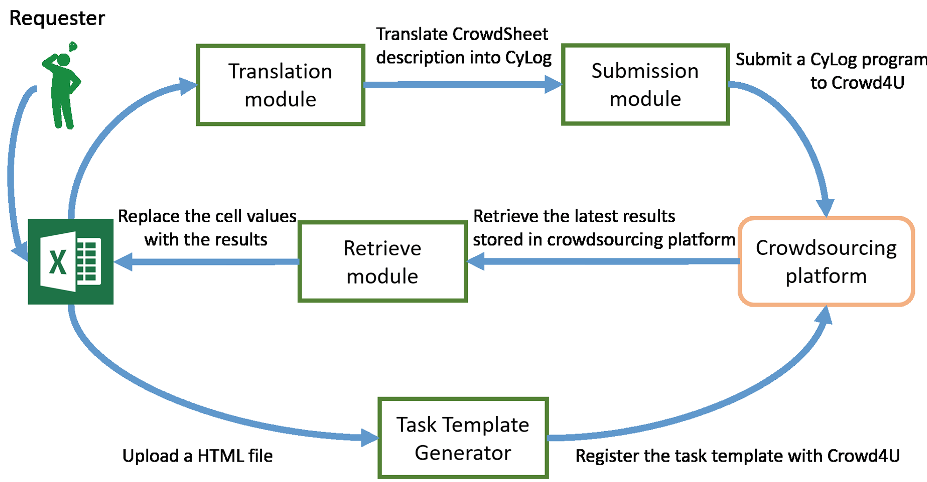
The Translation Module converts cell references into predicates and rules, ensuring that tasks are generated only when their parameters (cell dependencies) are satisfied.
Formal Expressive Power
The authors didn't just build a tool; they proved its theoretical limits. They identified a class of programs (Class P) that the spreadsheet can represent.
- Constraint 1: Each task must return a single value (matching a cell's nature).
- Constraint 2: The number of tasks must be finite (no infinite loops in a fixed grid).
- Constraint 3: Tasks must use predefined templates.
While this prevents building a recursive "infinite" system like Wikipedia, it is mathematically sufficient for a vast majority of real-world voting, information sharing, and creative workflows.
Experimental Validation: Can "Normal" People Use It?
The researchers tested CrowdSheet against 33 workers who knew basic Excel but were not programmers.

- Ease of Adoption: Over 63% of participants successfully implemented a multi-stage conditional workflow (Part 2) on their first try after a brief tutorial.
- Efficiency: Users built these apps in roughly 10 minutes. For comparison, a professional programmer takes about 28 minutes to achieve the same result using standard MTurk APIs.
Critical Insight & Future Outlook
The move toward "declarative crowdsourcing" (telling the system what you want, not how to manage the API calls) is essential for scaling human-in-the-loop systems. CrowdSheet's genius lies in choosing Excel as the interface—a tool with hundreds of millions of users—rather than trying to teach the world a new programming language.
Limitations: Currently, CrowdSheet struggles with highly interactive tasks (like games) or tasks requiring dynamic numbers of sub-tasks (recursive workflows). However, for data-gathering and validation, it represents a significant leap in "End-User Development" for the AI and data science era.