
Motionary: Scaling 3D Motion Reconstruction via Crowdsourcing and Kinect
Crowdsourcing 3D Motion Reconstruction
This paper introduces Motionary, a novel crowdsourcing system designed to reconstruct 3D human motions from 2D videos. By leveraging affordable consumer-grade sensors like Microsoft Kinect, the system allows non-expert internet users to perform and record motions, effectively bridging the gap between 2D visual data and 3D kinetic information through human computation.
TL;DR
Converting 2D videos of people into 3D motion data has historically required either unreliable algorithms or expensive professional actors. Motionary changes the game by using a crowdsourcing platform where everyday users use their home Kinect sensors to "perform" the motions they see in videos. By combining social rating systems with monetary incentives, the authors prove that we can collect high-quality 3D data at a fraction of the traditional cost.
The "Cost-Quality" Dilemma in Motion Capture
For years, researchers have faced a frustrating trade-off. You could go the Machine Processing route—using AI to estimate poses—but these methods "hallucinate" or break when a person is partially hidden behind a chair or a wall. Alternatively, you could hire Professional Experts, which provides pristine data but costs thousands of dollars per hour for studio time and equipment.
The authors identify a critical insight: The human brain is excellent at inferring what a person is doing even when the video is blurry or occluded. Why not use that innate human wisdom?
Methodology: Human Computation at its Finest
Motionary is built on three pillars: Requesters, Contributors, and Filters.
1. The Architecture of Participation
Requesters post a YouTube link and set a budget. Contributors then use a web interface powered by the Zigfu (ZDK) library to interact with their Microsoft Kinect. This setup samples the positions of 24 body joints at 30 frames per second, transforming a physical performance into a data-rich text log.
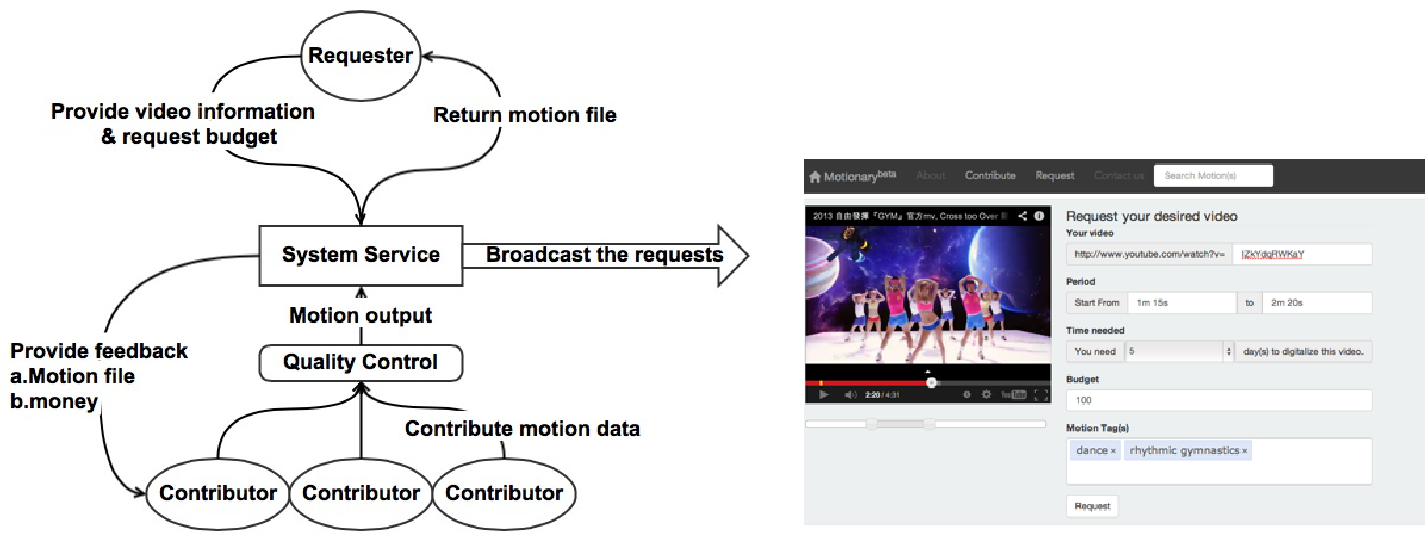 Figure 1: The system workflow—from YouTube request to Kinect-based motion capture.
2. Social Filtering & The Incentive Loop
How do you stop people from submitting "lazy" motions? Motionary uses a Social Rating Mechanism. Other users rate the accuracy of the performed motion on a 5-star scale.
The financial payout is calculated dynamically:
Contributor's Reward = Budget * (Your Stars / Total Stars of all Contributors)
This creates a competitive environment where only those who mirror the original video accurately receive the majority of the reward.
Experimental Results: Beating the AI at its own game
In their pilot study at National Tsing Hua University, the team tested the system with five distinct videos. The results highlighted a massive advantage over traditional CV: Handling Occlusions.
When a video showed a person whose legs were hidden by an object, the "human workers" were able to infer the movement and perform the full-body motion correctly.
 Figure 2: Performance matters. (a) Original video, (b) High-rated user motion (4.5 stars), (c) Low-rated user motion (1.5 stars).
Results Summary:
- Data Volume: 117 pieces of motion data collected in just two weeks.
- Accuracy: High correlation between social ratings and the actual objective quality of the 3D data.
- Robustness: Successful reconstruction even when video subjects were partially blocked.
Critical Analysis & Future Outlook
While Motionary is a brilliant application of human computation, it has its limitations:
- Hardware Dependency: It relies on users owning a Kinect, a device that has since been discontinued, though the principle applies to modern depth sensors or even pose-estimation-enabled smartphones.
- Subjectivity: Social ratings can sometimes be biased based on visual "coolness" rather than anatomical accuracy.
Future Impact: This research suggests that we don't need to wait for the "perfect" algorithm to digitize human history. By gamifying the process of motion capture, we can create a "Wikipedia of Human Movement," fueled by the power of the crowd and affordable consumer technology.
Takeaway
Motionary proves that the most powerful "algorithm" for understanding human motion is still the human mind. By outsourcing performance to the crowd, we can bridge the gap between 2D archival footage and the 3D future of the Metaverse and Robotics.