
Crowdsourcing Affect: Human-in-the-Loop Labeling for Real-World Gaming Data
16425_Crowdsourcing for affective-interaction in computer games.
The paper introduces a large-scale affective-interaction dataset containing over 40,000 images of facial expressions captured during real-world competitive gameplay. It utilizes a dual strategy of gamification for data acquisition and a structured crowdsourcing pipeline to generate high-quality ground-truth labels for eight emotional states.
TL;DR
This research tackles the "Data Scarcity" and "Label Quality" bottleneck in affective computing. By turning image collection into a competitive game and image labeling into a rigorous crowdsourcing task, the authors produced a massive dataset of 40,000+ faces that reflect genuine human reactions rather than posed laboratory samples.
Background & Motivation: Beyond the Laboratory
Most AI models today are trained on "perfect" data—clean backgrounds, front-facing subjects, and exaggerated smiles. However, real-world affective interaction (like a player reacting to a game) is messy. Faces are tilted, lighting varies, and emotions are often mixed.
The authors identified two primary hurdles:
- The Posing Gap: Posed expressions (Prototypes) don't match the spontaneous expressions of real users.
- The Annotation Burden: Expert labeling doesn't scale. We need a way to harness the "wisdom of the crowd" without sacrificing scientific rigor.
Methodology: The Gamification-Crowdsourcing Pipeline
1. Data Capture via Play
The researchers used a custom-built game where the facial expression is the controller. Players had to mimic an emotion (e.g., Disgust) to score points, ensuring that the resulting 40,000 images were captured in a state of active interaction.
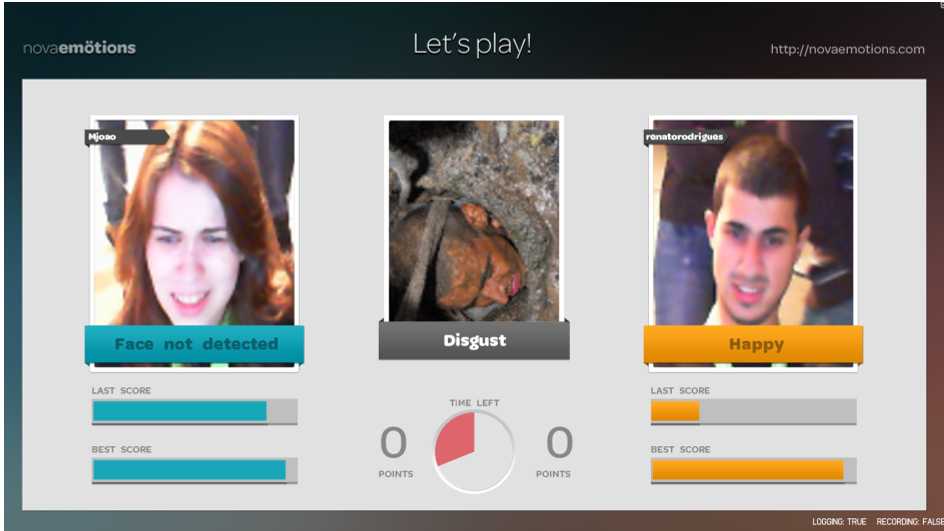 Figure 1: The dual-player game interface where facial expressions dictate score.
2. Crowdsourcing Design
To ensure the crowd didn't just provide "noisy" data, the authors implemented several constraints:
- Gold Questions: Pre-labeled "trap" images to filter out spammers.
- Multi-Level Relevance: Instead of asking "Is this person happy: Yes/No?", they asked for the intensity of the emotion. This recognizes that "Neutral" and a "Faint Smile" exist on a spectrum.
- Worker Diversity: Restricting tasks to specific regions and limiting the number of judgments per worker to prevent fatigue-induced errors.
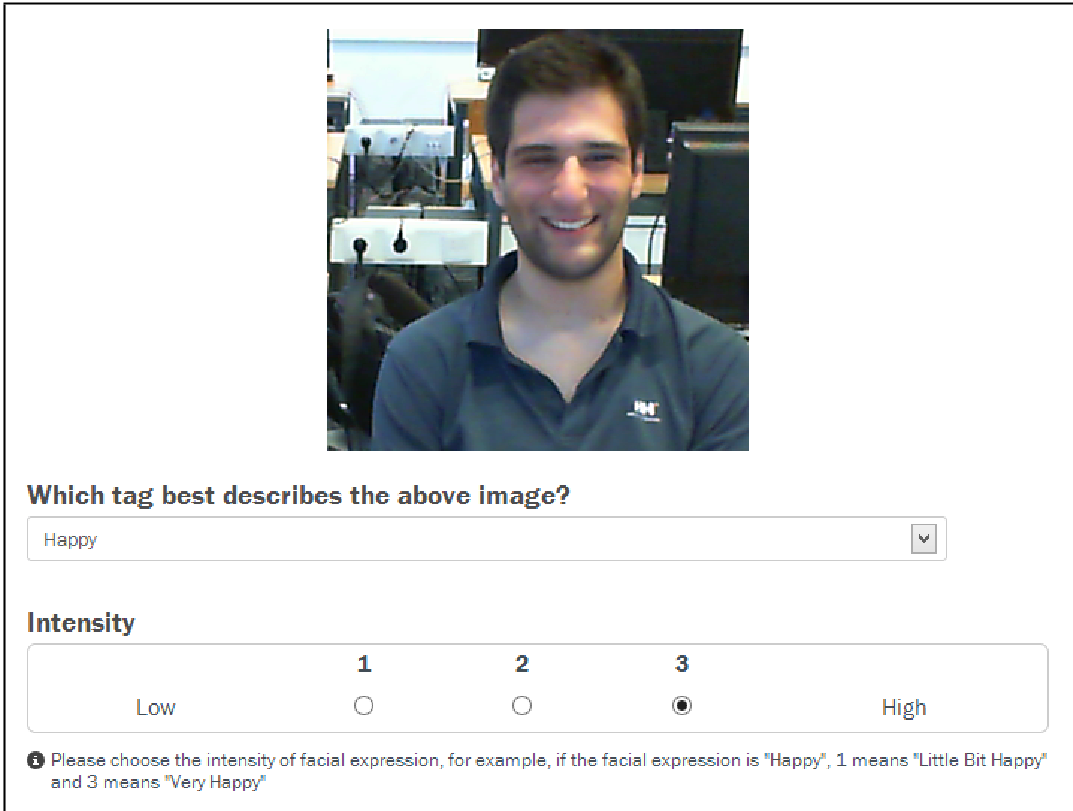 Figure 2: The UI designed for workers to categorize emotions and assign intensity.
Experimental Analysis: What Does the Crowd See?
The study reveals a fascinating "Hierarchy of Identification." Humans are exceptionally good at identifying Happiness (87.2% agreement), likely because the zygomatic major muscle movements are highly distinct. In contrast, Fear (31.4% agreement) is frequently confused with Surprise or Neutral.
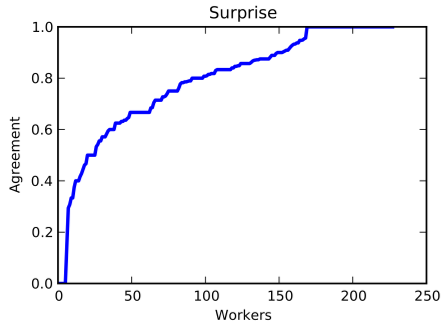 Figure 3: Agreement curves per expression. "Happy" shows the most consistent consensus.
The researchers argue that Low-Agreement images are not "bad data." Instead, they are valuable "counter-examples" that help models understand the boundaries of human perception. For instance, if 20 workers say "Happy" and 20 say "Neutral," the image represents a genuine edge case of a "mild smile" rather than a classification error.
Critical Insight & Future Work
The core value of this work lies in moving away from Binary Relevance. By providing a distribution of votes for each image, the authors allow future researchers to use "Soft Labels." This is crucial for training models that can handle the nuance of human social cues.
Limitations:
- The dataset relies on players trying to perform an emotion to win, which might still lead to some degree of "theatricality" compared to totally hidden-camera candid reactions.
- Cultural bias: By favoring English-speaking countries, the dataset might reflect Western-centric emotional displays.
Summary
Tavares et al. have bridged the gap between game design and data science. Their 40,000-image dataset serves as a benchmark for anyone building AI that needs to understand how humans actually look when they interact with a digital world.