
Crowdsourcing on the Spot: Turning Public Displays into Altruistic Engines
Crowdsourcing on the spot: altruistic use of public displays, feasibility, performance, and behaviours
The paper explores "Crowdsourcing on the Spot," a novel mechanism using interactive public displays to perform altruistic, non-paid tasks. Utilizing a malaria parasite counting task, the authors demonstrate that public displays can achieve performance comparable to online platforms like Amazon Mechanical Turk while providing significantly higher task uptake rates.
TL;DR
This study investigates whether interactive public displays can serve as effective crowdsourcing hubs. By deploying touchscreens in high-traffic campus areas to perform malaria parasite counting, the researchers found that public displays can outperform online markets like Amazon Mechanical Turk in speed and uptake, provided the interface uses the right motivational and quality-control "hooks."
Positioning: This is a seminal work in HCI that shifts public display usage from purely hedonic (games/ads) to "Human Computation" and altruistic utility.
Problem & Motivation: Beyond the Desktop
While online crowdsourcing markets are powerful, they are often disconnected from the physical world. If you need a local citizen to identify a plant or a student to help with a campus-specific task, MTurk fails.
Conversely, public displays have always faced a "seriousness" problem. Users treat them as toys, leading to "noisy" results or "subversive performances" (inputting fake data for fun). The authors’ insight was to see if intrinsic motivation (helping scientists) and instrumentation (fact-checking) could transform passers-by into a reliable, altruistic workforce.
Methodology: The Core
The researchers used a 4x2 experimental design to test how motivation affects results.
1. The Task: Malaria Counting
Participants were asked to count malaria-infected blood cells. This task is ideal: it has objective "correct" answers and an inherent sense of "doing good" for medical research.
2. Motivational Variants
- Enjoyment-based: "Help us produce better software."
- Community-based: "Help Oulu medical scientists."
- Combined: Both of the above.
- Control: No specific motivation.
3. Fact-Checking
A simple "planet identification" question (verifiable and easy) was used to signal to the user that their input was being monitored, encouraging serious participation.
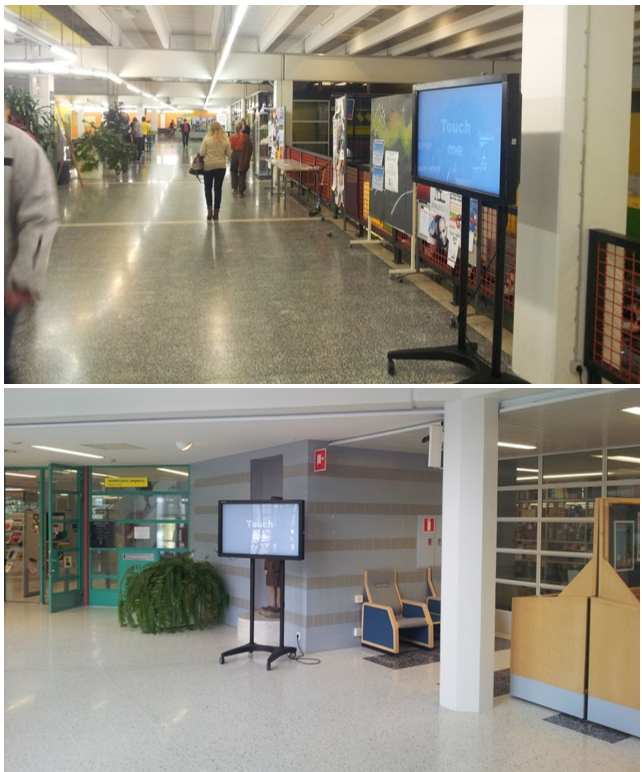 Figure: The in-situ deployment of the displays on campus walkways.
Experimental Results: Public Displays vs. MTurk
The results were surprising. While accuracy on MTurk was slightly higher for extremely complex tasks, the rate of uptake on public displays was staggering.
- Speed: 1,200 tasks in 25 days vs. MTurk’s 100 tasks in 45 days (for non-paid workers).
- Accuracy: Users who were motivated and passed the fact-check achieved 88% accuracy, comparable to or better than paid workers online.
- Motivation Impact: Simply adding a sentence about "helping scientists" significantly increased the time spent and the accuracy of the work.
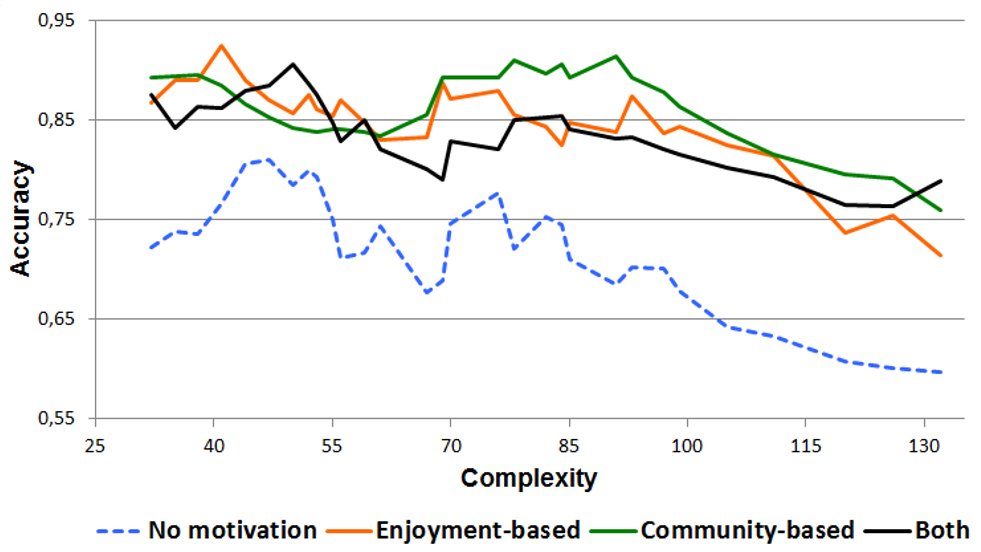 Figure: Accuracy levels across different image complexities for various motivation types.
Behavioral Taxonomy: Who is using the display?
By analyzing video logs, the authors identified several distinct user types:
- Loners (19%): The "Power Workers." They spend the most time and provide the best data because they aren't pressured by peers.
- Unlockers (44%): Passers-by who touch once and keep walking.
- Attractors & Herders: Users who build a "honeypot" effect, drawing in crowds.
- Repellers: Friends who stand nearby and impatiently pressure the user to leave, negatively impacting task completion.
Critical Analysis & Conclusion
Takeaway
The study proves that public displays can harness serendipitous availability. Unlike mobile apps, there is no "app to download" or "account to create." This frictionless entry allows for a self-renewing workforce.
Limitations
- The "Complexity Ceiling": As images become too difficult, public display users give up much faster than MTurk users. Public displays are better suited for "micro-tasks" that take <20 seconds.
- Social Pressure: Group dynamics often lead to "joke" inputs, suggesting that these systems should be designed to focus specifically on the "Loner" demographic.
Future Outlook
This work hints at a future where we "pay" to unlock public services (like Wi-Fi or transit info) by performing a quick 5-second human computation task—turning every digital screen in a city into a distributed supercomputer fueled by altruism.