
Outsourcing the Surgeon's Eye: Is the Crowd Reliable Enough for Cataract Surgery?
Crowdsourcing Annotation of Surgical Instruments in Videos of Cataract Surgery
This paper investigates the feasibility of using crowdsourcing via Amazon Mechanical Turk to annotate surgical instruments and their key points in cataract surgery videos. The authors developed a structured framework for non-expert annotation, achieving a Fleiss’ kappa of 0.63 and a high identification accuracy of 0.89 for specific instruments compared to expert ground truth.
TL;DR
To scale AI in the operating room, we need massive datasets. This paper proves that untrained crowd workers can identify and locate surgical instruments in cataract videos with surprisingly high accuracy (up to 89%), provided they are guided by a rigorous qualification process. While some tools remain "visually confusing" for the layperson, the study validates crowdsourcing as a legitimate tool for building the next generation of surgical AI.
The Scalability Bottleneck in Surgical AI
The standard for training surgical activity recognition models has always been "Expert Annotation." However, asking a board-certified surgeon to spend hours clicking on pixels is like asking a pilot to build the airport—it’s an inefficient use of highly specialized talent.
The core challenge lies in Visual Homogeneity. In cataract surgery, instruments like the I/A cannula and the Phaco probe look nearly identical to the untrained eye. Can a worker from Amazon Mechanical Turk (AMT) really distinguish between them? Previous work explored simple segmentation, but this study pushes into the harder territory of Categorization and Fine-grained Localization.
Methodology: The "Qualification" Filter
The authors didn't just throw images at the crowd. They built a multi-stage funnel:
- Instructional Phase: Workers were shown stock catalog photos alongside real-world surgical frames.
- Qualification HIT: A "test" where workers had to identify instruments and mark points within a 15-pixel error margin.
- Redundancy: Every image was annotated by up to 9 independent workers.
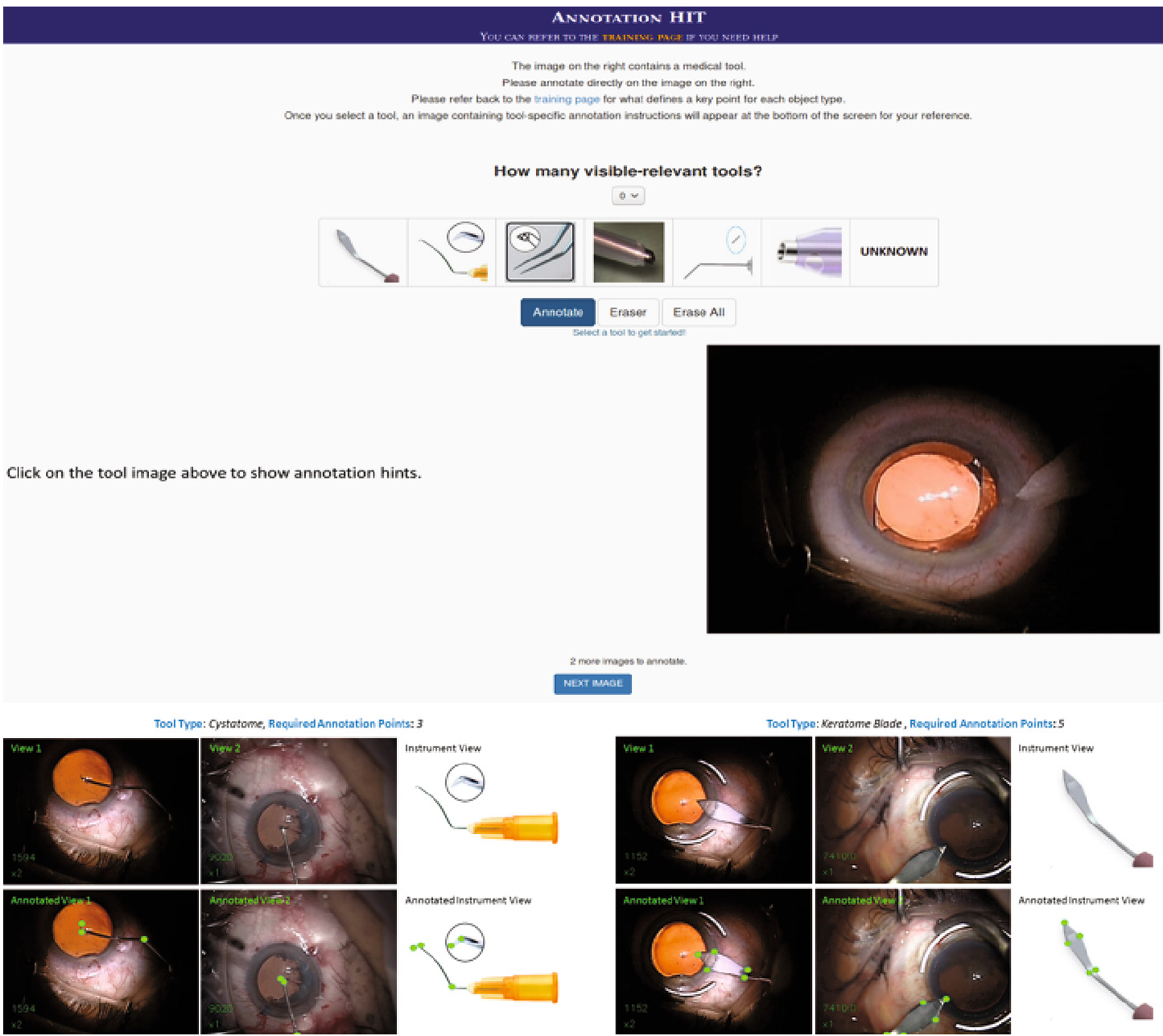 The annotation interface featuring target images, instrument choices, and instructional guides.
Instead of bounding boxes, the team focused on Key Points. This is a clever "Inductive Bias"—the tip of the instrument is often the most critical part for following surgical workflow and assessing movement economy.
Results: Tips are Easy, Shafts are Hard
The results revealed a fascinating split in performance:
- The Successes: Tools like the Keratome Blade (KB) and Utratas (forceps) achieved near-perfect (100%) accuracy. Their distinct shapes made them easy for the crowd to "solve."
- The Failures: The Cystotome was the Achilles' heel of the study, with accuracy dropping to 27% in some trials. Workers frequently confused it with the A/C cannula because they share a similar tubular structure.
- Precision: For the tips of the instruments, the error was only ~5.7 pixels, which is more than sufficient for training robust object detectors.
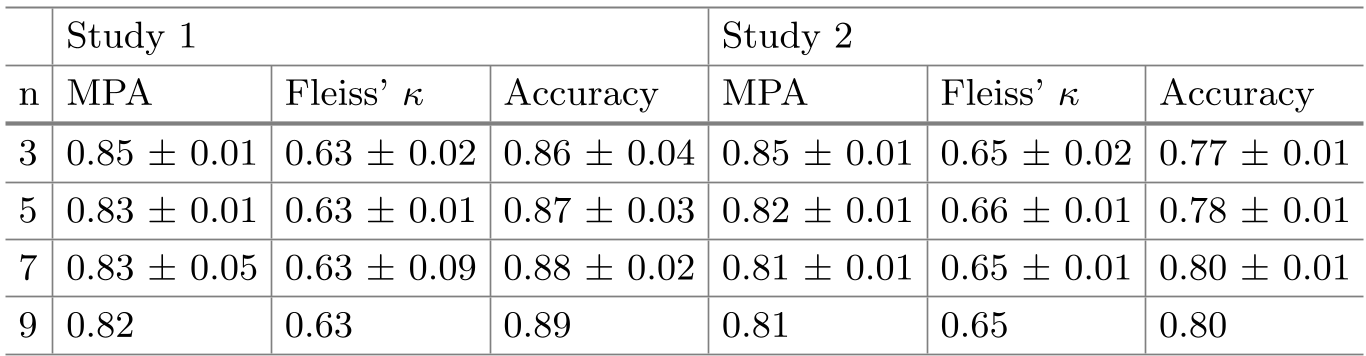 Table 1: Stability of Agreement (Fleiss' κ) and Accuracy across different numbers of annotators (n).
Critical Insight: Why Crowdsourcing is "Good Enough"
One of the most valuable insights from this paper is the Stability of Majority Voting. The study found that increasing the number of workers from 3 to 9 didn't significantly boost accuracy. This suggests a "diminishing return" on crowd size—once you have 3-5 decent workers agreeing, you've likely captured all the visual information a non-expert can possibly extract.
However, the failure to replicate identification accuracy for the Cystotome in the second study highlights Sampling Variability. The quality of your "crowd" on a Tuesday might be different from your "crowd" on a Friday, emphasizing the need for constant "Reference Image" checks (which the authors correctly implemented).
Conclusion & Future Outlook
This work demonstrates that for tasks requiring "coarse identification" and "precise tip localization," the crowd is a reliable proxy for the surgeon.
The Takeaway: To improve these systems, future researchers should provide temporal context (video clips instead of static frames). If a worker sees how a tool moves, they can distinguish a probe from a cannula much more easily.
As we move toward real-time clinical decision support, the ability to rapidly generate labeled sets for new surgical procedures via the crowd will be the engine that drives surgical AI out of the lab and into the OR.
Limitations: The study is limited to 2D images. The next frontier is assessing whether the crowd can handle 3D depth or complex occlusions where instruments are partially buried in tissue.