
Crowdsourcing Privacy: Can the Crowd Decode Legalese at Scale?
Crowdsourcing Annotations For Websites' Privacy Policies: Can It Really Work?
This paper investigates the feasibility of crowdsourcing privacy policy annotations and introduces a Machine Learning (ML) method to enhance annotator productivity. By using a specialized interface and requiring high worker agreement (≥80%), the authors achieve over 95% accuracy compared to legal experts. They further propose a paragraph-highlighting mechanism powered by logistic regression to reduce annotation time.
TL;DR
Researchers from Carnegie Mellon and their collaborators have validated that crowdsourcing is a viable method for translating dense website privacy policies into usable data. By combining human intelligence with a machine-learning-driven "highlighting" interface, they achieved 96% accuracy compared to legal experts and reduced worker fatigue. This study fills a critical gap in privacy research: proving that scalable, high-quality policy analysis is possible without relying solely on expensive legal professionals.
The "Notice and Choice" Paradox
The modern Internet operates on the "Notice and Choice" framework. Companies provide a notice (the privacy policy), and you provide the choice (usually by clicking "Accept"). The problem? McDonald and Cranor famously estimated that it would take the average person 244 hours per year to read the policies of every site they visit.
The Result: Users don't read them. The Motivation: If we can't make users read them, can we use the "Crowd" to summarize them into salient bits?
Methodology: Human Intelligence + Machine Assistance
The study was conducted in two primary phases: an accuracy assessment and a productivity improvement trial.
1. The Expert vs. Crowd Benchmark
The team recruited 5 skilled law/policy students (experts) and 218 Amazon Mechanical Turk workers. They used a custom tool that presented 9 core questions regarding:
- Collection: (Contact, Financial, Location, Health info)
- Sharing: (Who gets the data and for what purpose?)
- Deletion: (Can users actually scrub their data?)
2. The ML Relevance Model (Highlighting)
To stop workers from burning out, the authors built a classifier to identify the "needle in the haystack."
- Regex + TF-IDF: They combined expert-defined regular expressions with n-gram features.
- Logistic Regression: A model was trained for each question to predict paragraph relevance.
- Visual Cues: The top 5 (TOP05) or 10 (TOP10) paragraphs were highlighted in the UI.
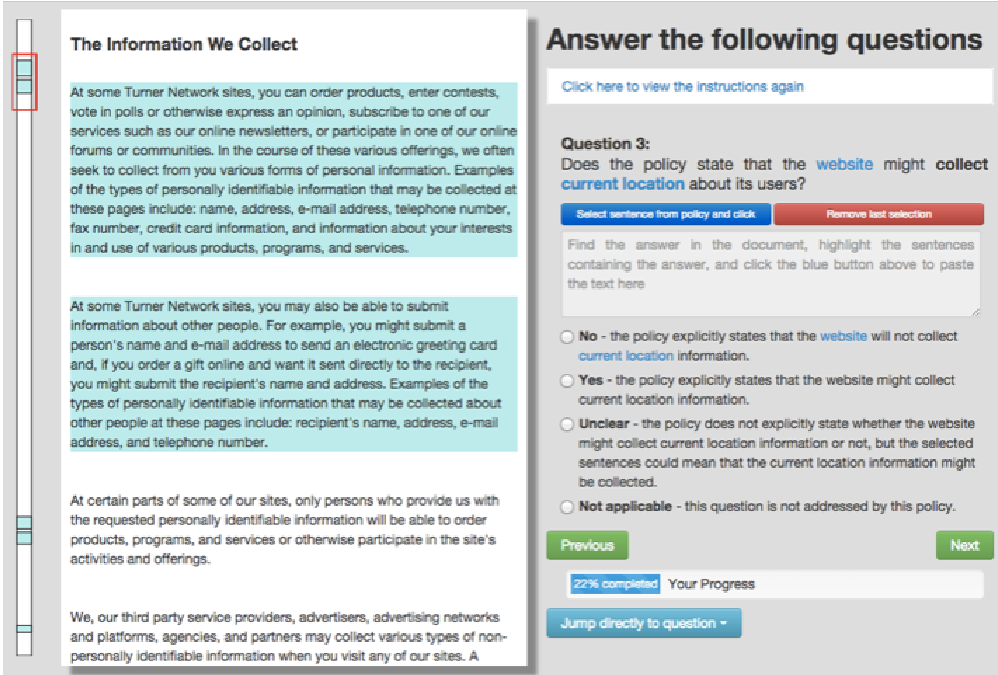 Above: The annotation tool showing a privacy policy with ML-driven paragraph highlights and a navigation bar.
Key Experimental Findings
High Accuracy through Consensus
The researchers found that individual crowdworkers might stumble, but the group is wise. By enforcing an 80% agreement threshold (where 8/10 workers must agree), the crowd's answers matched the legal experts’ gold standard with 96% accuracy.
Efficiency Gains
The "Highlighting" intervention was a major success. Using the TOP05 model:
- Time Saved: Median completion time dropped from 18 min 56 sec to 16 min 23 sec.
- User Experience: Workers in the highlighted group reported finding legal text much easier to understand compared to the control group.
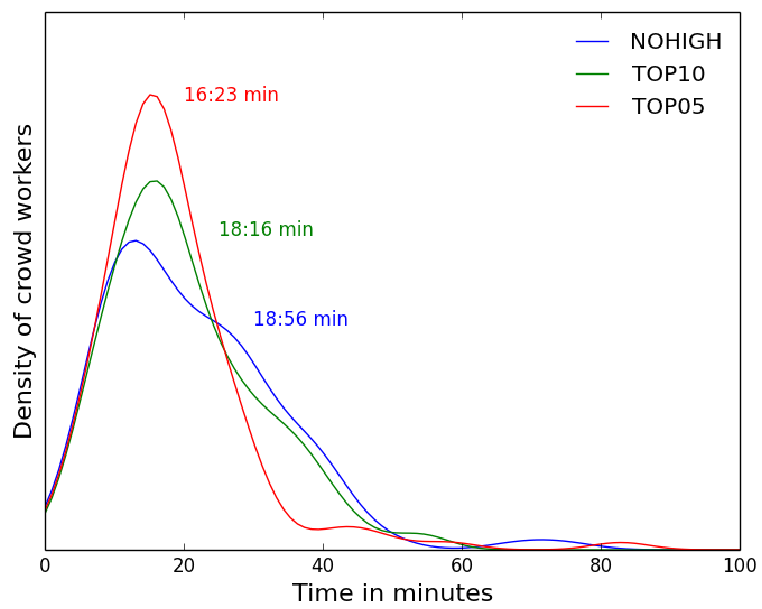 Figure: The impact of highlighting on task completion time. Note the reduction in median time while maintaining accuracy.
Critical Insights: Where the Crowd Struggles
While "Collection" questions were easy for everyone, "Sharing" practices proved much harder.
- Problem: Sharing clauses are often spread across multiple sections (e.g., a "Third Parties" section and a "Legal Disclosures" section).
- Crowd Performance: Workers often failed to reach the 80% agreement threshold on sharing questions, highlighting that some legal nuances still require expert intervention or more advanced AI assistance.
Conclusion & Future Value
This paper serves as a foundational proof-of-concept for Human-in-the-Loop AI in legal tech. It demonstrates that we don't need a single super-intelligent AI to read the Law; we need a well-designed system that focuses human attention on the right information.
For product developers, this provides a blueprint for building privacy-nutrition labels or automated browser extensions that can tell you—instantly—if a site is selling your health data or if "No" really means "No."
Limitations: The study used a 2016 timeframe; modern privacy laws like GDPR and CCPA have since altered the structure of these documents, potentially requiring more complex relevance models.