
Golden Maximum Likelihood: Scaling Web Accessibility Evaluation via Collaborative Crowdsourcing
Crowdsourcing-Based Web Accessibility Evaluation with Golden Maximum Likelihood Inference
This paper introduces a crowdsourcing-based Web accessibility evaluation system designed to replace scarce human experts with non-expert workers, including people with disabilities. The core innovation is the Golden Maximum Likelihood (GML) truth inference algorithm, which successfully aggregates conflicting opinions to achieve SOTA accuracy and recall in identifying accessibility barriers.
TL;DR
Web accessibility is a human right, yet 96% of the web remains inaccessible. This paper proposes a system that replaces rare accessibility experts with a crowd of non-experts (including those with disabilities). By using a new algorithm called Golden Maximum Likelihood (GML), the authors achieved a 32% improvement in barrier detection (recall) compared to standard approaches, turning crowdsourced noise into expert-level insights.
The "Expert Scarcity" Bottleneck
Evaluating a website for WCAG (Web Content Accessibility Guidelines) compliance is notoriously difficult. While automated tools can check for missing alt-text, they can't judge "contextual" barriers—like whether a video description is actually helpful. This requires manual inspection.
The problem? There aren't enough experts to audit millions of pages. Non-experts are available but unreliable: they often miss subtle barriers, leading to a "False Pass" where a website is labeled accessible when it’s actually broken for a blind or motor-impaired user.
Methodology: The GML Algorithm
Most crowdsourcing systems use Majority Vote (MV), but in accessibility, the "truth" is often found in the minority (e.g., only the blind user notices the screen reader trap).
The authors designed Golden Maximum Likelihood (GML) to fix this. GML works by:
- Golden Task Calibration: Mixing hidden, known tasks into a worker's queue to measure their specific "barrier-finding" ability.
- Convex Optimization: Unlike previous SOTA models (like ZenCrowd or Dawid-Skene) that use Expectation-Maximization (EM) which can get stuck in "local optima," GML formulates truth inference as a convex optimization problem. This ensures the system always finds the most mathematically sound "ground truth."
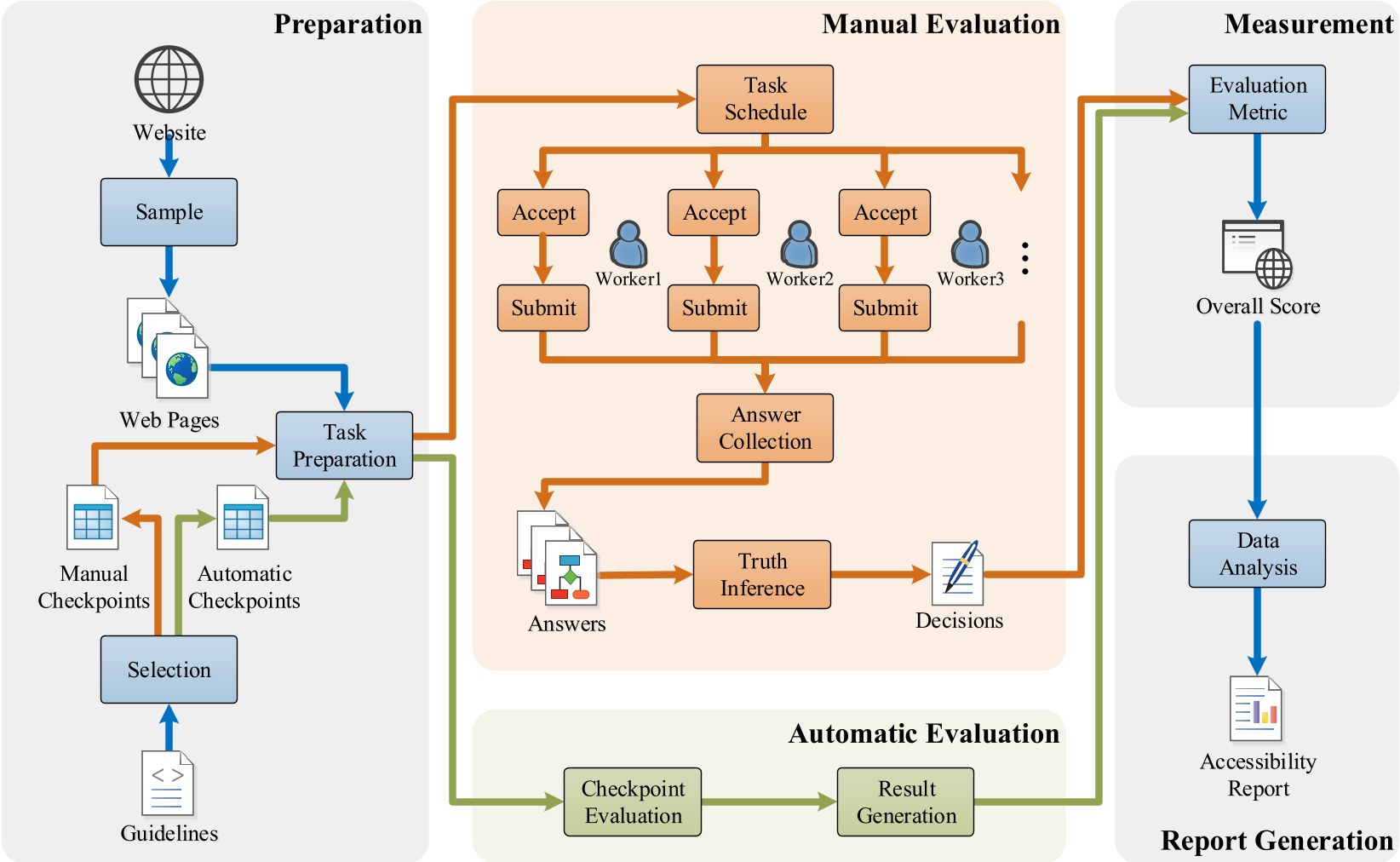 Figure 1: The system architecture showing the flow from page sampling to manual evaluation and GML-based report generation.
Real-World Evidence
The study was massive: 23,901 tasks, 50 workers (29 with disabilities), and 46 governmental websites.
Performance Breakthrough
The critical metric here isn't just Accuracy—it's Recall (the ability to find a barrier if it exists).
| Method | Accuracy | Recall |
|---|---|---|
| Majority Vote (MV) | 0.72 | 0.05 |
| Dawid-Skene (D&S) | 0.78 | 0.30 |
| GML (Ours) | 0.78 | 0.57 |
GML nearly doubled the recall of the best existing probabilistic models and outperformed Majority Vote by over 10x in detecting barriers.
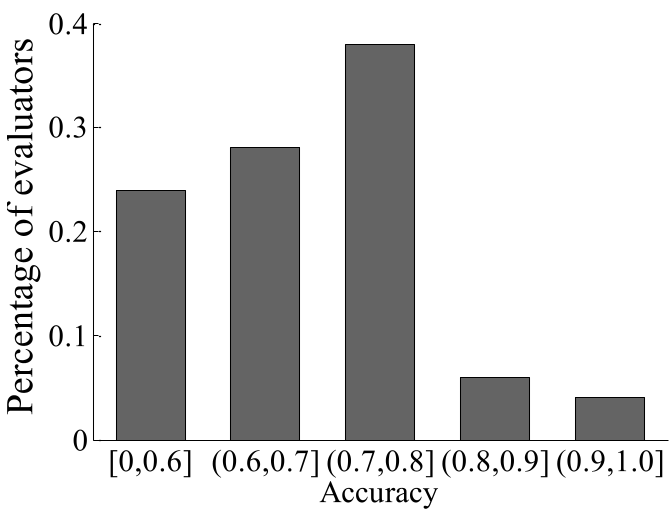 Figure 2: Distribution of accuracies for golden and normal tasks, highlighting the diversity in worker ability.
Deep Insights: The Subjective Reality of Disability
The authors didn't just stop at algorithms; they conducted surveys with 92 volunteers. They found a striking 0.65 correlation between what the crowd complained about in daily life (like "Keyboard Traps" and "Video Descriptions") and the weight the system's metric assigned to those barriers.
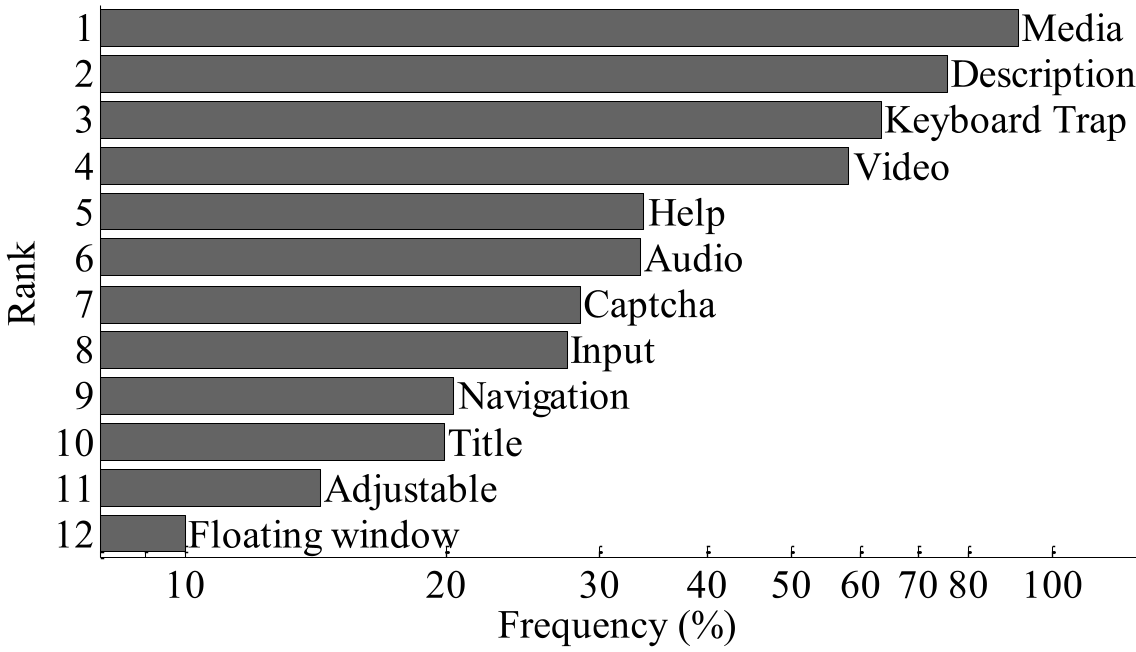 Figure 3: Word cloud/phrases most frequently mentioned by people with disabilities regarding daily web barriers.
The study revealed that "Keyboard Accessibility" is one of the most severe barriers yet often the most misunderstood by evaluators, suggesting that even with AI-driven aggregation, worker training remains a vital pillar.
Critical Analysis & Takeaways
The brilliance of this work lies in its Inductive Bias: it assumes that when it comes to disability, we should value specific "lived experience" over simple majority consensus.
- Value: It provides a blueprint for "Inclusion-by-Design" in AI systems—using technology not to replace users with disabilities, but to amplify their expertise.
- Limitation: The system still relies on "Golden Tasks," which require some initial expert labor to create.
- Future Impact: This GML approach could be applied to any domain where the "correct" answer is rare and requires specific sensitivity, such as medical image labeling or toxic content moderation.
Conclusion: By combining convex optimization with inclusive design, Song et al. have successfully bridged the gap between human diversity and data reliability.