
Deciphering the Digital Workplace: Why Crowdsourcing Communities Are Not Just Smaller Social Networks
Structure of Crowdsourcing Community Networks
This paper presents a large-scale structural comparative study of Crowdsourcing Communities (CCs) against Online Social Networks (OSNs) and the World Wide Web (WWW). By analyzing five successful CCs with nearly 2 million vertices, it identifies that CCs possess a distinct topological signature—combining power-law distributions with a lack of influence dilution and unique disassortative connecting behaviors.
TL;DR
While Crowdsourcing Communities (CCs) look like social networks on the surface, their "DNA" is much closer to the World Wide Web. A comprehensive study of 2 million nodes reveals that CCs are highly dense, competitive environments where popularity does not equal activity, and members actively seek out "dissimilar" peers to build social capital.
Background: Beyond the "Social" in Crowdsourcing
We often lump platforms like LEGO Ideas or brand advocacy forums into the broad bucket of Online Social Networks (OSNs). However, from a structural engineering perspective, this is a mistake. This paper argues that the goal-oriented nature of crowdsourcing—where users interact to solve tasks rather than just hang out—creates a unique topology that fundamentally changes how information flows and who holds power.
The "Work-Social" Hybrid: Methodology
The researchers split their analysis into two distinct layers:
- Association (ASSO) Networks: The formal structure (who follows whom).
- Interaction (INTR) Networks: The functional structure (who comments on or votes for whose work).
By comparing these against traditional OSNs (Flickr, YouTube) and the WWW, they identified where CCs sit in the academic coordinate system of network science.
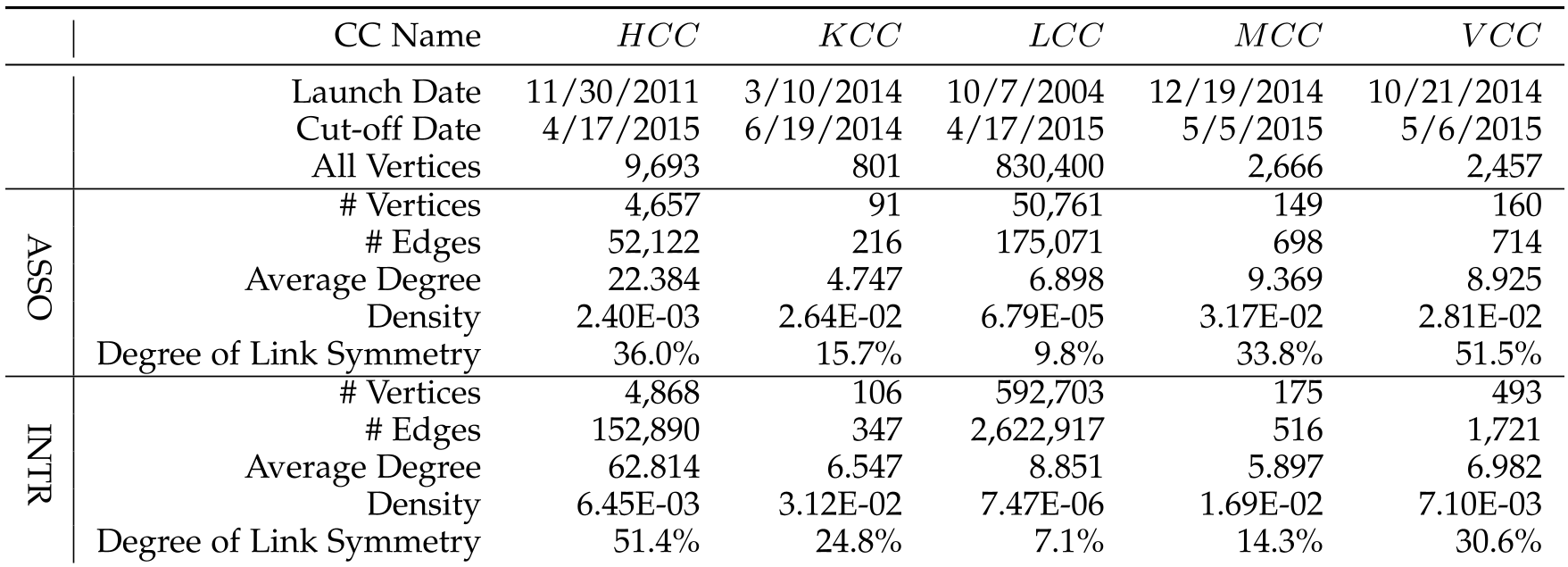 Table 1: High-level statistics showing that CCs are significantly smaller but much denser than OSNs.
Core Insight 1: The Death of Reciprocity
In OSNs like Orkut or Facebook, link symmetry is high (70-95%)—if I follow you, you likely follow me back. In CCs, this symmetry is much lower (averaging 10-30%). Why? Because crowdsourcing is a meritocracy. Members follow "authorities" and "subject matter experts" to learn or compete, not just to socialize. This makes CCs look more like the WWW (where pages link to authoritative sources) than a circle of friends.
Core Insight 2: High Density, Low Dilution
One of the most striking findings is the Density. CC networks are many orders of magnitude denser than OSNs.
- Moderation Effect: Moderators constantly engage members and prune inactive users, keeping the "liveliness" high.
- Influence Concentration: Unlike OSNs, where popularity is often diluted across millions of "friends," CCs maintain concentrated clusters of influence. As shown in the overlap analysis, the people who are the most active (out-degree) are often different from the people who are the most popular (in-degree).
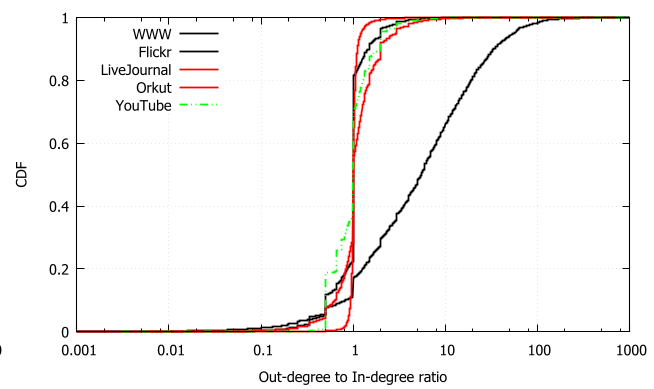 Figure 2: The low overlap between "Active" and "Popular" users in CCs indicates a clear distinction between influencers and contributors.
Core Insight 3: Disassortative Mixing
In most social networks, people connect with others of similar status (Assortative mixing). In CCs, we see the opposite.
- The Mentor-Apprentice Dynamic: New members (low degree) interact with veterans (high degree) to gain visibility.
- The Support Base: High-influence members interact with newcomers to build a "following" or support for their submitted ideas.
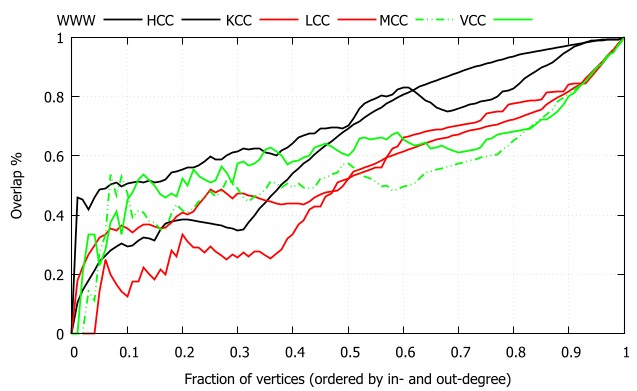 Figure 3: Knn plots showing the tendency of members to interact with peers of significantly higher or lower degrees.
Critical Analysis & Conclusion
The study concludes that traditional social ranking algorithms (like those used for Twitter) may fail in Crowdsourcing Communities. Because CCs are competitive, there is less collaboration among "top-tier" members—they are often rivals for the same rewards.
Takeaways for the Future:
- Algorithm Design: Trust and reputation systems in CCs must account for the lack of link symmetry.
- Platform Governance: The high density of CCs is a direct result of "active moderation," suggesting that the "human-in-the-loop" is essential for preventing network decay.
- Limitations: The study focuses on topological structure over text-based sentiment, leaving room for future NLP-driven analysis of how these interactions actually happen.
In the era of decentralized work, understanding that CCs are "small, dense, and authoritative" is the first step toward building more efficient crowdsourcing engines.