
From Crowdsourcing to CrowdMining: The Power of Implicit Human Intelligence
From crowdsourcing to crowdmining: using implicit human intelligence for better understanding of crowdsourced data
The paper introduces CrowdMining, a novel framework for crowdsourced data understanding that leverages Implicit Human Intelligence (Implicit HI). It moves beyond traditional content analysis by utilizing hidden behavioral patterns (mobility, interaction, and community context) to enhance data filtering, classification, and clustering, achieving superior performance in event localization and scenic route planning.
Executive Summary
TL;DR: While most AI systems struggle to clean and organize messy crowdsourced data using raw content analysis (NLP/CV), this paper proposes a paradigm shift called CrowdMining. Instead of just looking at what was uploaded, it analyzes how and why humans interacted with the environment to upload it. By capturing "Implicit Human Intelligence"—the unintentional wisdom found in our behavior—the authors achieve smarter data filtering and organization with significantly less computational overhead.
Academic Positioning: This work bridges the gap between Mobile Crowd Sensing (MCS) and traditional Data Mining, establishing a theoretical framework for "human-in-the-loop" systems where humans assist machines without even realizing it.
The Problem: The High Cost of "Loud" Noise
Crowdsourced data (from Twitter posts to mobile sensor logs) is notoriously difficult to handle. It is:
- Noisy: Unreliable contributors and redundant uploads.
- Fragmented: Data represents tiny, disconnected snapshots of a larger event.
- Heterogeneous: Mixing text, images, and GPS logs makes unified analysis a nightmare.
Traditionally, we solve this by asking users to label data (Explicit HI - laborious) or training massive deep learning models (Machine Intelligence - expensive). The authors ask: Can we find a third way?
The Methodology: Tapping into the "Implicit"
The core insight of CrowdMining is that the process of data generation is itself a form of intelligence. If ten people take a photo of a fire from different angles, their overlapping "field of view" is a high-accuracy geographical sensor that no single GPS tag can match.
Case Study 1: CrowdEvent (Localization & Segmentation)
The authors developed a method to locate events using Shared Attention.
- Shared Attention Trapezoids: Instead of a single GPS point, they create a trapezoid representing a user's field of view.
- Probability Grids: They use a normal distribution to weigh areas in the center of the photo more heavily (since humans tend to center their subjects).
- CIS Segmentation: To detect sub-events (like a street performer changing acts), they look at posting bursts. If a crowd of individuals all suddenly take a second photo, it implicitly signals a semantic shift in the event.
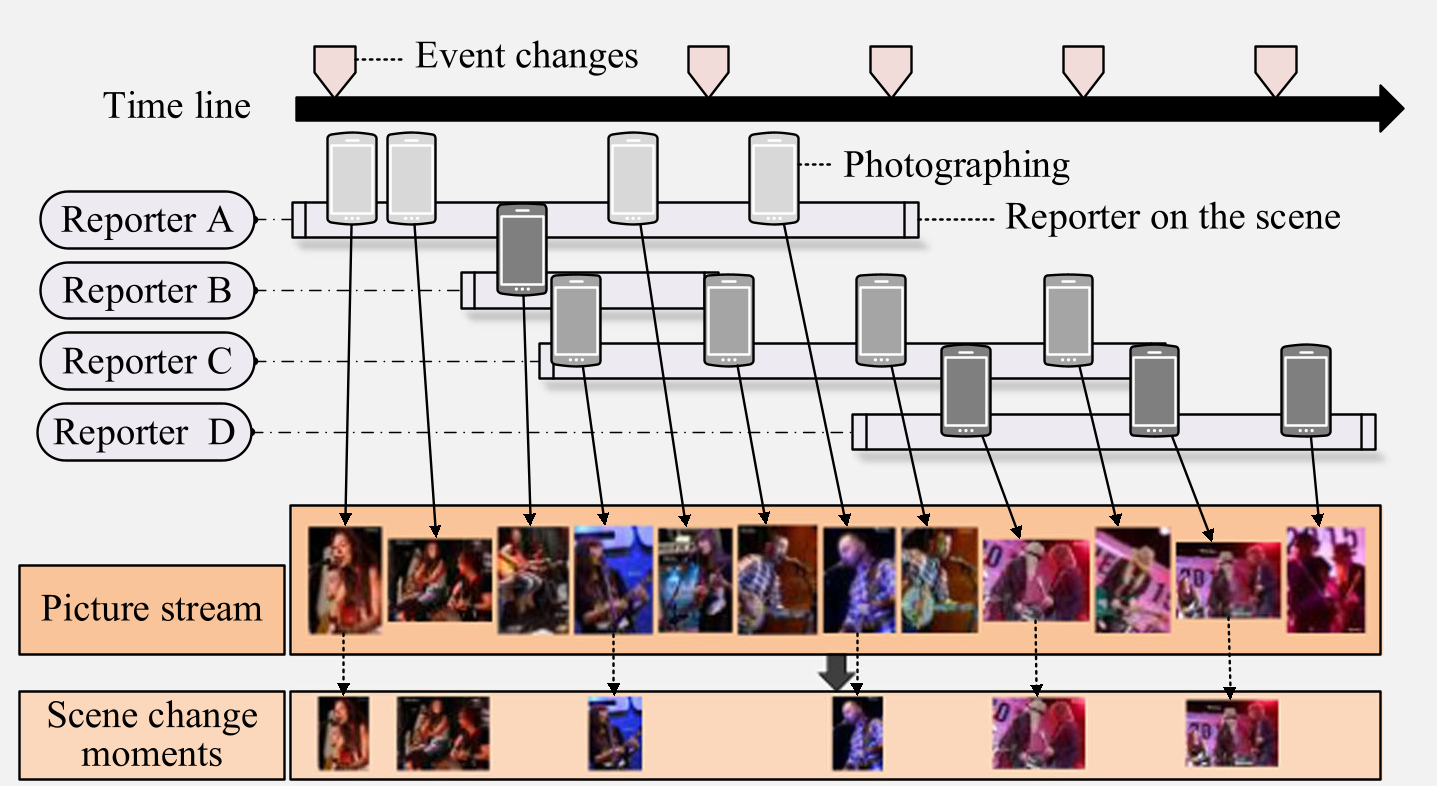 Figure: The "Attention Trapezoid" model used to infer event locations from crowd behavior.
Case Study 2: CrowdTrip (Scenic Route Planning)
How do you find the "prettiest" way to drive? Most maps give you the shortest path. CrowdMining solves this by fusing:
- Flickr Density: More photos = higher "beauty" score.
- Foursquare Category Weights: A park check-in is weighted higher than a shopping mall check-in for "scenery."
- Taxi Trajectories: Mined GPS data from taxis helps determine the most natural "flow" of driving directions.
Experiments and Results
The researchers tested CrowdMining on real-world datasets from San Francisco and campus event logs.
- Accuracy Boost: The "Attention Trapezoid" (DMVD) significantly reduced localization errors compared to static methods (iSee).
- Efficiency: The CIS segmentation method reached F-Measures comparable to state-of-the-art image similarity (SIM) algorithms but with a fraction of the CPU/GPU cost, as it only processes timestamps and user IDs rather than pixels.
- Qualitative Superiority: In route planning, the system correctly identified "Bicycle Route 65" as a top scenic drive, whereas previous models incorrectly ranked commercial streets higher just because they had more total "check-ins."
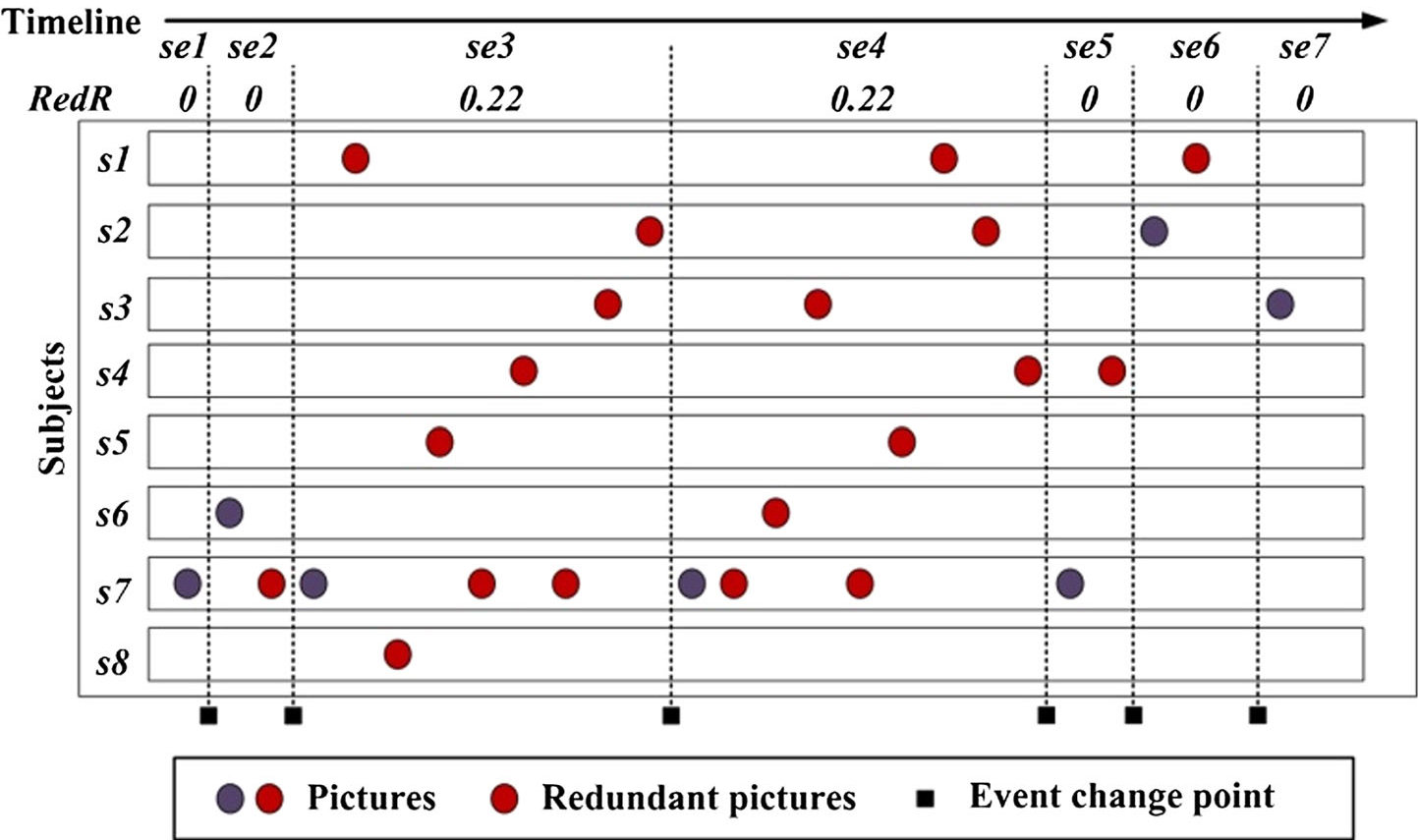 Figure: Comparison of temporal distribution of crowd-contributed pictures during a fire-fighting activity.
Critical Insights & Future Vision
The defining contribution of this paper is the Generic CrowdMining Model. It categorizes Human Intelligence into Explicit (task-aware) and Implicit (task-unaware).
Takeaway for the industry: We are currently in an era of "Brute Force AI" where we throw parameters at data. This paper suggests that "Behavioral AI"—understanding the human context behind the data—can lead to much lighter, more "elegant" solutions for urban computing and social media analysis.
Limitations: The model assumes a "cooperative" or at least honest crowd. Malicious users providing fake behavioral signals (GPS spoofing) could potentially subvert the implicit HI layer. Future work needs to integrate "trust-awareness" into the CrowdMining framework.