
Crowdsourcing in the Dark: Building Resilient kNN Overlays for Emergency Response
Crowdsourcing emergency data in non-operational cellular networks
The paper introduces a specialized framework for generating k-Nearest-Neighbor (kNN) overlay graphs in non-operational or overloaded cellular networks to facilitate emergency communication. It proposes two main algorithms, Akin and Prox, designed for resource-constrained mobile devices to extract real-time situational awareness by connecting users to their geographically closest peers.
TL;DR
When cellular towers fail during a disaster, how can thousands of smartphones coordinate? This paper presents a framework for building k-Nearest-Neighbor (kNN) overlay graphs using short-range communication (Wi-Fi Direct/Bluetooth). By introducing optimized algorithms like Prox and Akin, the researchers enable a "Rayzit" messaging system that functions entirely without a central cellular backbone, providing a 10% performance boost over prior state-of-the-art spatial query methods.
Proximity vs. Connectivity: The Motivation
In a crisis, connectivity is a luxury. If a flood takes out the base stations or a massive protest overloads the spectrum, the traditional "client-server" model of the internet collapses.
The authors argue that in such scenarios, your most valuable connections are not your digital social circle, but your geographical neighbors. These are the people who can see what you see, help you if you are trapped, or act as a relay for vital information. However, building an efficient kNN graph (where every user is connected to their closest neighbors) on a low-power smartphone is computationally expensive—especially when the crowd is moving and the network is "unstable."
Methodology: Beyond Simple Search
The core challenge is the All k-Nearest Neighbor (AkNN) problem. A naive approach requires complexity, which would drain a smartphone battery in minutes. The authors propose two primary strategies:
1. The Prox Algorithm & k+-heap
Instead of checking every user, the space is divided into an equi-width grid. Each grid cell maintains a specialized k+-heap structure consisting of:
- : Internal objects within the cell.
- : A max-heap of the closest external objects.
- : A boundary set of external objects that could be a kNN for someone inside the cell.
The "Prox" variant further tightens the search bound by allowing the set to include both internal and external objects, drastically reducing the search space for the "Final Search" phase.
2. The Akin Algorithm
Recognizing that maintaining a heap for every insertion is costly, Akin uses Floyd’s linear-time heap construction. It builds the candidate set in bulk once all locations are collected, trading a small amount of memory for significantly faster CPU execution.
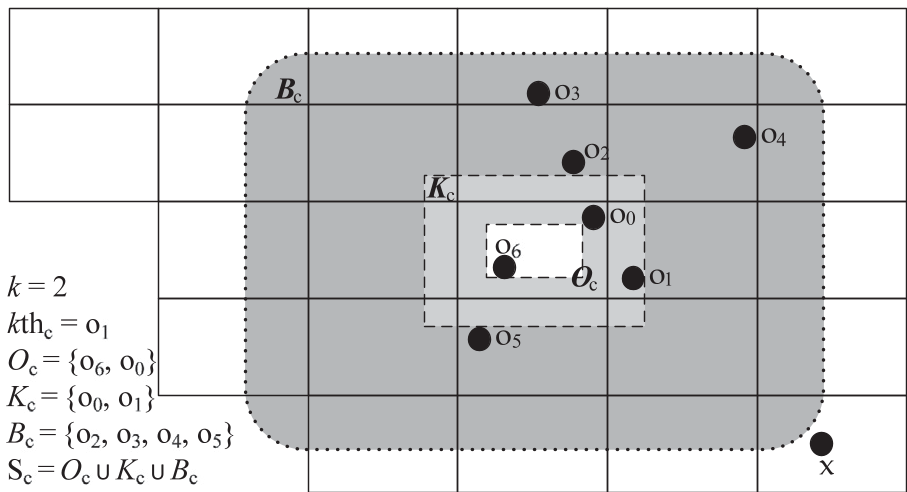 Figure: The construction of a candidate set . The dotted line represents the pruning boundary—anyone outside this line is guaranteed NOT to be a neighbor, allowing the processor to ignore them.
Real-World Experiments: Handling the "Skew"
The researchers tested their algorithms on three datasets: Oldenburg (traffic), Geolife (Beijing pedestrians), and Rayzit (real crowd data).
The toughest test for any spatial algorithm is a skewed distribution—where everyone is bunched up in one square (like a stadium).
- Results: While existing methods like YPK/CPM struggled with iteratively enlarging search circles, Prox+ and Akin+ (the '+' denoting an internal pruning optimization) maintained high efficiency.
- Performance: The proposed methods outperformed baselines across the board, particularly as the number of users scaled to 10k, proving they are robust enough for real-city deployments.
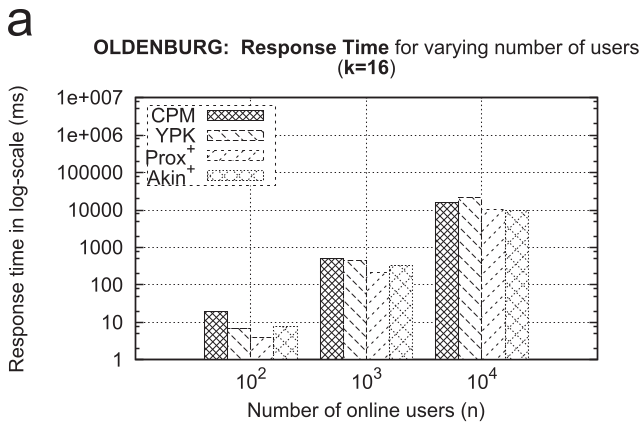 Figure: CPU time comparison on the Oldenburg dataset. Note the log-scale: the gap between Prox+ and traditional CPM represents a significant real-world latency difference.
Critical Insight & Conclusion
The brilliance of this work lies in its Infrastructure-Ready nature. It doesn't ask for better hardware; it asks for smarter geometry. By moving the AkNN computation from the "Cloud" to a "local operator" (a device held by a first responder), it turns a disconnected crowd into a living, sensing network.
Takeaway: In the future of edge computing, the ability to rapidly structure "stateless" networks will be the difference between information silence and life-saving awareness. While the paper assumes one "Query Processor" collects all data, future iterations might look into fully distributed kNN construction where no single device holds the full location map.