
Crowdsourcing Evolution: Mapping the DNA of the Modern Digital Crowd
Crowdsourcing evolution: Towards a taxonomy of crowdsourcing initiatives
The paper "Crowdsourcing Evolution: Towards a Taxonomy of Crowdsourcing Initiatives" presents a comprehensive taxonomy comprising six core components: User, Process, Task, Content, Platform, and Reward. Developed through a bottom-up analysis of 60 exemplary initiatives, it provides a standardized framework to categorize the rapid diversification of crowdsourcing beyond its original 2006 definition.
TL;DR
The term "Crowdsourcing" has traveled a long way since Jeff Howe first coined it in 2006. In this paper, researchers from Universiti Tenaga Nasional dismantle the original, rigid definition of crowdsourcing to build a flexible, six-component taxonomy—User, Process, Content, Platform, Task, and Reward. By analyzing 60 real-world examples, the study reveals that the "crowd" is no longer just a group of workers, but a complex ecosystem of seekers, sensors, and co-creators.
Problem & Motivation: Beyond the 2006 Blueprint
The original 2006 model of crowdsourcing was simple: a company has a problem, they post an open call on their platform, a solver provides a solution, and the company pays them.
However, the "mushrooming" of platforms like Waze (where data is collected automatically) or Zooniverse (where the reward is purely intrinsic) proved that the original blueprint was too narrow. The authors argue that academic research has been lagging behind industry practice. Most existing classifications were "top-down" (theoretical), failing to account for the weird and wonderful ways crowdsourcing is actually implemented today.
Methodology: The Bottom-Up Breakdown
The researchers didn't start with a theory; they started with 60 success stories. Using a bottom-up approach, they treated each initiative as a case study to find "points of departure" from the classic model.
The Taxonomy's Six Pillars
Through axial and selective coding, they distilled the complexity into six essential themes:
- User: Includes the separation of Organizers (intermediaries) from Crowdsourcers, and Active Solvers from Passive Seekers.
- Process: Evolution from simple "call and response" to complex bidding, co-creation, and automated sensing.
- Task: Ranges from "Micro-tasks" to high-complexity "Co-creation."
- Content: Not just solutions, but raw data, ideas, or even funding.
- Platform: The shift from proprietary company sites to "Intermediary Marketplaces" and mobile-first environments.
- Reward: A critical expansion beyond cash to include reputation, ranking, or zero extrinsic reward in non-profit sectors.
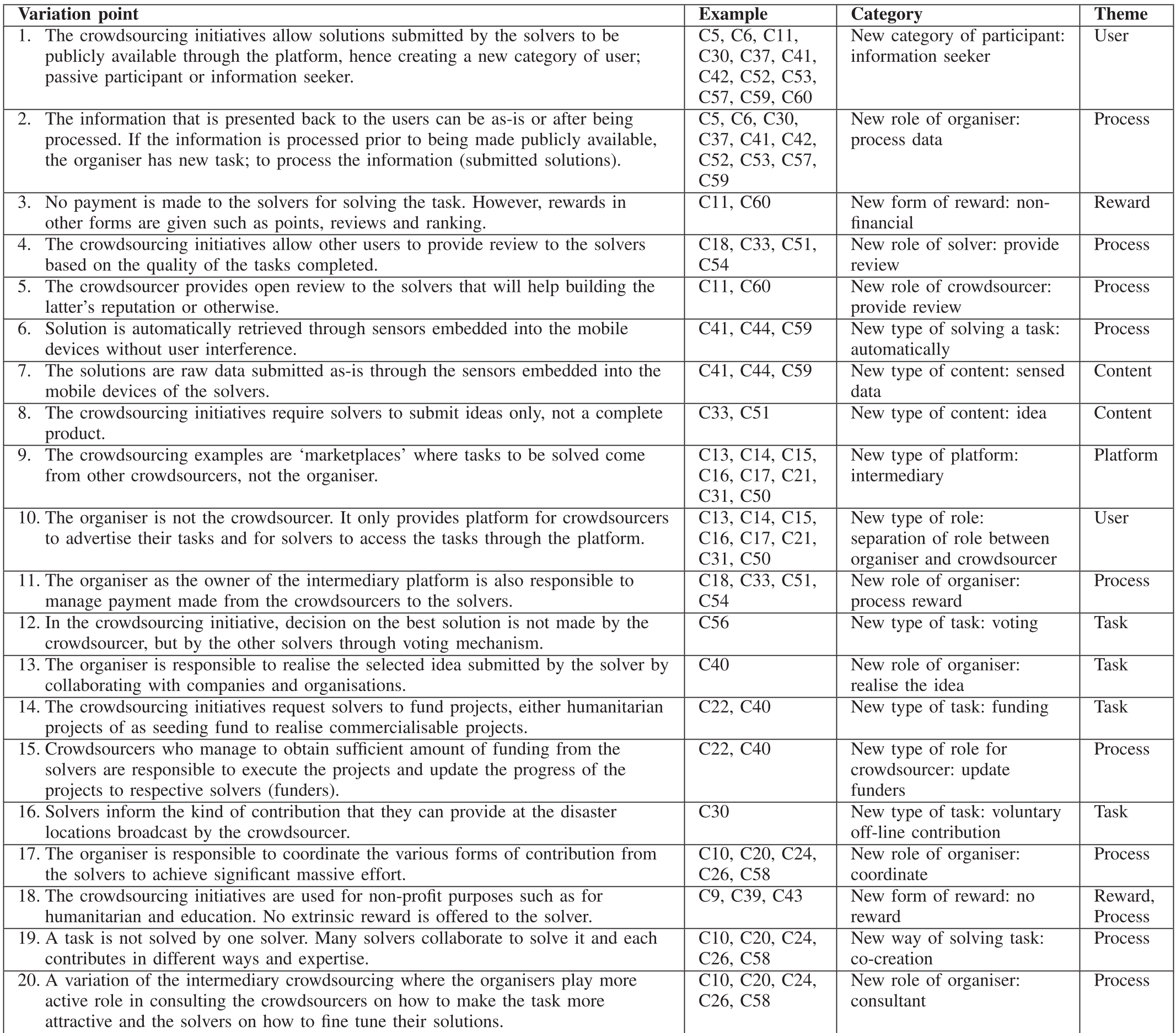
Key Insights: How Crowdsourcing Has Mutated
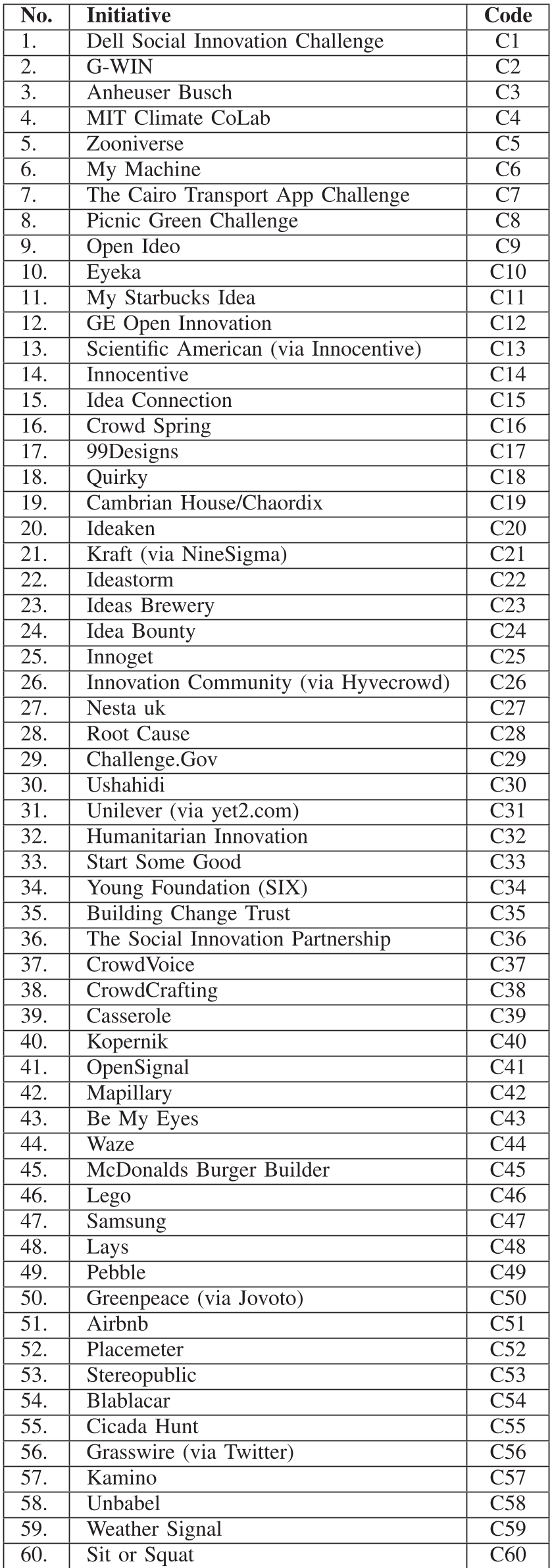
The results from the analysis of the 60 initiatives (listed below) highlight several radical shifts:
- The Passive Participant: In 18 out of 60 cases, a new user type emerged. These "Information Seekers" don't provide solutions; they consume the wisdom of the crowd.
- Automation: In apps like Weather Signal or Waze, the "work" is done by sensors in the background, removing human effort from the equation—a concept never envisioned in 2006.
- Intermediaries: The rise of "Marketplaces" (Innocentive, 99Designs) means the platform owner and the task owner are often different entities, adding layers of management and consultation.
Critical Analysis & Conclusion
Why this matters
The value of this paper lies in its Inductive Realism. By recognizing Reward and Content as mandatory components of a taxonomy, it forces researchers to look at the motivation and granularity of data, which are often the primary failure points of crowdsourcing projects.
Limitations
- Metric Gap: While the taxonomy defines the "what," it doesn't yet provide the "how much" (metrics for measuring success).
- Temporal Snapshot: As 2026 continues to see advances in AI, the "Crowd" may soon include LLM agents, a category not yet fully explored in this paper's dataset.
Takeaway
Crowdsourcing is no longer just "outsourcing to the crowd"; it is a sophisticated method of data orchestration. For developers and strategists, this taxonomy serves as a checklist: If you are building a platform, have you identified your passive users? Is your content raw or processed? Is your reward strictly financial or reputational?
Future work will focus on turning this taxonomy into an evaluation framework to measure the complexity and viability of new crowdsourcing ventures.