
BeFaced: Gamifying Crowdsourcing for Robust Facial Expression Analysis
Crowdsourcing facial expressions using popular gameplay
This paper introduces BeFaced, a casual tile-matching tablet game designed to crowdsource high-quality, diverse facial expression datasets. By integrating expression performance into the core gameplay loop, the authors leverage intrinsic motivation to capture labeled facial data "in the wild."
TL;DR
Researchers have developed BeFaced, a mobile game that turns facial expression data collection into a "Bejeweled-style" puzzle. By requiring players to mimic expressions to clear tiles, the system captures labeled, diverse, and naturalistic facial data, bypassing the limitations of traditional, sterile laboratory databases.
Background: The Data Bottleneck in Affective Computing
For decades, facial expression recognition has relied on datasets like CK+ or MMI. While accurate, these datasets suffer from a "Lab Bias": they feature a limited number of participants, often in controlled lighting and fixed poses. To build AI that works in the real world, we need "data in the wild"—varied ages, ethnicities, and environments.
Prior crowdsourcing efforts suggested having users watch ads, but who actually enjoys that? BeFaced shifts the paradigm from "passive viewing" to "active play," using intrinsic motivation to build a sustainable data pipeline.
Methodology: Gaming the System
The core of BeFaced is a tile-matching mechanic. When a player aligns three "expression tiles" (e.g., Sad, Disgust, Joy), they are prompted to perform that expression within three seconds using the front-facing camera.
The Technical Pipeline
- Real-time Tracking: Sensitive feature points are tracked using a deformable model fitting approach based on landmark mean-shift.
- DDA (Dynamic Difficulty Adjustment): This is the "secret sauce." If the algorithm struggles to recognize a player's expression, the game dynamically lowers the classification threshold. This ensures the player doesn't get frustrated, allowing the system to capture even "weak" or "noisy" expressions that are invaluable for training robust models.
- Privacy-Preserving Uploads: Users can choose to upload only the mathematical feature points (splines) rather than raw video, addressing a major ethical hurdle in crowdsourcing.
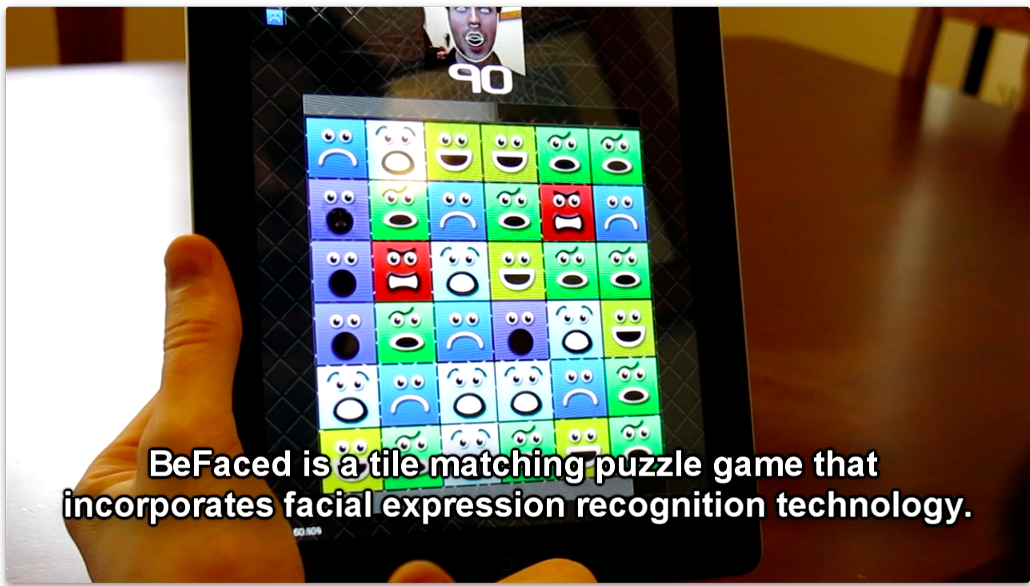 Figure 1: The BeFaced Game interface showing the real-time face tracking and tile-matching mechanic.
Experiments and Evaluation
The authors propose a rigorous evaluation framework comparing BeFaced against the Forbes dataset and laboratory standards across several dimensions:
- Demographic Variability: Tracking age, gender, and ethnicity through voluntary questionnaires.
- Environmental Variability: Testing how algorithms handle different lighting and head poses captured in casual, mobile settings.
- Engagement Metrics: Using the Intrinsic Motivation Inventory to prove that game-based collection is more effective than traditional viewing tasks.
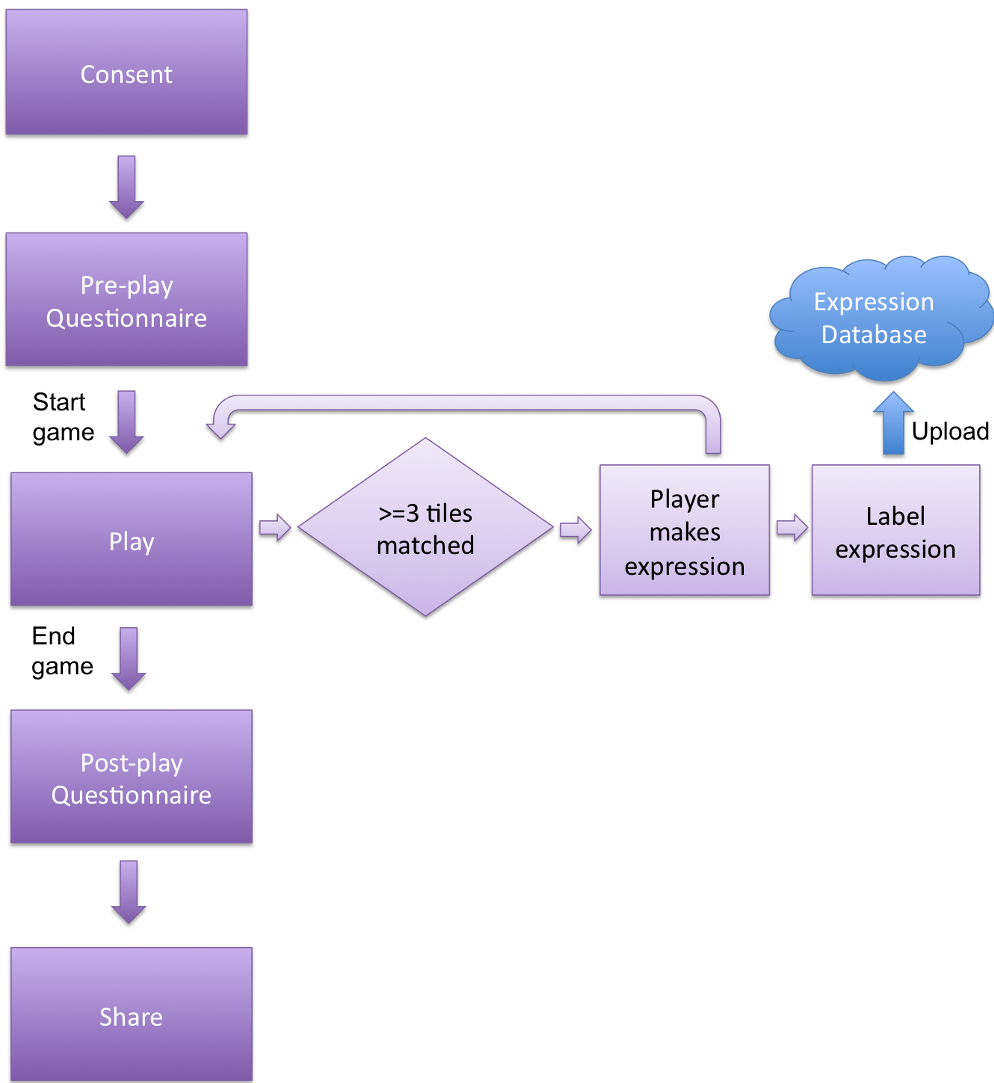 Figure 2: The interaction flow from consent to demographic gathering and automated data transmission.
Deep Insight: Beyond Just Smiling
The brilliance of BeFaced lies in its extensibility. Unlike video-based collection where you are at the mercy of the content's emotional trigger, BeFaced can "request" any specific expression (even rare ones like 'Contempt' or 'Cringe') simply by introducing a new tile type.
Limitations & Future Work
- Verification: Currently, the system assumes the player is telling the truth. Future versions might use other players to "verify" expressions as part of the game loop.
- Mechanism: The game is currently limited to the six basic Ekman expressions, but the framework allows for a much broader affective range.
Conclusion
BeFaced demonstrates that the future of academic data collection might not be in the lab, but in the pocket. By aligning the goals of the researcher (labeled data) with the goals of the user (entertainment), we can bridge the "Data Gap" in AI.
Takeaway: If you want better data, make the collection process fun. Serious games are not just for education; they are the next frontier for large-scale machine learning supervised training.