
Crowdsourcing the Fuzzy Clinical Web: A New Frontier for SNOMED CT Tagging
Crowdsourcing techniques to create a fuzzy subset of SNOMED CT for semantic tagging of medical documents
This paper introduces a crowdsourcing-based approach to create fuzzy subsets of the massive SNOMED CT clinical vocabulary. The method facilitates semi-automatic semantic tagging of medical documents by leveraging user input to refine the membership degree of concepts within specific clinical domains, such as Women’s Health Ultrasound (WHU).
TL;DR
Medicine is drowning in data but starving for standardized semantics. This paper presents a novel framework that uses crowdsourcing and fuzzy logic to carve out manageable, relevant subsets from the gargantuan SNOMED CT vocabulary. By allowing clinicians to "vote" on term relevance through daily document tagging, the system learns the vague boundaries of medical domains, significantly improving the efficiency of semantic interoperability.
Background: The Paradox of Choice in Clinical Coding
In the quest for semantic interoperability, SNOMED CT is the "gold standard" with over 300,000 concepts. However, for a sonographer or a cardiologist, this is a curse. When searching for a simple term like "Stomach," the system might return dozens of anatomical, surgical, or pathological codes. Traditional "crisp" subsets—where a term is either IN or OUT—are too rigid for the overlapping realities of modern medicine.
The authors identify a critical bottleneck: The Semantic Gap. Manual expert curation of subsets is too slow, while fully automated parsing often misses the nuance of clinical intent.
Methodology: Fuzzifying the Crowd
The core innovation lies in treating a vocabulary subset not as a list, but as a Fuzzy Set. A concept belongs to a specialty (like Women’s Health Ultrasound) with a degree of membership () between 0 and 1.
1. The Crowdsourcing Loop
Inspired by ReCaptcha, the system integrates into the clinician's workflow. As they review a report, the system suggests concepts. Every time a clinician selects a concept, they aren't just tagging a document; they are providing a "signal" to the underlying fuzzy engine.
2. The Learning Algorithm
The system employs a clever update rule to ensure the ontology evolves without oscillating wildly:

The new membership () is a function of the historical value and the current user's assessment, weighted by the frequency of historical confirmations (). This allows the system to be responsive to new trends while remaining robust against occasional "noisy" input.
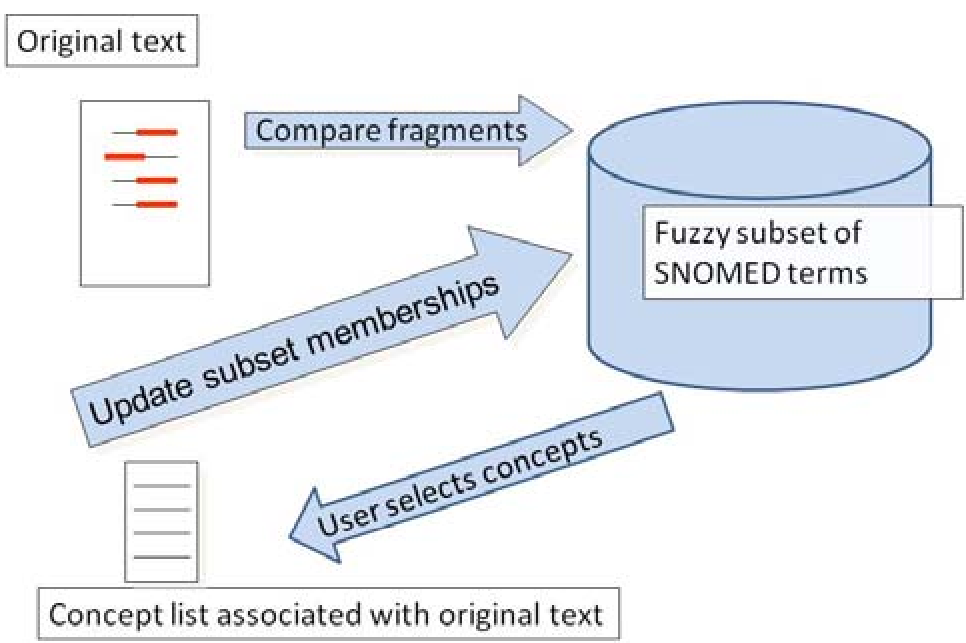
3. Architecture Overview
The information flow transforms raw clinical text into structured, semantically tagged HL7 documents through a feedback loop.
Experiments and Interface
The authors prototyped the system for Women’s Health Ultrasound (WHU). One of the primary hurdles was the "Cold Start" problem—how do you rank terms when the system is new? They solve this by pre-seeding the subset with broad clinical guesses ( for obvious matches, for others).
The user interface (UI) is designed for high-velocity environments, presenting concepts in order of their fuzzy relevance scores.
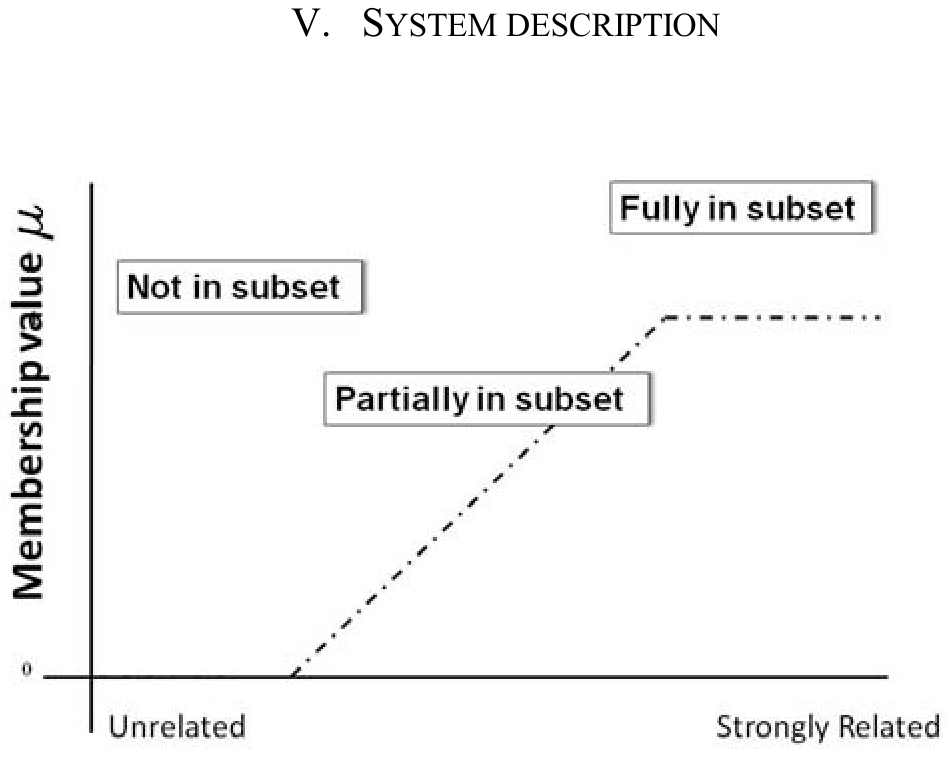 Figure: The interface ranks concepts by fuzzy relevance, reducing the cognitive load on the physician.
Critical Insight: Why This Matters
The brilliance of this work isn't just in the fuzzy math—it's in the Incentive Design. By providing a tool that makes coding easier for the doctor (by putting the most likely terms at the top), the researchers get high-quality labeling data for free.
However, the paper leaves some questions open:
- The Expertise Weighting: Should a senior consultant's "vote" count more than a junior resident's?
- Scalability: How does this handle the "long tail" of extremely rare medical conditions that may never get enough "crowd" hits to update their membership?
Conclusion
This research moves us away from the "dictatorship of the expert" in ontology design and toward a "democracy of the practitioner." By embracing the inherent fuzziness of medical language and leveraging crowdsourcing, Parry and Tsai have provided a blueprint for more usable, adaptable health information systems.
Future Outlook: Integrating these fuzzy subsets with LLM-based extraction could create a hybrid system where AI suggests and the fuzzy-weighted crowd validates, leading to near-perfect semantic tagging in real-time.