
Can the Crowd Outperform the Surgeon? Scaling Surgical AI via Crowdsourcing
Can Masses of Non-Experts Train Highly Accurate Image Classifiers? - A Crowdsourcing Approach to Instrument Segmentation in Laparoscopic Images
This paper investigates the feasibility of using Amazon Mechanical Turk (MTurk) to outsource the segmentation of medical instruments in laparoscopic images to non-expert "crowd" workers. By employing majority voting among 10 workers, the study achieves segmentation quality and classifier training performance comparable to those provided by medical experts.
TL;DR
Building AI for surgery usually requires thousands of hours from expensive surgeons to label data. This paper challenges that status quo by proving that anonymous, untrained online workers can segment surgical instruments with the same accuracy as medical experts. By using "Majority Voting" to filter out noise, the authors show we can generate high-quality training data in hours rather than months, at a fraction of the cost.
Problem & Motivation: The Expert Bottleneck
In the world of computer-assisted minimally-invasive surgery (MIS), tracking instruments is the "holy grail" for workflow analysis and surgical navigation. However, training these models requires pixel-perfect masks of tools in video frames.
The current bottleneck is scalability. Medical experts (surgeons) have zero spare time, and their "labeling hourly rate" is prohibitively high. Consequently, most surgical datasets are tiny, failing to capture the messy reality of diverse surgeries. The researchers asked a radical question: Does one really need a medical degree to outline a metal grasper in a video frame?
Methodology: Majority Voting as a Noise Filter
The authors tasked workers on Amazon Mechanical Turk (MTurk) to draw polygons around instruments in 120 laparoscopic images.
1. The Crowdsourcing Pipeline
- Task (HIT): Each worker was given a bounding box and asked to place a polygon around the instrument.
- Redundancy: Every instrument was segmented by 10 different "Knowledge Workers" (KWs).
- Majority Voting: To eliminate "lazy" workers or outliers, they merged results. If 5 or more workers agreed a pixel was part of a tool, it was included in the final mask.
2. Validation Framework
The researchers didn't just look at the masks; they trained actual Random Forest classifiers using three different data sources:
- : Trained only on Expert data.
- : Trained only on Crowd data.
- : A 50/50 hybrid.
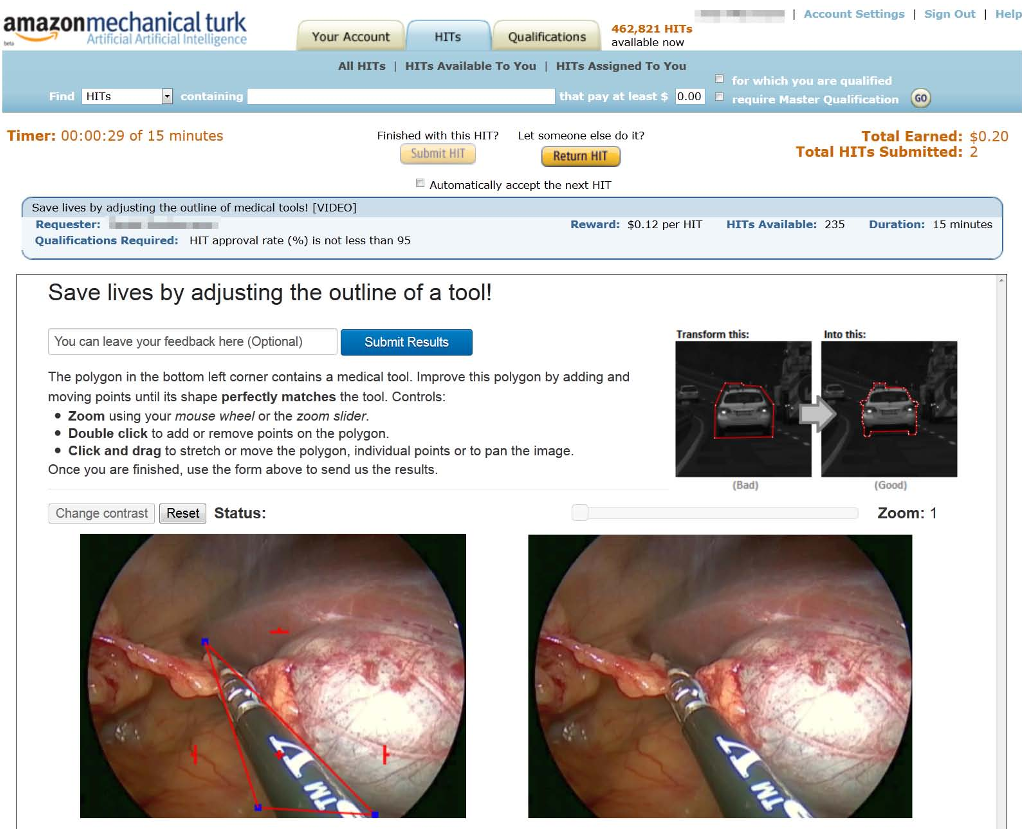 Figure 1: The web-based interface used by non-experts to segment instruments.
Experiments & Results: Experts vs. The Masses
The results were striking. While individual crowd workers varied in quality, the aggregated wisdom of the crowd was formidable.
- Segmentation Quality: Individual workers achieved a Dice Similarity Coefficient (DSC) of 0.89. With majority voting, this jumped to 0.93, effectively matching expert performance.
- Classifier Accuracy: When testing the Random Forest models, there was no statistically significant difference in True Positive (TP) rates or Precision between models trained by surgeons and those trained by the crowd.
- Efficiency: All 2,350 annotations were completed in less than 24 hours. Achieving this with surgeons would typically take weeks of coordination.
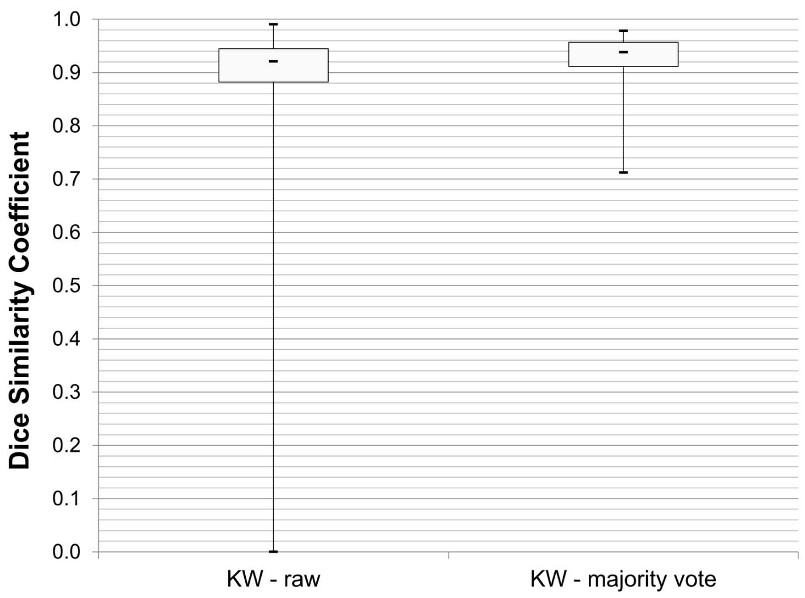 Figure 2: Boxplots showing that Majority Voting (right) significantly tightens the variance and improves the mean DSC compared to individual workers (left).
Critical Analysis & Conclusion
This paper is a pivotal proof-of-concept for the "democratization" of medical data labeling. It proves that Inductive Bias (the inherent knowledge of what a tool looks like) is not exclusive to doctors; it's a general cognitive task that the public can handle.
Takeaway
The community can stop waiting for surgeons to find free time. For tasks like instrument segmentation, the "Crowd" is a viable, high-speed engine for scaling AI.
Limitations
- Task Simplicity: This works for tools, but what about identifying a "Stage 2 Tumor"? That likely still requires years of medical school.
- Preprocessing: The researchers still had to provide manual bounding boxes to tell the crowd which tool to segment. Future work must automate this "priming" step.
- Complex Geometry: The polygon tool used struggled with instruments containing "holes" or complex apertures, which slightly capped the maximum possible DSC.
In summary, this study provides a blueprint for bypassing the expert bottleneck, enabling the creation of "Massive-scale" surgical datasets that were previously thought impossible.