
ALFRED: Scaling Out High-Accuracy Data Extraction with Noisy Crowds
Crowdsourcing large scale wrapper inference
The paper introduces ALFRED, a crowdsourcing system designed for large-scale wrapper induction from data-intensive websites. It leverages supervised learning through Active Learning (Membership Queries) to minimize human effort and a Bayesian model to handle noisy labels from non-expert workers.
TL;DR
Web scraping at scale usually forces a choice between the high cost of manual maintenance and the instability of automation. This paper presents ALFRED, a system that uses Active Learning to turn low-cost, "noisy" crowdsourced labor into highly accurate data extraction wrappers (F-measure > 99%). By asking simple Yes/No questions and using a Bayesian model to handle worker errors, it achieves SOTA results at a fraction of the traditional cost.
Context & Motivation: The Scalability Bottleneck
Data-intensive websites (like IMDb or NASDAQ) use scripts to generate pages from databases. To extract this data, we use "wrappers."
- Unsupervised wrappers (e.g., RoadRunner) try to guess the template but often break.
- Supervised wrappers are accurate but require expert labeling.
The authors identify a middle ground: Crowdsourcing. However, the "crowd" isn't expert-level. They make mistakes, and they don't understand XPath. The challenge is: How do we build a perfect wrapper using imperfect people?
Methodology: Active Learning meets Bayesian Probability
1. Simple queries (Membership Queries)
Instead of asking a worker to "write a rule," ALFRED asks: "Is 'Inception' the title of this movie?" (Yes/No). This is a Membership Query (MQ).
2. ALF: The Active Learning Engine
To save money, we shouldn't ask random questions. The algorithm uses Vote Entropy to identify the most "uncertain" data points. By resolving these first, the model learns the correct wrapper faster.
3. ALFRED: Redundancy and Error Estimation
Real workers are noisy. ALFRED's "Secret Sauce" is Adaptive Redundancy. It assigns the same attribute to multiple workers only when it senses disagreement or high uncertainty.
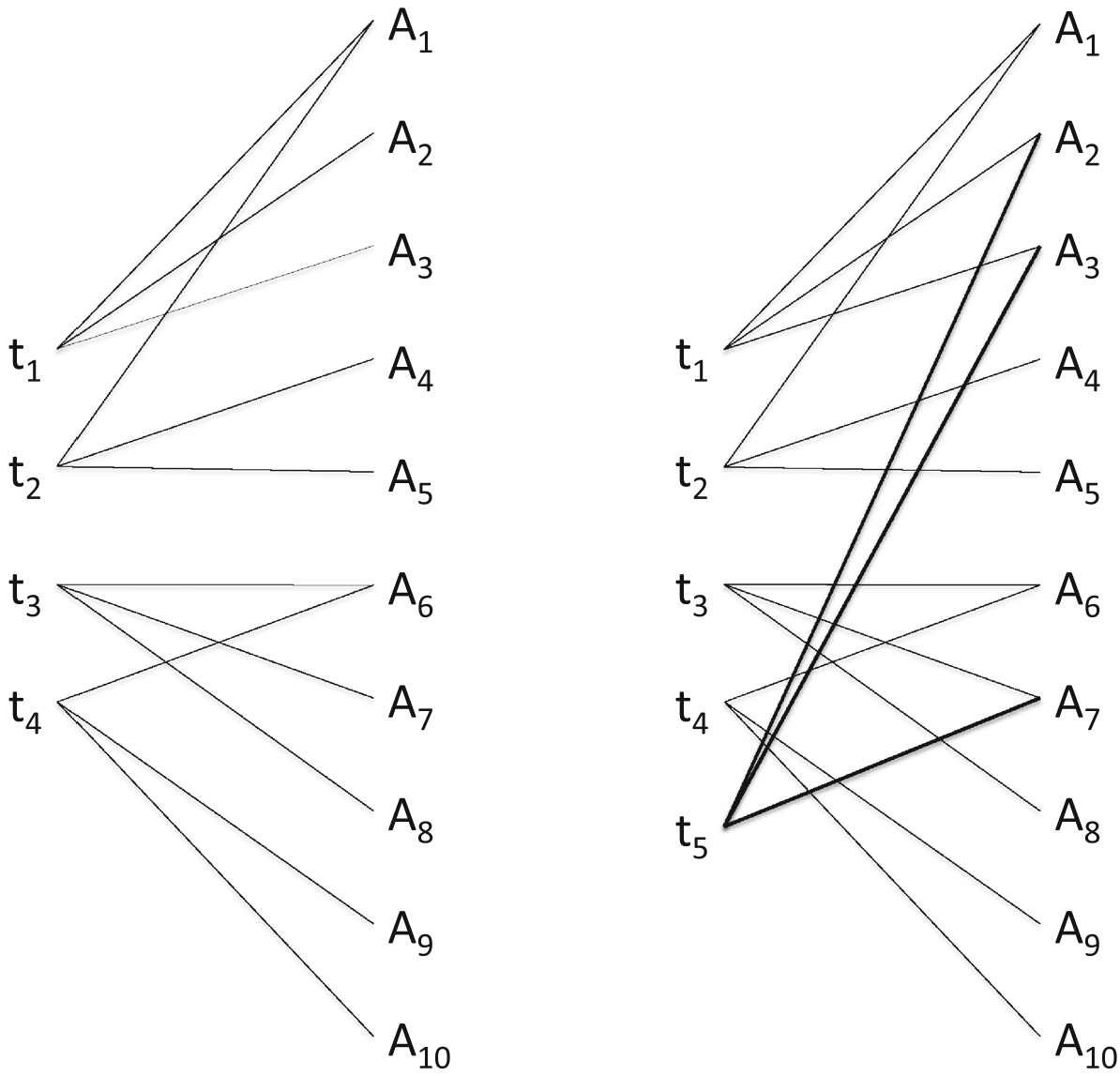 The bipartite graph showing how tasks and attributes are linked to estimate worker error rates.
The system uses a Bayesian formula to update the probability of a wrapper's correctness: This allows the system to calculate (worker error rate) on the fly without needing a pre-labeled "gold standard" (Ground Truth).
Experimental Results: High Quality, Low Cost
The authors tested ALFRED on 124,000 pages.
- Accuracy: It reached an F-measure of 99.7%.
- Cost Efficiency: By using adaptive redundancy, it only needed about 1.57 workers per attribute on average, saving significant costs compared to "majority vote" systems that usually require 3-5 workers.
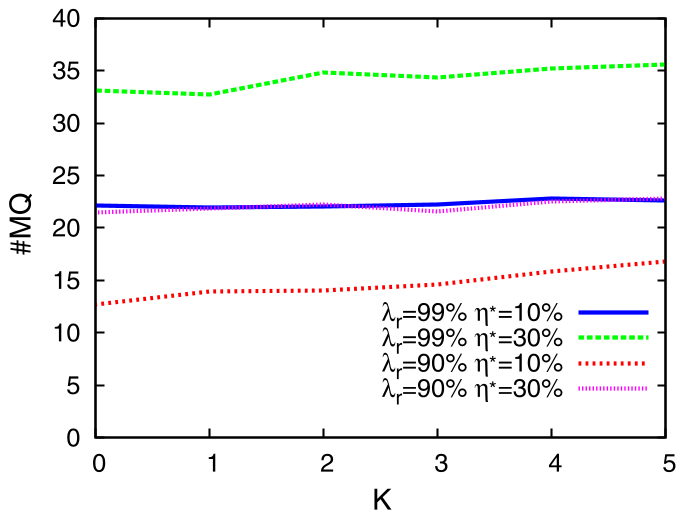 Cost vs. Quality: Note how the system compensates for 30% error rates by increasing Queries (MQ) while maintaining nearly 1.0 F-measure.
Critical Insight & Conclusion
The genius of ALFRED is not just in using the crowd, but in modeling the crowd's unreliability as a first-class citizen in the algorithm.
Takeaway for the industry: If you are building data pipelines, don't ignore noisy signals. Mathematical frameworks like Bayesian updates can transform cheap, low-quality inputs into high-quality training data. While modern LLMs might replace some "simple" labeling, the adaptive redundancy logic here remains a backbone for any cost-optimized human-in-the-loop system.
Limitations: The current study focuses on single-value attributes. Handling multi-valued lists (like a list of cast members) remains a future challenge for the framework.