
Synergizing Minds and Machines: The Frontier of Modern Educational Assessment
Utilizing crowdsourcing and machine learning in education: Literature review
2020-01-14
Summary
Problem
Method
Results
Takeaways
Abstract
This paper presents a systematic literature review (SLR) on the integration of Crowdsourcing and Machine Learning within the education sector. It analyzes 30 key studies to evaluate how these technologies enhance e-learning activities, specifically focusing on assessment methods and student interactions in MOOCs.
## TL;DR
This systematic review dives into how **Crowdsourcing** and **Machine Learning (ML)** are revolutionizing the educational landscape. By analyzing 30 seminal works, the paper highlights a shift from manual instruction to automated and community-driven ecosystems. The core finding? While Crowdsourcing handles diversity, and ML handles scale, the **Hybrid approach** is the only robust path forward for accurate, real-time student evaluation.
## The Core Tension: Scale vs. Quality
The fundamental pain point in education—particularly in Massive Open Online Courses (MOOCs)—is the **latency of feedback**. A student's growth is directly proportional to the speed and accuracy of the feedback they receive. However, human instructors cannot grade thousands of papers instantly, and pure ML often misses the semantic nuance of complex student answers.
The authors argue that the "road toward improvement" lies in utilizing "extra hands" (the crowd) and "extra brains" (the machine) to break this bottleneck.
## Methodology: Mapping the Educational Tech-Stack
The review categorizes learning activities into several high-impact zones:
* **Assessment (Grading):** Moving from manual checking to NLP-driven similarity scoring.
* **Content Generation:** Using the crowd to build massive question banks.
* **Student Interaction:** Implementing "Talkabout" and "PeerStudio" to simulate classroom engagement.
## Strategic Insight: The Power of the Hybrid Approach
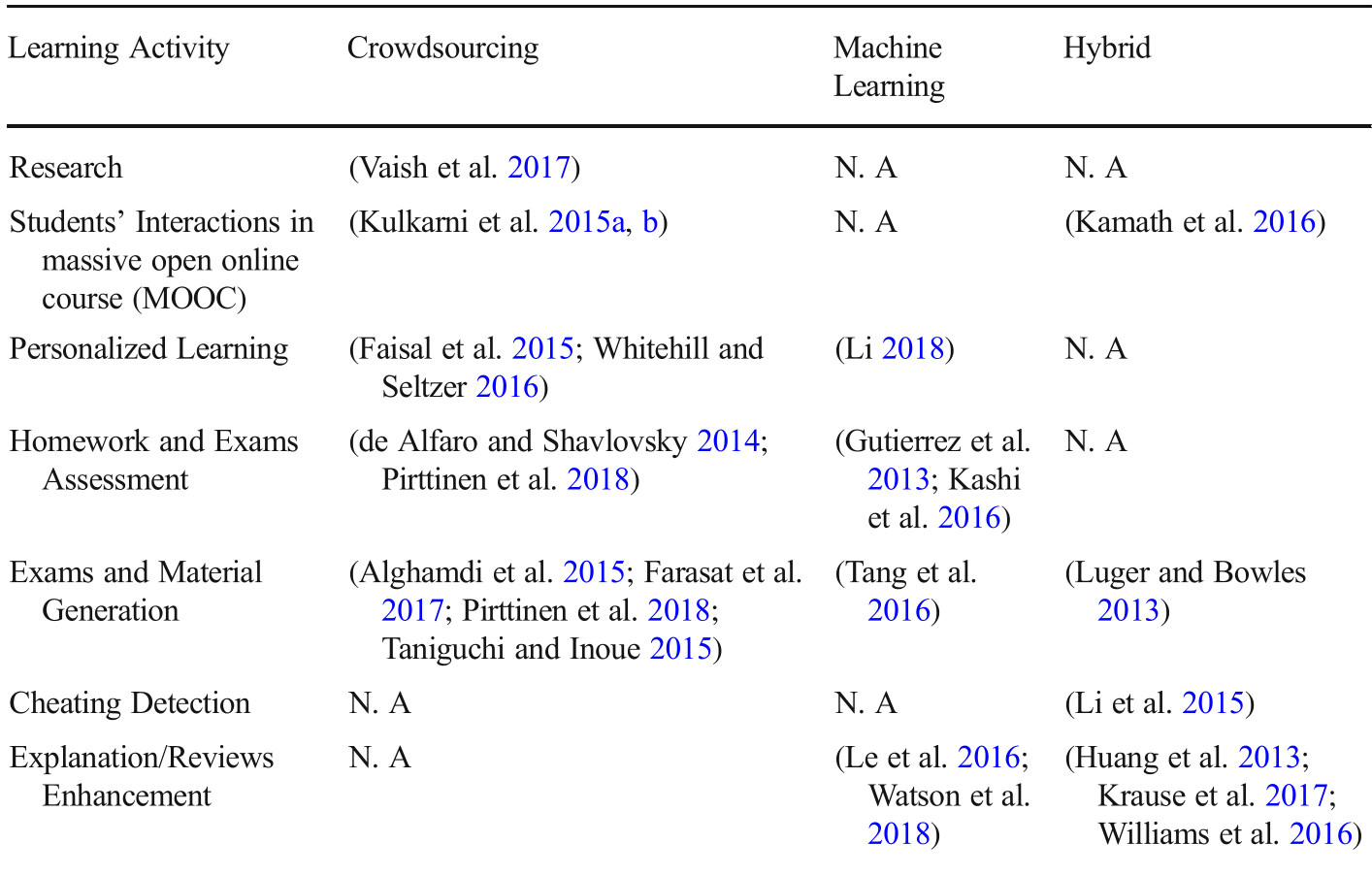
One of the most compelling insights is the breakdown of technical adoption. While Crowdsourcing is widely used for research and question generation (approx. 47.8%), **Hybrid solutions** are taking over areas like "Cheating Detection" and "Explanation Enhancement."
### Why Hybrid?
1. **Error Correction**: ML can filter out low-quality crowd contributions.
2. **Cold Start Mitigation**: Crowds can provide initial labels for training sets where no expert data exists.
3. **Contextual Nuance**: Humans (the crowd) can validate if an ML-generated grade is "fair" or "logical" based on classroom context.
## Critical Results: Impact on Assessment
The review highlights systems like **CrowdGrader** and **Score Recommendation Systems**:
* **CrowdGrader** utilizes a collaborative consensus model where students grade each other. The system "grades the graders," ensuring accountability.
* **NLP Models** are used to calculate "similarity scores" between student input and "Gold Standard" answers, drastically reducing the time required for descriptive assessments.
| Activity | Crowdsourcing % | Machine Learning % | Hybrid % |
| :--- | :--- | :--- | :--- |
| Research | 100% | 0% | 0% |
| Homework/Exams | 50% | 50% | 0% |
| Cheating Detection | 0% | 0% | 100% |
## Limitations and Future Outlook
The paper concludes with a warning: **Data Integrity**. Whether it is "crowd bias" or "training set bias," inaccurate input data will jeopardize the learning experience. Future research must focus on:
* **Incentive Design**: How to reward the crowd (Physical vs. Logical rewards) to ensure high-quality feedback.
* **Robust NLP**: Moving beyond simple keyword matching to deep semantic understanding.
* **Scalability**: Applying these models to fields requiring "Critical Thinking" rather than just MCQ-based testing.
## Final Takeaway
The integration of AI and Crowdsourcing is no longer a luxury—it is a necessity for the survival of global e-learning. By leveraging the efficiency of ML and the empathy/nuance of the crowd, we can finally achieve **Personalized Learning at Scale**.