
Scaling LIBRAS Segmentation: Can the Unskilled Crowd Outperform the Machine?
A Crowdsourcing Method for Sign Segmentation in Brazilian Sign Language Videos
This paper presents a novel crowdsourcing-based method for the temporal segmentation of Brazilian Sign Language (LIBRAS) in continuous video streams. By utilizing a "CrowdWaterfall" approach that cascades simple tasks to unskilled workers, the system successfully identified 96.97% of signs and achieved high-quality boundary delimitation in 93.75% of cases.
TL;DR
Researchers at the Federal University of Espírito Santo have developed a crowdsourcing methodology to solve one of the most tedious bottlenecks in Sign Language AI: temporal segmentation. By breaking down the complex task of identifying sign boundaries in LIBRAS (Brazilian Sign Language) into simple, cascaded microtasks for non-expert workers, they achieved a 97% sign identification rate and a 93.75% segmentation quality score, rivaling professional interpreters.
Background: The Invisible Barrier in Sign Language AI
Unlike spoken language, where pauses or punctuation provide natural "breaks," sign languages like LIBRAS are fluid, continuous streams of hand configurations, facial expressions, and spatial modifiers. Current SOTA (State-of-the-Art) translation models face a "chicken and egg" problem: they need massive segmented datasets to learn, but segmenting these videos manually is so labor-intensive that such datasets rarely exist.
Existing automated solutions are often "brittle"—they only work in controlled laboratory settings with perfect lighting and green screens. The human factor—the way individuals uniquely concatenate signs—remains a significant hurdle for pure algorithmic approaches.
Methodology: The CrowdWaterfall Approach
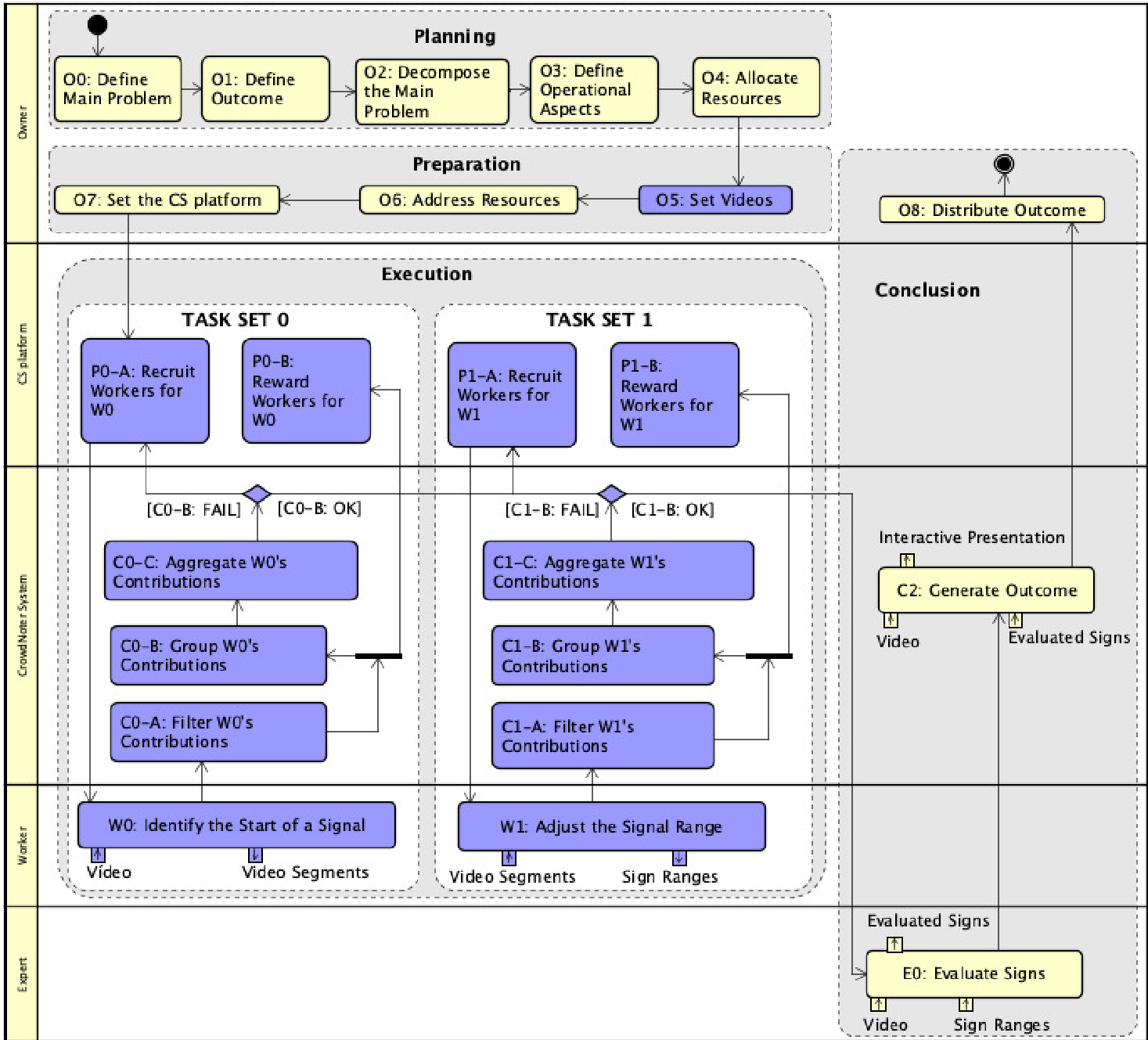
The authors leverage the Human Computation (HC) paradigm through a system called CrowdMuse. The core insight is that while a non-signer cannot understand LIBRAS, they can visually perceive the transitions and changes in motion that signify a new "unit" of communication.
The Two-Step Workflow
- Task T0 (Identification): Workers mark the start of what looks like a new sign. The system then groups these marks to find "clusters" of agreement using a center-of-mass calculation.
- Task T1 (Refinement): A second set of workers receives these rough segments and fine-tunes the start/end times (at 50ms increments) to perfectly encapsulate the sign.
Quality Control: The "Honey Pot" Strategy
To filter out malicious or lazy workers, the authors used the "Resting Sign" (a standard neutral position in LIBRAS) as a Honey Pot. If a worker failed to identify this obvious sign, their entire contribution was discarded, ensuring only attentive data influenced the final results.
Experimental Results: Precision from Noise
The study processed four LIBRAS videos ranging from 14s to 31s. Despite using workers from 24 different countries who had no prior knowledge of LIBRAS:
- Identification Success: The crowd caught 100% of signs in videos V1-V3 and 90.47% in V4.
- Expert Alignment: The average temporal difference between the crowd and expert interpreters was a mere 0.15 seconds.
- Interpretability: 93.75% of the segments were rated as "perfect" or "near-perfect" for sign recognition by experts.
 The image above demonstrates how dense clusters of crowd markings align perfectly with the transitions between LIBRAS units.
Critical Insight & Future Outlook
The most striking takeaway is the hybrid efficiency. By delegating the "tedious" task of boundary-finding to the crowd, professional interpreters only have to perform the "high-value" task of labeling the meaning. This reduces the expert workload by an order of magnitude.
Limitations: The method struggled slightly with rapid, repetitive signs (like the "t-t" in "http"), where transitions are minimal. Future iterations might require "zoomed-in" microtasks for high-velocity gesture sequences.
Conclusion: This research provides a scalable blueprint for building the massive, annotated LIBRAS corpora that will eventually power real-time, robust sign-to-text translators. It proves that with the right workflow, "unskilled" eyes can provide "expert" precision.