
Scaling Medical Expertise: A Hybrid Crowdsourcing Pipeline for Compound Figure Annotation
Using Crowdsourcing for Multi-label Biomedical Compound Figure Annotation
The paper introduces a hybrid human-AI pipeline for multi-label annotation of biomedical compound figures, creating the gold standard for the ImageCLEFmed 2016 benchmark. By combining automatic separation and classification algorithms with crowdsourced validation, the authors successfully annotated 2,651 complex figures containing 8,397 subfigures.
TL;DR
Navigating the vast ocean of biomedical literature is hindered by "Compound Figures"—single images containing multiple sub-panes (e.g., an X-ray alongside a CT scan). This paper presents a cost-effective, hybrid pipeline combining machine learning with crowdsourced validation to create a high-quality "Gold Standard" dataset for these images. By spending just $870, the authors annotated thousands of figures, enabling the next generation of medical image retrieval systems.
The "Compound Figure" Problem
In repositories like PubMed Central, over 50% of images are composite. Standard Image Retrieval (IR) systems treat these as a single unit, missing the granular data stored in subfigures.
The challenge is twofold:
- Structural Complexity: Automatically finding "cut lines" to separate subfigures is error-prone.
- Domain Specificity: Identifying whether a subfigure is a "Histopathology slice" or an "MRI T2-weighted image" usually requires a MD, making large-scale manual labeling impossibly expensive.
Methodology: The Hybrid Human-AI Loop
The authors didn't rely solely on humans or AI. Instead, they built a staged pipeline designed to maximize efficiency and quality.
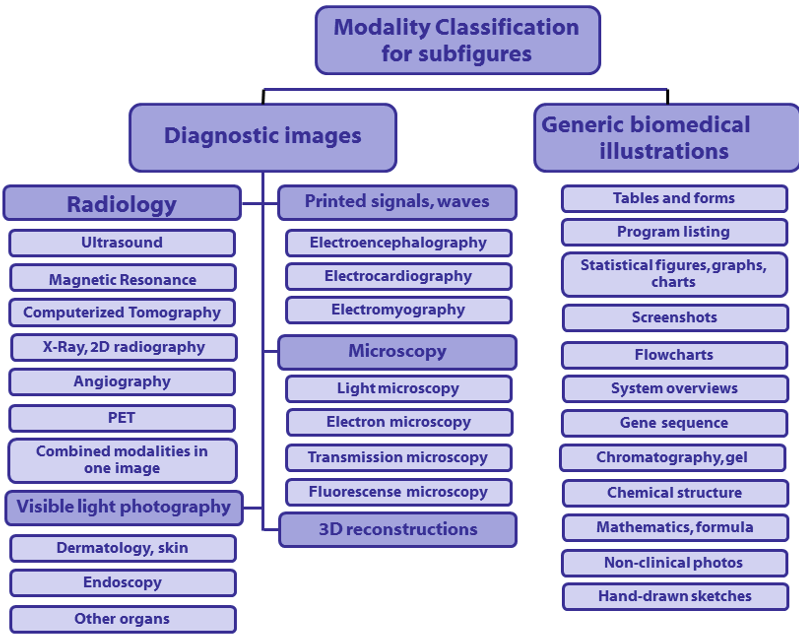
1. The Hierarchy of Modalities
To standardize the task, they used a 30-class hierarchy for biomedical image types, ranging from diagnostic (X-ray, CT, MR) to general illustrations (flowcharts, screenshots).
2. The Workflow
The process moved through several filters:
- Auto-Separation: Algorithms detected initial cut lines.
- Crowdsourced Verification: Workers answered "Yes/No" if the separation was correct.
- Hierarchical Classification: For incorrectly classified images, workers used a custom UI.
- UI De-biasing: In 2015, workers chose "easy" categories that required fewer clicks. In 2016, the authors redesigned the UI so every class required the same number of clicks, eliminating "path of least resistance" bias.
Quality Control: How to Trust the "Crowd"?
How do you ensure a non-expert on the internet provides medical-grade labels? The authors used a tripartite QC strategy:
- Gold Questions: Randomly inserting images with known labels to "trap" lazy or incompetent workers.
- Output Agreement: Requiring at least two independent workers to agree before a label is accepted.
- Expert Review: A final "sanity check" by biomedical imaging experts to resolve edge cases.
Results and Impact
The pipeline processed 2,651 compound figures (~8,400 subfigures).
- Cost Efficiency: $870 for 625 hours of work—a fraction of what professional medical annotators would charge.
- AI Performance: The automatic k-NN classifier only managed ~56% accuracy, proving that the human validation step is still critical in the medical domain.
- Community Contribution: This dataset became the foundation for the ImageCLEFmed 2016 competition, driving research in 14 different international groups.
Critical Insight: Why This Matters
This work demonstrates that task decomposition is the "silver bullet" for medical AI. By breaking down a complex diagnostic question into a series of "Is this correct?" and "Click the category" tasks, we can unlock the massive amount of latent knowledge trapped in the 4 million+ images of PubMed Central.
While modern Deep Learning (like DETR or SegFormer) would likely perform the "separation" task better today, the process of hybrid validation remains the industry standard for creating reliable medical ground truth.
Future Outlook
As we move toward Foundation Models (like GPT-4V or LLaVA), these manually verified datasets are more valuable than ever. They serve as the "ground truth" to evaluate whether large-scale models truly understand the nuanced differences between specialized medical modalities.