
Crowdsourcing Semantic Corpora: Solving the Dialog "Cold-Start" Problem
Crowdsourcing the acquisition of natural language corpora: Methods and observations
This paper explores crowdsourcing as a cost-effective method to acquire natural language corpora by mapping semantic forms to lexical realizations. Using three distinct elicitation methods—Sentence, Scenario, and List-based—the authors achieve high semantic accuracy and demonstrate that crowd workers can capture natural linguistic variations and canonical slot orderings with minimal bias.
TL;DR
This research investigates how to efficiently scale the creation of natural language datasets for spoken dialog systems. By benchmarking three elicitation methods—Sentences, Scenarios, and Lists—the authors prove that crowdsourcing can produce semantically accurate and linguistically natural data at a fraction of the cost of traditional manual authoring.
Background: The Cold-Start Dilemma
In the lifecycle of Spoken Language Understanding (SLU) systems, developers face a catch-22: to build a robust model, you need a corpus of how users actually talk; but to get users to talk, you need a deployed system. Historically, this meant hiring experts to write "expert grammars" or conducting expensive Wizard-of-Oz studies. This paper explores a third way: Crowdsourcing the mapping between semantic frames and human speech.
Methodology: Conveying Meaning to the Crowd
The core challenge is: How do you tell a human what to say without telling them exactly how to say it? The authors tested three UI approaches to present a semantic frame (e.g., FindJob(Location=Seattle)):
- Sentence-based: "Find a Seattle job." (High bias risk).
- Scenario-based: "The goal is to find a job... the city is Seattle."
- List-based: Goal: Find Job; City: Seattle.
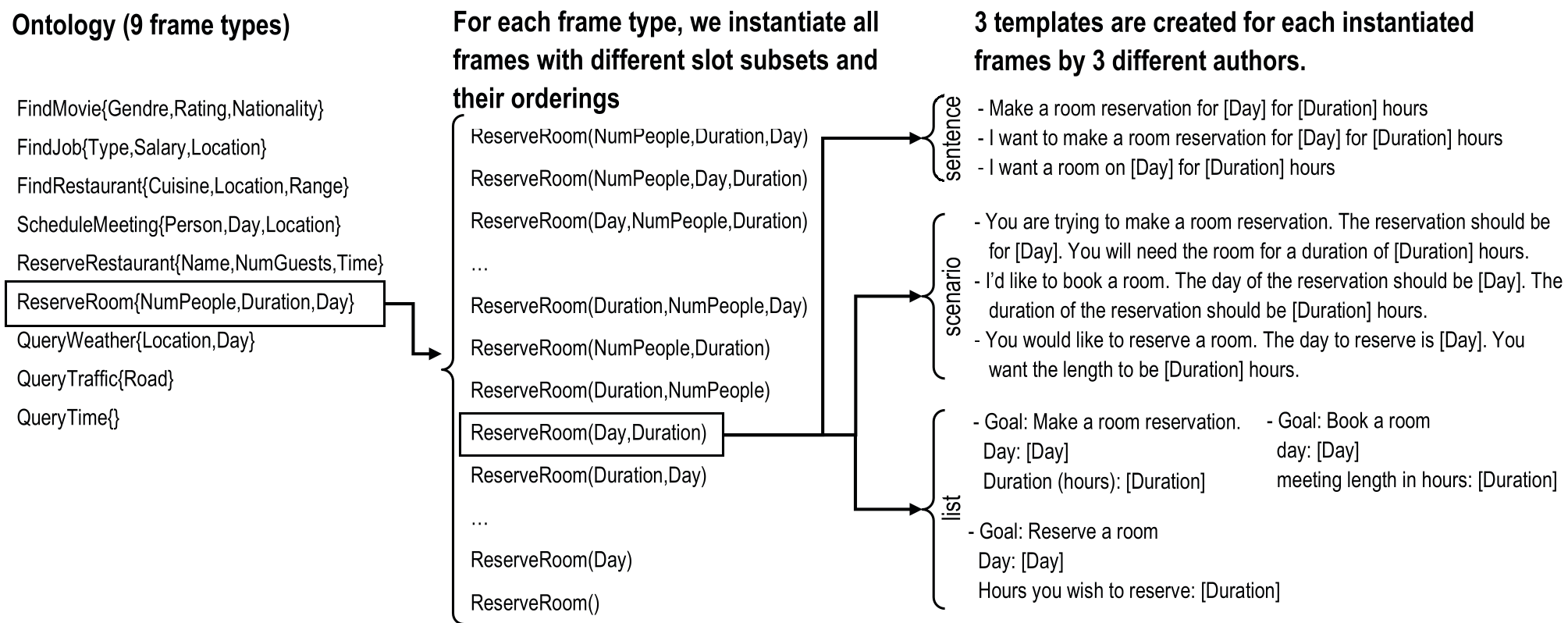
Key Insights: Accuracy and Natural Bias
The study surfaced several critical technical observations:
- Semantic Integrity: Despite the lack of expert oversight, 94% of the collected utterances were semantically correct. Most errors were simple typos or synonym usage (e.g., "high-end" for "expensive").
- The Power of Lists: The List-based method was the clear winner. It was the fastest for workers and had the lowest "lexical sensitivity" (ρ=0.08), meaning the workers were less likely to parrot the prompt's wording and more likely to use their own natural phrasing.
- Inherent Linguistic Structure: One of the most fascinating results was Slot Ordering. Even when the researchers intentionally scrambled the order of attributes in the prompt, workers naturally reordered them into a canonical English format (e.g., "Expensive Italian restaurant" rather than "Restaurant in Seattle that is Italian").
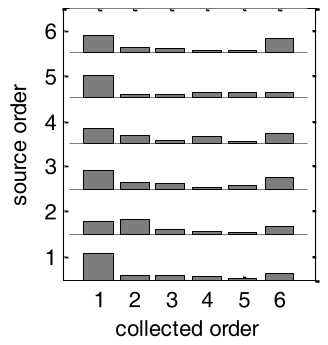 Figure: The charts above show how crowd workers converged on preferred slot orderings (Natural Distribution) regardless of the template order provided.
Critical Analysis & Conclusion
While this work demonstrates the efficiency of the crowd, it also highlights process control as a bottleneck. The authors noted that if a few workers dominate the task pool, lexical diversity plummets.
Takeaway: For modern AI practitioners, this paper serves as a foundational reminder that "structured elicitation" is an art. Whether using human crowds or prompting LLMs, the List-based approach remains the gold standard for minimizing "prompt-copying" bias and maximizing the natural variation of linguistic output.
Future Outlook
The next frontier is moving beyond static text-to-text elicitation. Can we use images or interactive simulations to elicit even more diverse speech patterns? As we move toward more complex multi-turn dialog systems, these crowdsourcing methodologies will be essential for building the massive, high-entropy datasets that modern transformer-based models crave.