
Crowdsourcing the Skyline: Finding Pareto-Optimal Objects via Pairwise Comparisons
Crowdsourcing Pareto-Optimal Object Finding By Pairwise Comparisons
This paper introduces the first framework for crowdsourcing Pareto-optimal object finding using pairwise comparisons over strict partial orders. It proposes an iterative algorithm that identifies Pareto-optimal objects (skyline queries) without requiring explicit attribute values, achieving orders of magnitude reduction in human tasks compared to brute-force methods.
TL;DR
When comparing complex items like movies or photos, we often lack numerical scores. This paper presents a novel framework to find Pareto-optimal objects (those not "bettered" by any other) using crowdsourced pairwise comparisons. By moving away from total orders to strict partial orders and utilizing smart pruning heuristics, the authors reduce the human labor required by orders of magnitude, nearing the theoretical efficiency limit.
The Problem: The High Cost of Subjectivity
In classic database theory, finding the "best" items (the Skyline) is easy if you have numbers: "Find a hotel that is both cheap and near the beach." But what if the criteria are "Service Quality" and "Atmosphere"?
Current methods face three walls:
- Lack of Attributes: Real-world preferences are often based on "subtle perceptions" that can't be mapped to a 1-10 scale.
- Intransitivity: Unlike numerical data (A > B and B > C \implies A > C), subjective dominance isn't always transitive. If Alice likes Movie A's story over B's, and B's music over C's, she doesn't necessarily prefer A over C.
- Query Explosion: A brute-force comparison of objects across criteria requires questions—an impossible expense for human crowds.
Methodology: Eager Pruning and Smart Selection
The core insight of this paper is that we don't need to know everything to find the best. To prove an object is not Pareto-optimal, we only need to find one other object that dominates it.
1. The Iterative Framework
The system follows a 4-step loop:
- Step 1: Selection: Pick the most "informative" pair of objects and a criterion.
- Step 2: Derivation: Aggregate crowd votes (using a threshold ) to determine the outcome.
- Step 3: Resolution: Fix rare logical contradictions caused by human error.
- Step 4: Termination: Use the transitive closure of existing results to partition objects into "Optimal," "Non-Optimal," and "Unknown."
2. The "Candidate Question" Logic
To minimize questions, the authors define "Candidate Questions" that satisfy three strict conditions:
- The outcome must be unknown.
- The object being pruned must still be in the "Unknown" set ().
- The possibility of dominance must not have been ruled out yet.
3. Micro-Ordering: The FRQ Advantage
The "Pair with Fewest Remaining Questions" (FRQ) heuristic is the star of the show. It prioritizes pairs that are close to completion. If you only need one more criterion to prove Object A dominates Object B, FRQ asks that question first.
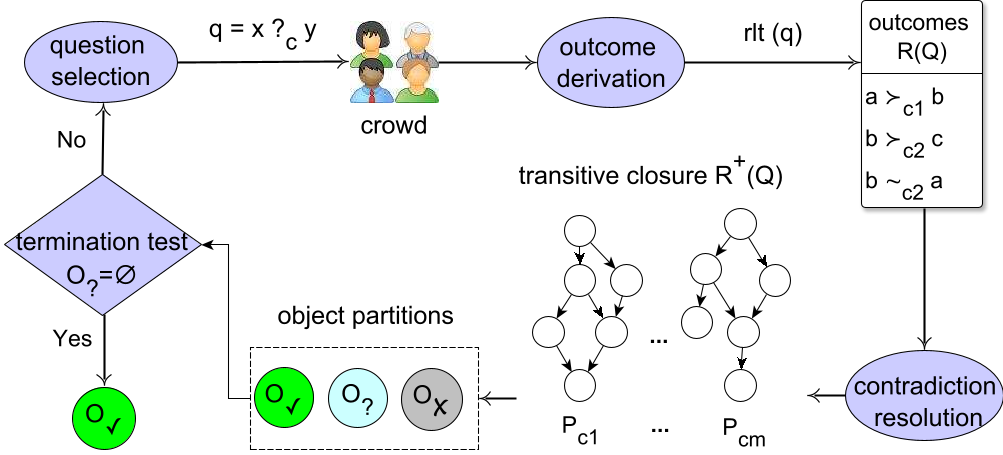 Figure 1: The general iterative framework for question selection and object partitioning.
Experimental Results: Near-Optimal Performance
The authors tested their methods against "BruteForce" using NBA player stats and a real-world Amazon Mechanical Turk study involving 100 institution photos.
- Efficiency: The FRQ algorithm performed significantly better than random selection, using roughly of the questions required by a brute-force approach for large datasets.
- Tightness: As shown in the performance graphs, the FRQ curve nearly overlaps with the theoretical lower bound, meaning it's almost impossible to find the Pareto-optimal set with fewer questions.
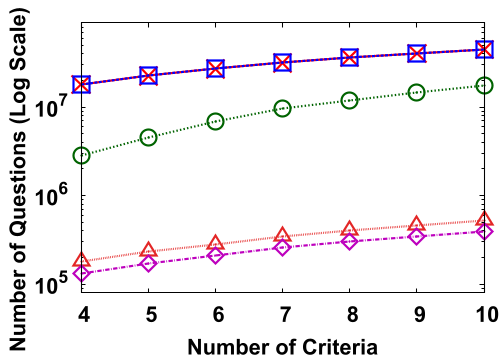 Figure 2: Scaling by criteria and object set size. FRQ (red) stays closest to the theoretical lower bound (purple).
Critical Insight & Conclusion
This work's elegance lies in its management of uncertainty and partial information. By mathematically formalizing why we can skip comparisons between non-optimal objects, the paper transforms a daunting problem into a manageable task.
Takeaway for Practitioners: If you are building a recommendation engine or a public opinion tool where "the best" is subjective, don't ask users to rate items 1-5. Ask them to compare two items on specific traits, and use an iterative partial-order framework to synthesize the results. This maximizes accuracy while minimizing user fatigue.
Limitations: The current model assumes a sequential process (waiting for one answer before asking the next). Future improvements could likely involve batch-parallel question selection to reduce latency in real-time applications.