
Crowdsourcing Vulnerability Verification: Breaking the Administrative Bottleneck in Cybersecurity
Crowdsourcing platform for collaboration management in vulnerability verification
The paper proposes a specialized crowdsourcing platform designed to automate and accelerate vulnerability verification. By introducing new roles like "Script Writers" and "Target Providers" along with automated software agents, the platform moves beyond simple reporting to provide a full-cycle collaborative environment for security assessment.
TL;DR
Vulnerability management is often a slow, manual process where reporting outpaces verification. This paper introduces a novel crowdsourcing platform that distributes the workload of vulnerability verification across a community of script writers and target providers. By utilizing automated agents for scheduling and logging, the platform transforms a high-cost, specialized task into a scalable, collaborative ecosystem.
The Verification Paradox
In the current security landscape, "White Hat" hackers are prolific in finding bugs, but "Administrators" are the bottleneck. A reported vulnerability is useless—and potentially anxiety-inducing for users—until it is verified. Most platforms fail here because:
- Target Scarcity: Administrators don't have every possible version of every software/hardware combination.
- Skill Gaps: Writing a reliable verification script for every unique report is a Herculean task for a small team.
- High Costs: Outsourcing this to professional firms can cost upwards of $20,000 per test.
The authors argue that we shouldn't just crowdsource the discovery (bug bounty), but also the verification and infrastructure.
Methodology: The Collaborative Core
The paper redefines the vulnerability lifecycle by introducing five distinct roles and two autonomous agents.
1. New Roles in the Ecosystem
- Script Writers: Instead of the admin writing the exploit, the community develops the verification scripts.
- Target Providers: Users who happen to have the specific vulnerable environment "rent" out their configurations for testing.
- Software Agents: The Test Scheduler manages the queue of untested scripts, while the Log Collector automatically monitors the interaction between the script and the target.
2. Architecture & Workflow
The process is divided into three distinct phases: Mission Assignment, Vulnerability Verification, and Online Penetration Testing.
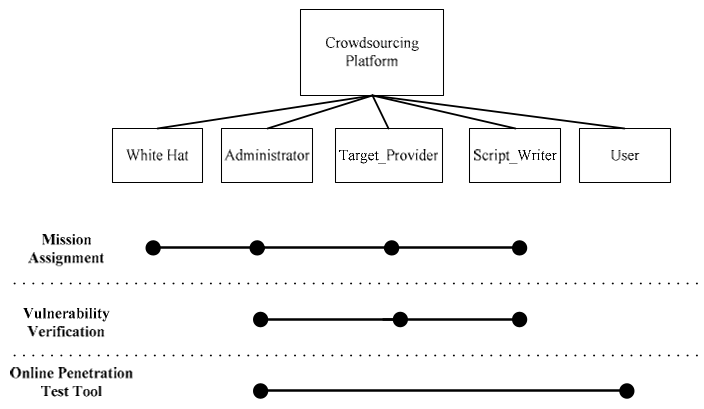
As shown in the architecture above, the platform acts as a central hub (implemented via Django) that manages various databases for tasks, scripts, and logs. This structure ensures that once a script is verified, it can be repurposed into a user-friendly tool.
Automating the "Handshake"
The most innovative technical contribution is the Vulnerability Verification phase. Unlike static repositories like Exploit-DB, this platform facilitates a dynamic feedback loop.
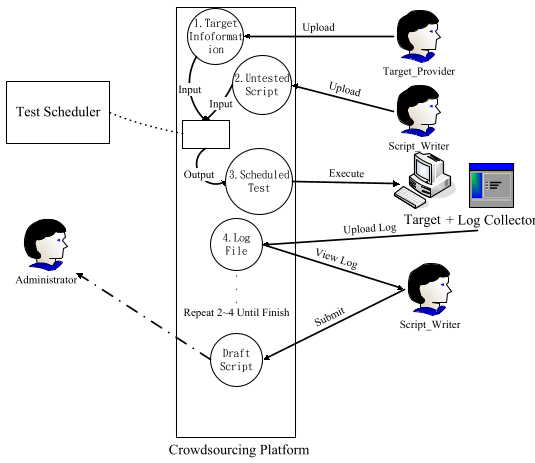
- The Log Collector removes the need for manual observation. It captures network packets and system logs on the target machine and feeds them back to the Script Writer for debugging.
- The Test Scheduler optimizes resource usage, ensuring that script writers don't have to wait for manual environment setup.
Experimental Comparison & SOTA Positioning
The paper sets its work apart by comparing it with industry giants like HackerOne and Exploit-DB. While most platforms focus either on publication or bug bounties, the proposed platform is the only one to integrate Target Provision and Automatic Verification simultaneously.
| Feature | Proposed Platform | Exploit-DB | HackerOne |
|---|---|---|---|
| Target Provision | Yes | Yes | No |
| Bonus System | Yes | No | Yes |
| Auto-Verification | Yes | No | No |
Furthermore, the "Online Penetration Tool" simplifies the UX significantly. Unlike tools like Metasploit or Sqlmap, which require complex command-line arguments, this platform's tool allows beginners to initiate a test simply by providing a Target IP.
Critical Insight & Future Outlook
The move toward Verification-as-a-Service (VaaS) via crowdsourcing is a logical step in an era of exponentially increasing CVEs (Common Vulnerabilities and Exposures). However, the platform faces a few hurdles:
- Trust & Security: How does the platform ensure that the "Target Provider's" machine isn't actually a honeypot or that the "Script Writer" isn't introducing malware?
- Incentive Alignment: While the paper mentions a "Bonus" system, the competition for high-tier security talent is fierce.
Conclusion: This work provides a solid blueprint for a decentralized security testing infrastructure. By treating vulnerability verification as a modular task, the authors have created a framework where the "crowd" can protect itself more efficiently than a centralized authority ever could.