
Is This Thing On?: Leveraging the Crowd to Design Intuitive Privacy Indicators
Is This Thing On? Crowdsourcing Privacy Indicators for Ubiquitous Sensing Platforms
This paper presents a novel crowdsourced methodology for designing and evaluating privacy indicators for ubiquitous sensing platforms (e.g., gesture-controlled kiosks, smart glasses). By leveraging Amazon Mechanical Turk to generate and iterate on icon designs, the authors developed a set of indicators that communicate specific data types being accessed, achieving significantly higher user comprehension for complex concepts like age and language detection.
TL;DR
As we enter the era of ubiquitous sensing—where devices like Microsoft Xbox, Google Glass, and Intel RealSense are "always-on"—conveying privacy risks to users is a major bottleneck. This paper demonstrates that crowdsourcing the design process can produce privacy icons that are significantly more intuitive than those created by professional designers, particularly for abstract data types like age or heart rate detection.
The "Always-On" Privacy Gap
We are surrounded by devices that "see" and "hear" us to enable gesture and voice control. However, there is a fundamental disconnect between technical data minimization (e.g., an app only knowing you are 25 years old) and user perception (e.g., "is the camera recording my face?").
Existing systems, like Android's permission model, have been proven ineffective because users either ignore them or misunderstand the technical nuance. The authors argue that since ubiquitous sensing is not yet "fully entrenched," we have a golden window to establish a visual language for privacy before bad habits set in.
Methodology: Thinking Like a User
The core insight of this research is that professional designers often create icons based on technical logic, whereas users rely on mental models. To bridge this, the authors used a three-phase approach:
- Sketching: Participants were asked to draw icons for 14 concepts (e.g., "Speech to Text," "Eye Tracking").
- Thematic Analysis: Researchers analyzed these sketches to find universal visual metaphors. For instance, for Age Detection, users didn't draw sensors; they drew a child next to an adult.
- Iterative Refinement: These sketches were turned into professional icons and tested against a control group of "expert-designed" icons.
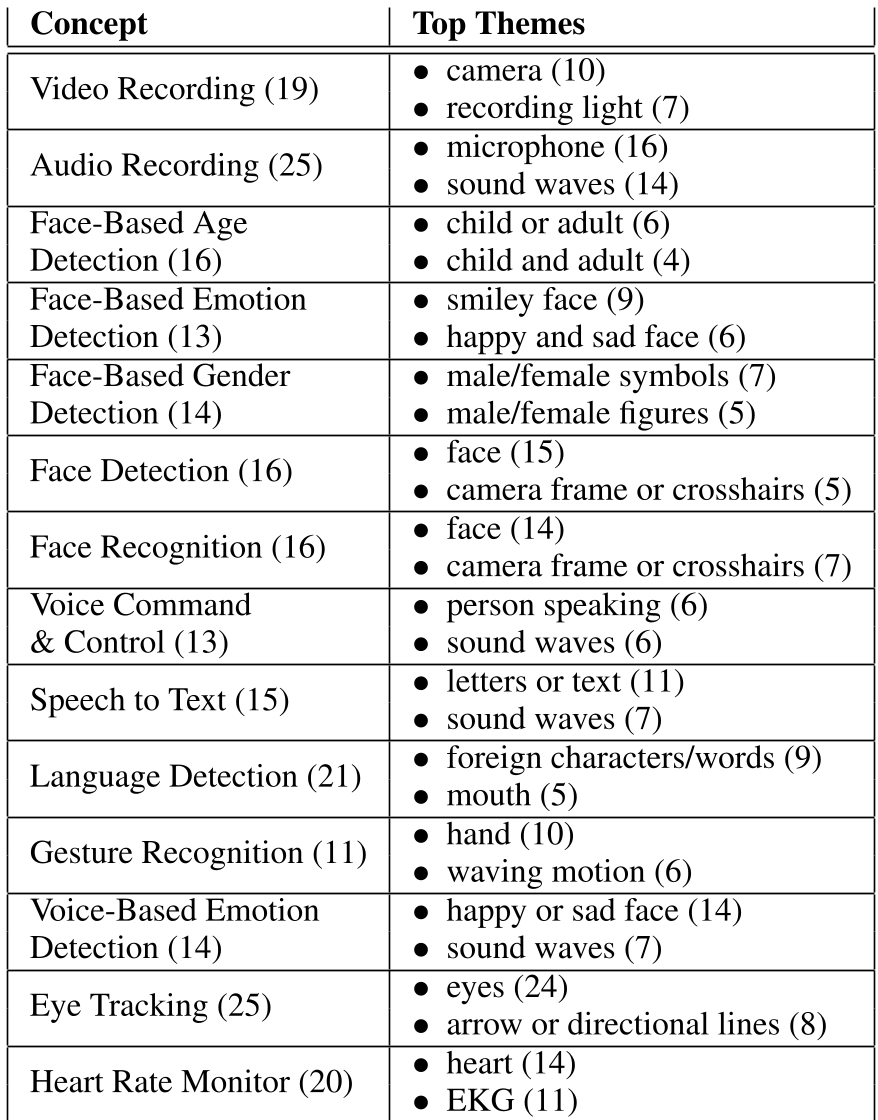 Figure 1: Top themes extracted from crowdsourced sketches, highlighting the mental models of non-experts.
Key Results: Crowd vs. Expert
The results were striking. The crowdsourced icons were never worse than the expert icons and were significantly better in several categories.
- Age Detection: Jumped from a dismal 27.1% comprehension (expert) to 86.3% (crowd).
- Language Detection: Improved from 67.6% to 90.5%.
- Heart Rate: Reached near-perfect 98.8% comprehension.
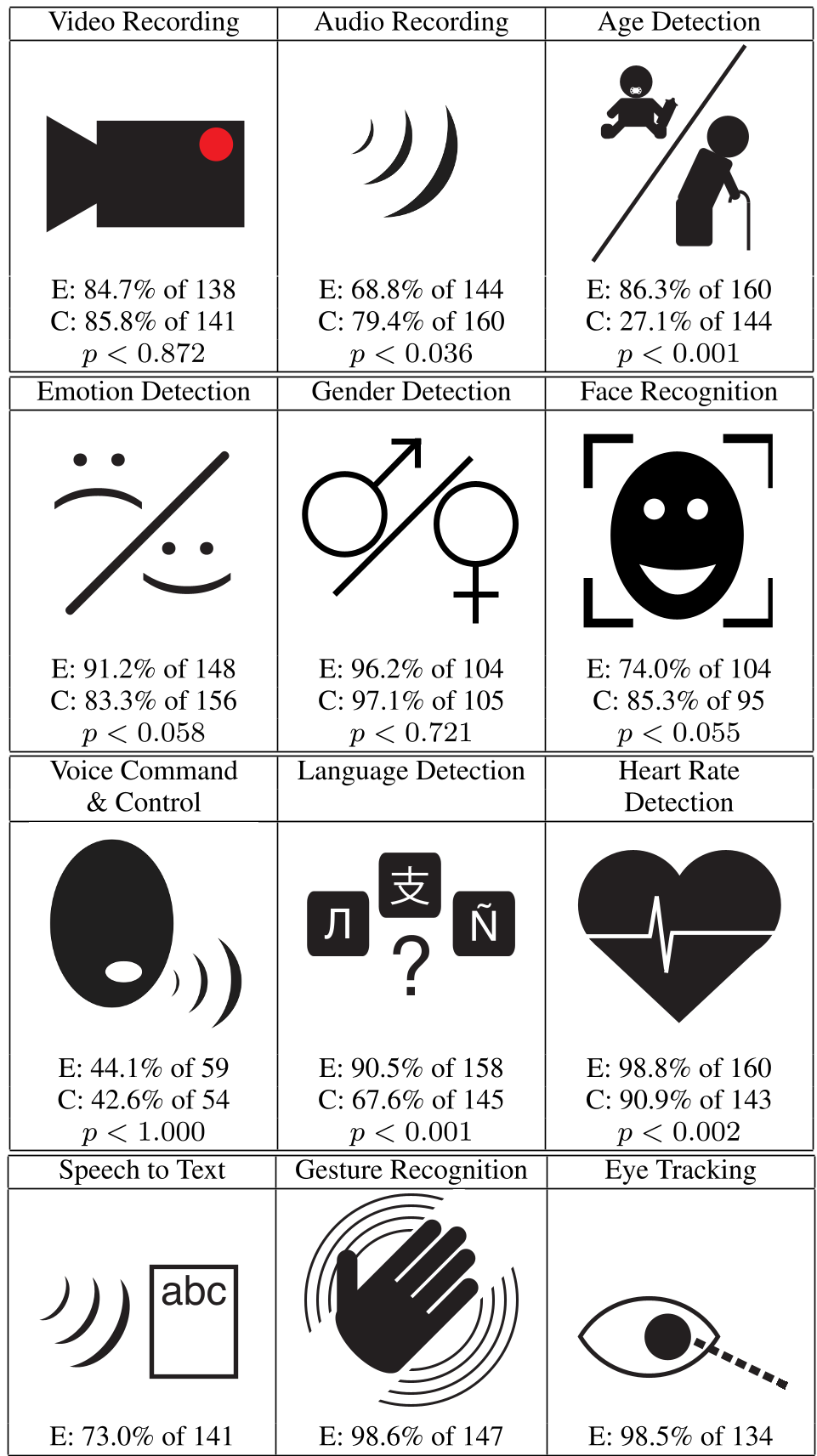 Table 1: Comprehension rates comparing Experimental (Crowd) vs. Control (Expert) icons.
The "Face" Problem
One of the most profound findings was the confusion between Face Detection (is a human there?) and Face Recognition (who is this specific human?). Even with optimized icons, users struggled to distinguish the two. The authors ultimately suggested removing indicators for low-risk concepts (like simple presence detection) to avoid "notification fatigue."
Deep Insights & Takeaway
The paper concludes with two major shifts in how we should think about UI for privacy:
- Abstraction over Implementation: Users care about what information is being extracted (the fact that the app knows their gender), not how (whether it used a 3D camera or an infrared sensor). Adding "how" information actually decreased comprehension.
- The Power of Concrete Metaphors: Professional icons often drift toward abstraction (minimalist lines), while users crave concrete visuals (happy/sad faces for emotion).
Future Work: While these icons work well in the U.S., the next frontier is Global Standardization. Privacy is a universal right, but visual metaphors are often culturally specific.
Professional Summary
This research is a masterclass in applying "User-Centered Design" to the "Principle of Least Privilege." It proves that for emerging technologies, our best designers might actually be the users themselves. By using crowdsourced mental models, we can create a safer, more transparent ubiquitous computing environment.