
Leveraging the Crowd: Beyond the Hype of Open Innovation
Leveraging the crowd as a source of innovation: does crowdsourcing represent a new model for product and service innovation?
This paper explores how established organizations strategically leverage "the crowd" for innovation via a grounded theory approach. It identifies four primary functional uses—Productivity, Innovation, Knowledge Capture, and Marketing/Branding—and proposes a preliminary framework to match task types with specific crowd characteristics.
TL;DR
Crowdsourcing is often treated as a "black box" of creativity, but Lee B. Erickson’s research provides a much-needed structural taxonomy. By analyzing established for-profit organizations, this work breaks crowdsourcing down into four strategic pillars—Productivity, Innovation, Knowledge Capture, and Marketing—and reveals that the crowd's most untapped value might lie in filtering ideas rather than just generating them.
Background: The Innovation Crisis
In the modern global economy, mass-produced goods are no longer enough to sustain growth. Companies face an "innovation gap"—a disconnect between market demand for constant novelty and the limited capacity of internal teams. Crowdsourcing has emerged as the go-to solution, yet many firms struggle with "how" and "why" to use it effectively. This paper moves beyond anecdotes to build a grounded theory of organizational crowdsourcing.
Problem: The Strategic Vacuum
Prior work on crowdsourcing was often descriptive or focused on "born-digital" companies (like Wikipedia or Threadless). Established legacy organizations face different hurdles: internal resistance, IP leakage risks, and difficulty in quantifying value. Without a framework to match Task Type to Crowd Knowledge, organizations often end up with high costs and low-quality output.
Methodology: Grounding the Theory
The author employed a Glaserian Grounded Theory approach, which is ideal for emerging phenomena where existing theory is thin.
- Data Sources: A triad of literature reviews, 18 pilot interviews with CEOs/Consultants, and 28 case study interviews across 6 diverse companies.
- The Goal: To uncover the patterns of how organizations actually integrate "outsiders" into their sacred internal R&D rituals.
The Categorization Framework
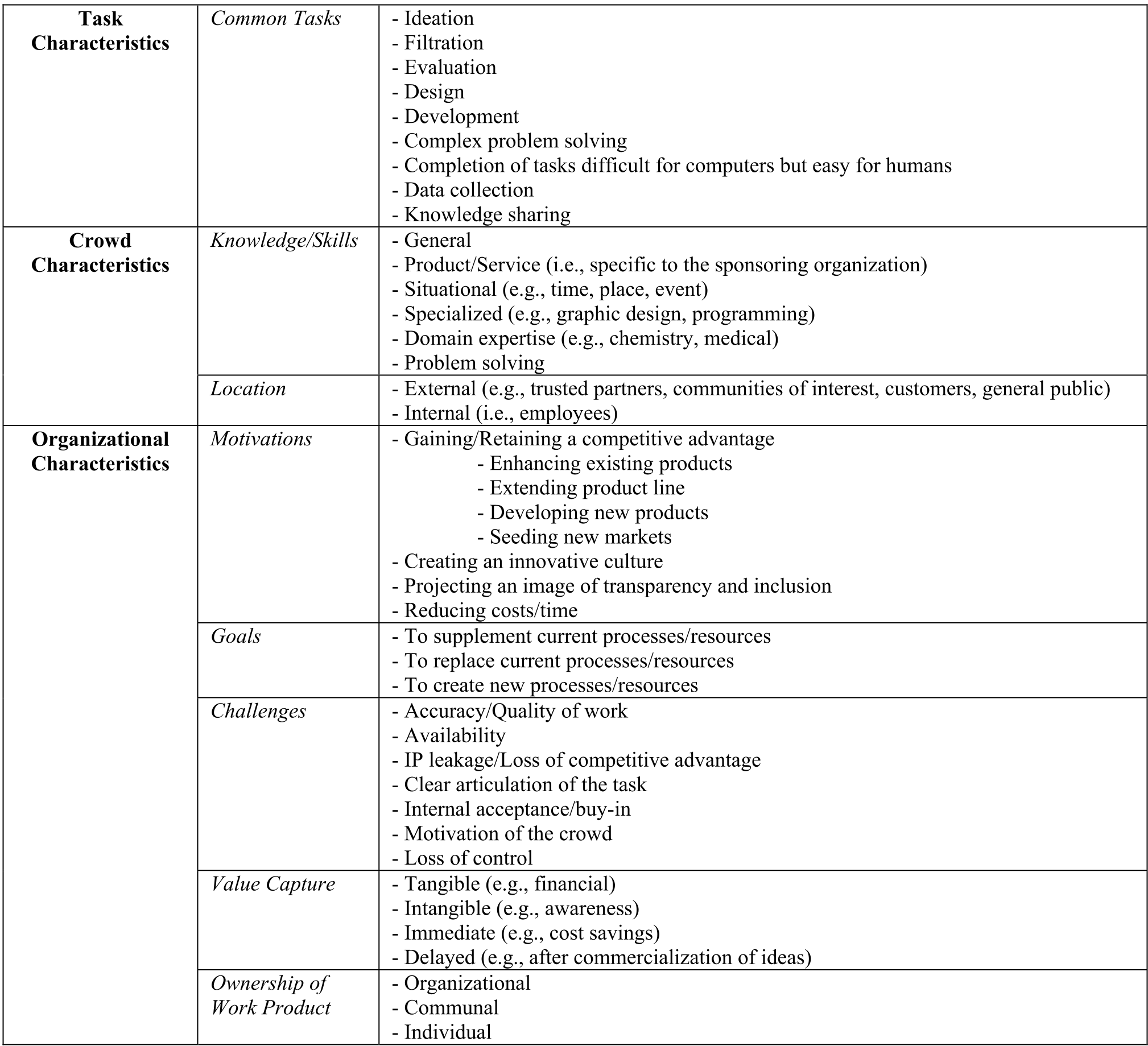
The paper collapses complex organizational behaviors into three digestible categories:
- Task Characteristics: From simple tagging to complex R&D problem solving.
- Crowd Characteristics: Distinguishing between general, situational, and domain-specific knowledge.
- Organizational Characteristics: Analyzing the tension between tangible (financial) and intangible (brand) value capture.
Core Insight: The Four Models of Use
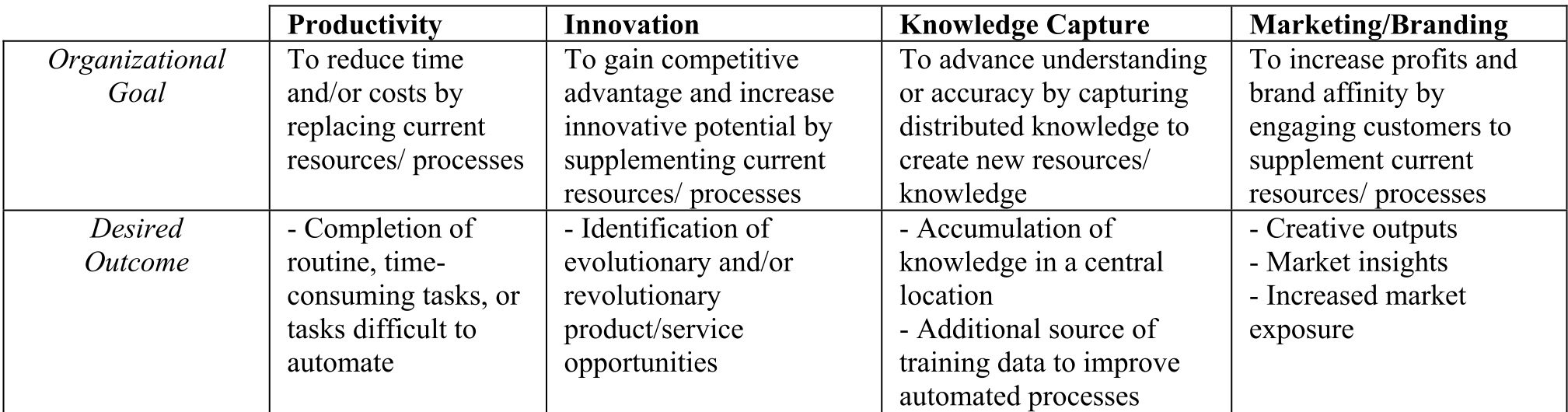
The research synthesizes these characteristics into a preliminary framework that defines why and how a company should engage the crowd:
- Productivity: Replacing internal resources to reduce time/cost (e.g., data tagging).
- Innovation: Supplementing internal teams to gain a competitive edge (e.g., seeking breakthrough ideas).
- Knowledge Capture: Accumulating distributed knowledge in a central location (e.g., customer service wikis).
- Marketing/Branding: Increasing brand affinity through participation (e.g., custom flavor contests).
Critical Analysis: The Crowd as a Filter
One of the most profound insights in Erickson’s work is the role of Filtration. While traditional models assume the crowd provides the raw material (ideation), many successful organizations use the crowd to rank and evaluate those ideas.
This suggests a fundamental shift in the Stage-Gate model of innovation. Instead of managers acting as the sole gatekeepers, the crowd provides a "social filtration" layer that can more accurately predict market success. However, the author warns that value extraction in innovation is often delayed; companies looking for immediate ROI from a single "brilliant idea" may be disappointed.
Conclusion & Takeaways
Crowdsourcing is not a monolithic tool; it is a spectrum of strategies.
- Align the Crowd to the Knowledge: Don't ask the general public for pharmaceutical chemistry solutions; use them for situational insights or brand affinity.
- Prepare for Challenges: Quality control and internal buy-in remain the biggest barriers to successful implementation.
- Future Impact: This framework serves as a roadmap for practitioners to "right-size" their crowdsourcing initiatives, ensuring that the crowd is an asset rather than a management burden.
Limitations
As a "research in progress" (at the time of publication), the framework is preliminary. It focuses on large, established firms, meaning the conclusions might not apply to agile startups or non-profits.