
Deciphering Social Standing: Turning Forum Posts into Socioeconomic Proxies
Using Crowdsourcing to Identify a Proxy of Socio-economic Status
The paper explores using crowdsourced social media data as a proxy for Socioeconomic Status (SES) by analyzing the readability of user-generated content. By applying the Flesch-Kincaid Grade Level test to vehicle discussion forums segmented by geography, it establishes a linguistic corpus for predicting regional educational attainment.
TL;DR
Can your choice of words in a car forum reveal your education level and economic status? This research suggests it can. By analyzing the readability of over 400 posts across North American vehicle forums, the authors demonstrate that the Flesch-Kincaid Grade Level acts as a powerful linguistic mirror for Socioeconomic Status (SES), providing a scalable, non-intrusive way for health and social scientists to map community demographics.
The Motivation: Why Readability Matters
Socioeconomic status (SES)—typically a blend of income, education, and occupation—is one of the most significant predictors of everything from obesity to brain function. However, collecting SES data is historically slow and expensive.
The researchers recognized an untapped gold mine: Social Media. Unlike surveys, forum posts represent "disinhibited" expression. The core insight here is that linguistic complexity—how many syllables we use and how long our sentences are—is a direct artifact of our educational background, which is a cornerstone of SES.
Methodology: From Web Scraping to Grade Levels
The study utilized a specialized pipeline to turn raw text into sociological data:
- Segmented Crowdsourcing: Instead of general Twitter data, they targeted vehicle forums already organized by geography (e.g., Northeast, South, Midwest).
- Linguistic Processing: Using Python's
BeautifulSoupfor scraping and thetextstatpackage, they calculated the Flesch-Kincaid Grade Level for each post. - The Formula: This formula outputs a number corresponding to U.S. school grades (e.g., a score of 8 means an 8th-grade reading level).
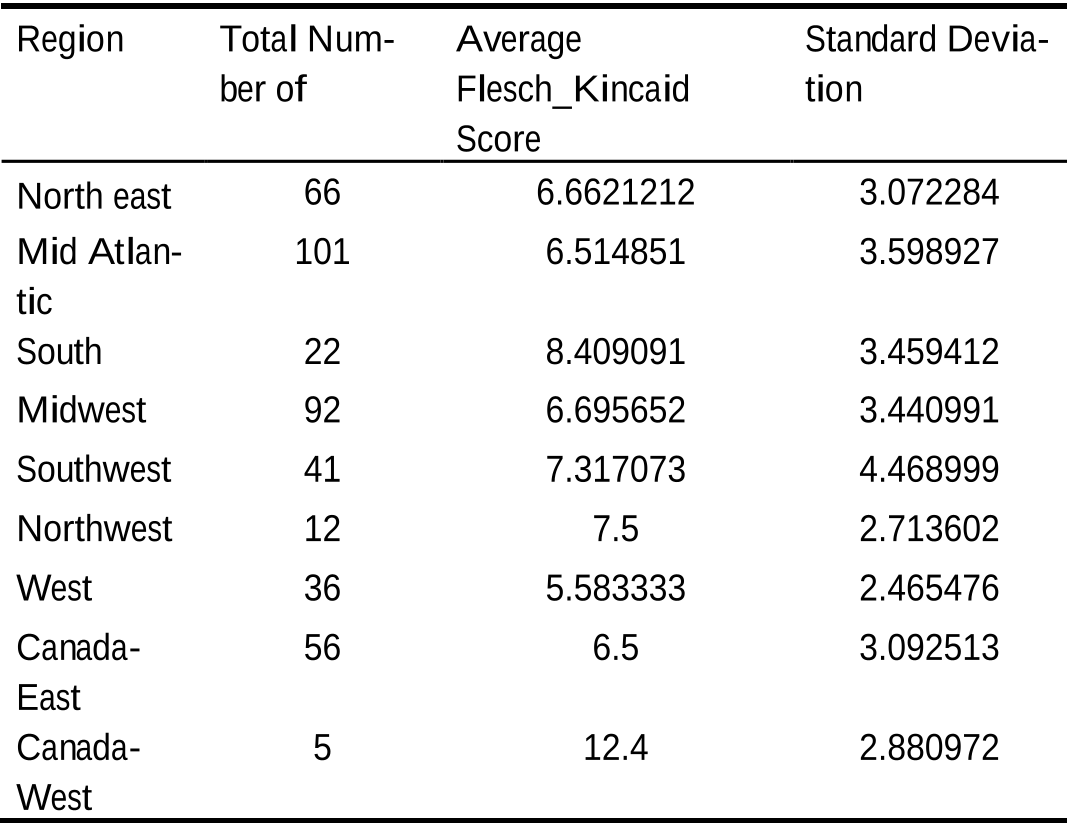 Table 1: Regional variance in Flesch-Kincaid scores across North America.
Key Findings: The Geography of Language
The results showed a fascinating disparity in how different regions communicate about the same vehicle:
- Complexity Leaders: The South (Avg: 8.4) and Northwest (Avg: 7.5) exhibited the highest grade levels.
- The Urban/Metro Ceiling: Regions like the Northeast and Mid-Atlantic hovered around 6.5.
- The "Internet Slang" Noise: 10-15% of posts yielded a score of 0, primarily due to the heavy use of emojis and acronyms like "lol," which the authors identified as "Out of Vocabulary" (OOV) challenges for future refinement.
The authors hypothesized that in high-wage metropolitan areas (Northeast/Midwest), the vehicle in question might be purchased by a wider demographic with varying education levels, whereas in other regions, the ownership could be more skewed toward those with specific educational backgrounds.
Critical Analysis & Conclusion
The value of this work lies in its scalability. By using open-source tools to analyze publicly available text, researchers can bypass the "survey fatigue" that plagues traditional sociology.
Limitations:
- Sample Size: Some regions (like Canada-West) had too few posts to be statistically significant.
- Linguistic Evolution: The Flesch-Kincaid test was designed for formal Navy manuals, not 21st-century digital shorthand. Emojis and hashtags currently break the model.
Future Outlook: The next frontier is integrating LLMs (Large Language Models) to understand the sentiment and context of these posts alongside their complexity. If we can refine how we handle emojis and OOV words, linguistic SES proxies could become a standard feature in "Smart City" dashboards, helping urban planners deploy resources where they are most needed based on the "digital pulse" of the community.
Takeaway: Your digital footprint is more than just data; it is a linguistic signature of your social and educational journey.