
CQA: Revolutionizing Mobile Cloud QoS through the Power of Crowdsourcing
Using Crowdsourcing to Provide QoS for Mobile Cloud Computing
This paper introduces the Crowdsourcing-based QoS Adaptor (CQA), a middleware framework designed to enhance Quality of Service (QoS) in Mobile Cloud Computing. By leveraging collective user data and context-awareness, CQA achieves superior service discovery and selection compared to traditional local sensing methods.
TL;DR
The efficiency of Mobile Cloud Computing (MCC) is often hampered by the limited ability of a single device to sense its environment and choose the best service provider. This paper introduces CQA, a crowdsourcing-based middleware that aggregates performance data from a "crowd" of users. By replacing active local sensing with historical data queries, CQA slashes service discovery time by nearly 50%, saves battery life, and ensures stable QoS even for fast-moving users.
The Bottleneck: The "Loneliness" of Traditional Sensing
In the current MCC landscape, Quality of Service (QoS) is the kingmaker. However, mobile environments are notoriously volatile. When a user moves from an office to a mall, their device must frantically re-test available cloud providers to find the lowest latency or highest bandwidth.
The Pain Points:
- Energy Drain: Constant environmental scanning kills the battery.
- Limited Knowledge: A single device only knows what it sees in its immediate vicinity.
- Decision Latency: By the time a device finishes testing all candidates ( complexity), the network context might have already changed.
The authors' key insight is simple yet profound: Why should every device reinvent the wheel? If another user was in this exact location ten minutes ago, their experience can guide your device's choice.
Methodology: CQA Architecture
The Crowdsourcing-based QoS Adaptor (CQA) acts as an intelligent intermediary. It doesn't just look at signal strength; it looks at four dimensions: Activity, Social, Service, and Device contexts.
1. The Core Components
- Context Inference & Collector: Gathers anonymous snippets of "User-Provider-Performance" triplets.
- Determiner: The "brain" of the system. It uses a similarity-based algorithm to match a user's current request against a massive database of historical records.
- QoS Ranking Engine: It doesn't just find a provider; it ranks them based on specific application needs (e.g., Bandwidth for video, Response Time for gaming).
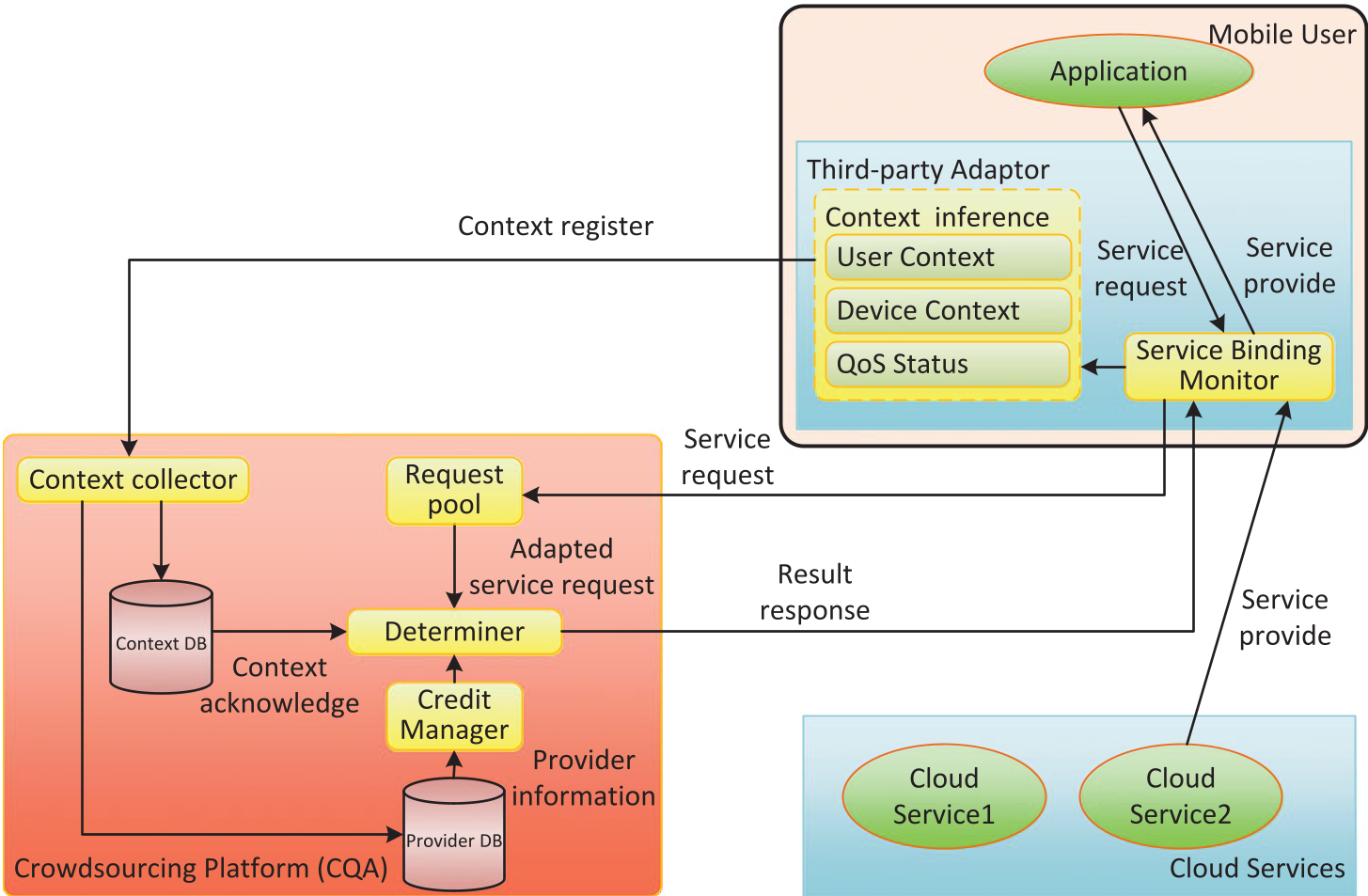 Figure: The high-level architecture of the CQA framework serving as a bridge between applications and cloud services.
2. From Sensing to Querying
Traditional discovery is an task (number of providers number of carriers). CQA transforms this into an query. When a user requests a service, the platform identifies the most similar context in its Context DB and immediately hands back the top-ranked provider.
Experimental Results: Strength in Numbers
The researchers utilized NS-3 to simulate a 500m x 500m area with 50 mobile users and various Access Points (APs).
Key Performance Wins:
- Discovery Time: As the platform "learns" from the crowd, the discovery time drops sharply. While traditional methods remain stuck at high latency, CQA reaches a stable, ultra-low response time.
- Scalability: Unlike local methods, CQA actually gets better as the number of users increases. More users mean a more complete and accurate "Context Alphabet."
- Network Overhead: CQA significantly reduces the amount of "junk" traffic in the network because it eliminates the need for every device to perform redundant benchmark tests.
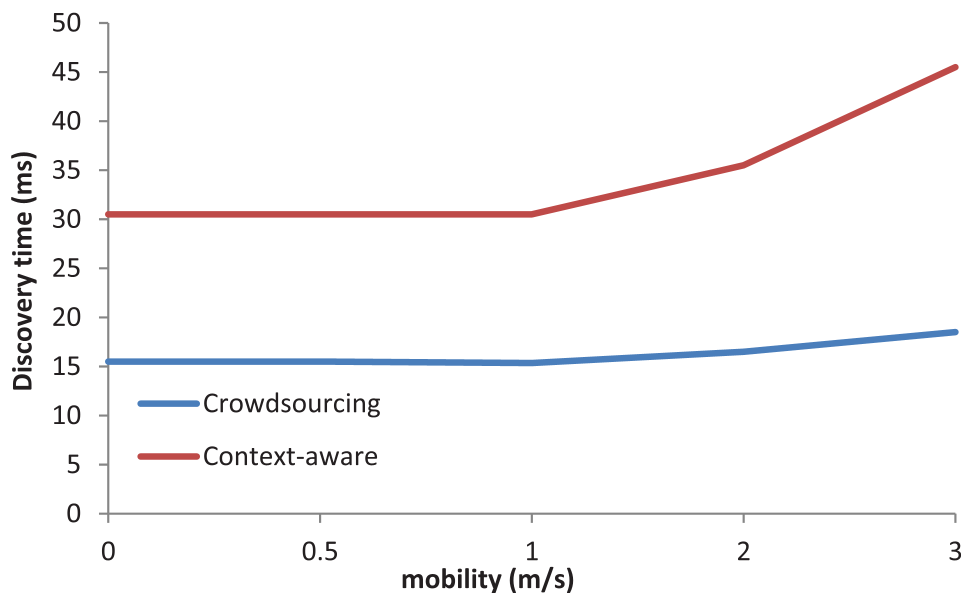 Figure: The dramatic reduction in service discovery time as the CQA platform accumulates context data.
Deep Insight: Why It Matters
The brilliance of this paper lies in its treatment of QoS as a socially shared resource. It acknowledges that while mobile hardware is getting faster, the physics of wireless transmission and the economics of cloud providers remain complex.
By using distributed wisdom, CQA provides a "Waze-like" experience for cloud services. Just as Waze tells you which road is congested based on other drivers, CQA tells your app which cloud provider is "congested" or underperforming in your current location.
Critical Analysis & Conclusion
Limitations: The paper assumes a level of honesty in the crowd. In real-world scenarios, malicious users could upload "fake" performance data to boost or tank certain providers. Future iterations would benefit from a Reputation or Credit Management system beyond just uptime.
Takeaway: CQA proves that crowdsourcing is not just for labeling images or translating text—it is a viable infrastructure-level strategy for optimizing the guts of our mobile internet. For developers building delay-sensitive apps (like AR/VR or cloud gaming), this framework represents a significant leap toward "invisible" and seamless connectivity.
Senior Editor's Note: This work successfully bridges the gap between context-awareness and crowdsourcing. It moves the needle from "Self-Aware" devices to "Crowd-Aware" ecosystems.