
Virtual Labs: Scaling eLearning Maintenance via Targeted Crowdsourcing
13794_A Crowdsourcing Approach for Quality Enhancement of eLearning Systems.
This paper presents a targeted crowdsourcing framework for the quality enhancement and maintenance of "Virtual Labs," a massive Indian eLearning initiative. By leveraging engineering students as both stakeholders and contributors, the approach systematically identifies and fixes software issues (broken links, compatibility, UI/UX) across 14 pilot labs using GitHub-based integration.
TL;DR
Maintaining 200+ virtual engineering labs for millions of users is a logistical nightmare. This paper introduces a targeted crowdsourcing approach that turns engineering students into "crowd-workers." By formalizing a GitHub-based workflow and a Lab Maturity Model, the authors successfully fixed nearly a thousand system issues, proving that stakeholder-driven maintenance is both viable and cost-effective.
Background: The "Virtual Labs" Challenge
Virtual Labs is a premier Government of India initiative providing remote-triggered and simulated experiments to engineering undergraduates. While Phase I (2009-2015) successfully built over 200 labs, the project hit a "maintenance wall." Original developers (students) graduated, and the software—built on technologies like Adobe Flash and Java3D—began to suffer from "digital decay" (deprecation and browser incompatibility).
The Core Insight: Stakeholders as Solvers
The authors' central premise is simple: The primary users (engineering students) are also the most capable of fixing the problems.
Traditional crowdsourcing often suffers from low quality due to a lack of domain knowledge. By targeting engineering students who need these labs for their curriculum, the authors identified an "intrinsic motivation" loop. However, to translate this into high-quality code, they needed more than just volunteers; they needed a process.
Methodology: The Engineering Rigor behind the Crowd
The paper doesn't just "open the gates"; it applies rigorous software engineering principles to the crowd.
1. The Lab Maturity Model
Not every lab was ready for crowdsourcing. The authors categorized labs from Level 0 (Unversioned) to Level 5 (Full Life Cycle Management). This allowed them to prioritize labs that already had automated build processes (Level 3) for the crowd.
2. Formalized Issue Severity
The QA team didn't just report "bugs." They categorized 1,831 issues into:
- S1 (Critical): Total functionality loss.
- S2 (Major): Broken links, inconsistent field views.
- S3 (Minor): Visual imperfections, spelling, and CSS alignment.
3. The Deployment Workflow
The architecture of the contribution is tightly controlled to prevent "crowd chaos":
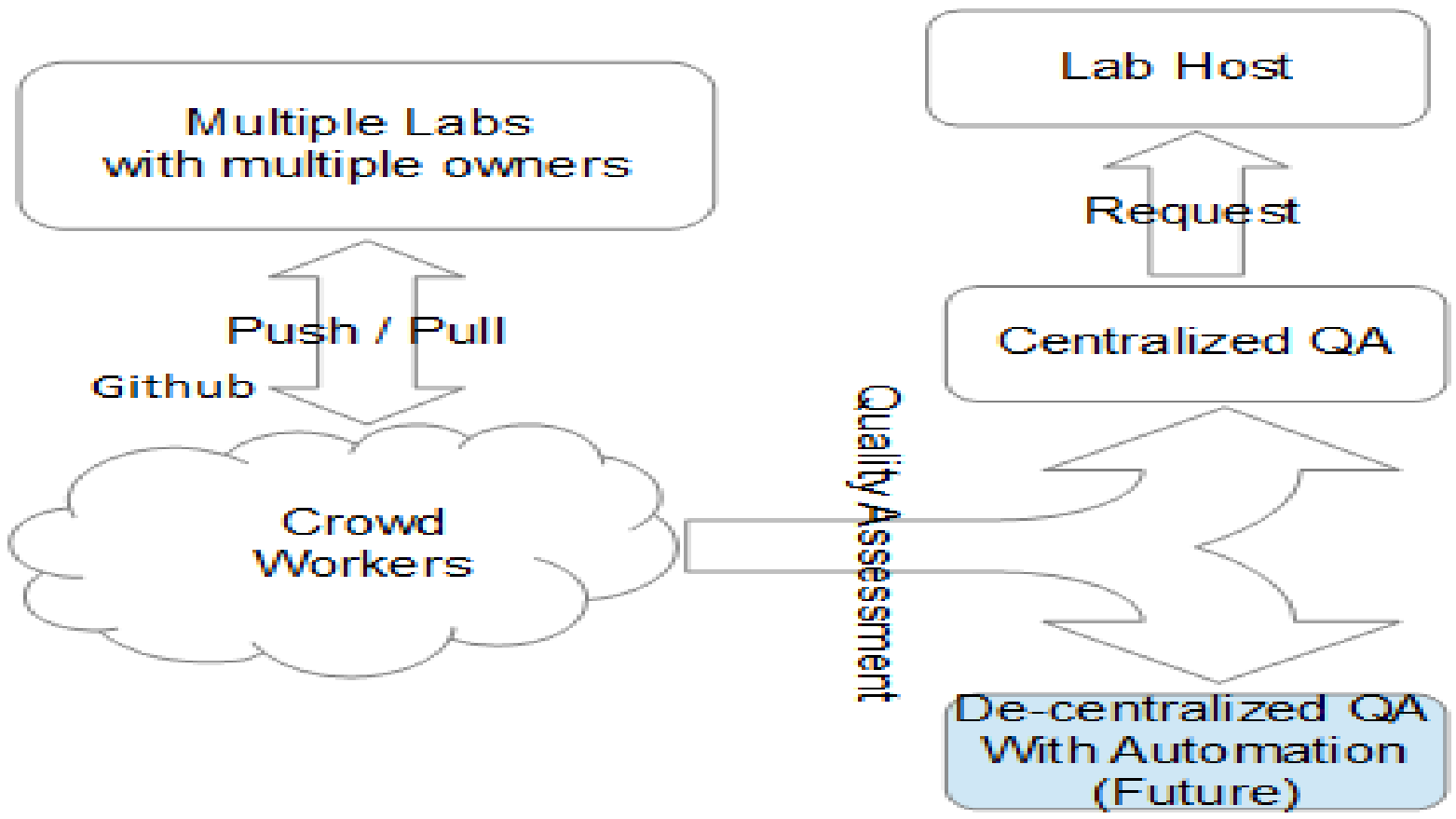
- Step-by-step: Issues are identified Crowd forks repo Pull request Release Engineer (RE) deploys to Test Pro QA validates Final Hosting.
Results & Validation
The pilot program focused on 14 labs. Over three months, 44 forks were committed. The results indicated that:
- Complexity vs. Effort: Tasks requiring less than one person-day (S3 and some S2 issues) are the "sweet spot" for crowdsourcing.
- Iterative Quality: Some fixes required multiple iterations (e.g., handling double-click bugs), but the presence of a professional "Centralized QA" team ensured no regressions reached production.

Critical Analysis & Professional Insight
From a Software Engineering perspective, this paper is significant because it bridges the gap between Open Source communities and Government-funded content.
The Genius of the Approach: Instead of paying for a massive QA department, they used a "hybrid" model.
- Professionals handle Structure and Validation (Issue logging, final testing).
- The Crowd handles Execution (The "grunt work" of fixing 900+ UI bugs).
Current Limitations: The paper notes that they did not establish a "tipping point"—at what level of algorithmic complexity does a student crowd-worker fail compared to a professional? Additionally, the reliance on extrinsic motivation (certificates) might see diminishing returns over time.
Future Outlook
The authors suggest two major evolutions:
- Migration to Open edX: Integrating issue reporting directly into the learning platform.
- Automated Testing: Using scripts to catch broken links and spelling errors before a human even sees the pull request.
Conclusion
This work demonstrates that for large-scale public initiatives, crowdsourcing isn't just a cost-saving measure—it's a sustainable ecosystem. It transforms passive users into active contributors, ensuring that digital educational resources remain alive and compatible in an ever-changing tech landscape.