
Crowdsourcing the Surgeon's Eye: High-Quality Endoscopic Annotations via the Masses
Crowdsourcing for Reference Correspondence Generation in Endoscopic Images
This paper introduces the first investigation into using Crowdsourcing (via Amazon Mechanical Turk) for generating reference correspondences in endoscopic images for Minimally-Invasive Surgery (MIS). By utilizing Gaussian finite mixture model clustering on multiple non-expert annotations, the authors achieve a median error of approximately 1 px, rivaling the performance of medical experts.
TL;DR
Establishing image correspondences in endoscopic video is critical for surgical AR and 3D reconstruction, but relying on surgeons for labeling is a scaling nightmare. This study proves that "knowledge workers" from the crowd can achieve expert-level precision (1 px error) by aggregating redundant non-expert annotations through intelligent clustering, potentially unlocking massive datasets for surgical AI.
The Bottleneck: Expert Scarcity in MIS
In the world of Minimally-Invasive Surgery (MIS), algorithms for shape recovery and camera motion estimation live or die by the quality of their "ground truth" correspondences. Traditionally, these points are hand-labeled by medical experts.
The problem? Experts are expensive, their time is strictly limited, and the resulting datasets are often too small to capture the sheer variance of human anatomy. The authors ask a radical question: Can an anonymous, untrained online crowd do a surgeon's "homework" just as well?
Methodology: From Chaos to Precision
The researchers used Amazon Mechanical Turk (MTurk) to distribute Human Intelligence Tasks (HITs). Ten workers were asked to identify the same correspondence points across 100 image pairs.
1. The Raw Crowd Performance
Initially, the crowd is noisy. Individual workers (KWs) produced a wide range of errors, with a median of 2.0 px. However, the study found that the main source of variance was the user, not the image or the specific anatomical feature, suggesting that the "wisdom of the crowd" could be filtered.
2. Gaussian Mixture Model (GMM) Clustering
To turn noise into signal, the authors didn't just take a simple average. They treated the annotations as a "mixture" of valid points and outliers.
- EM Algorithm: They fitted Gaussian finite mixture models to the 10 annotations per point.
- Clustering: By selecting the mean of the largest cluster (the consensus), they effectively ignored the "lazy" or "confused" workers.
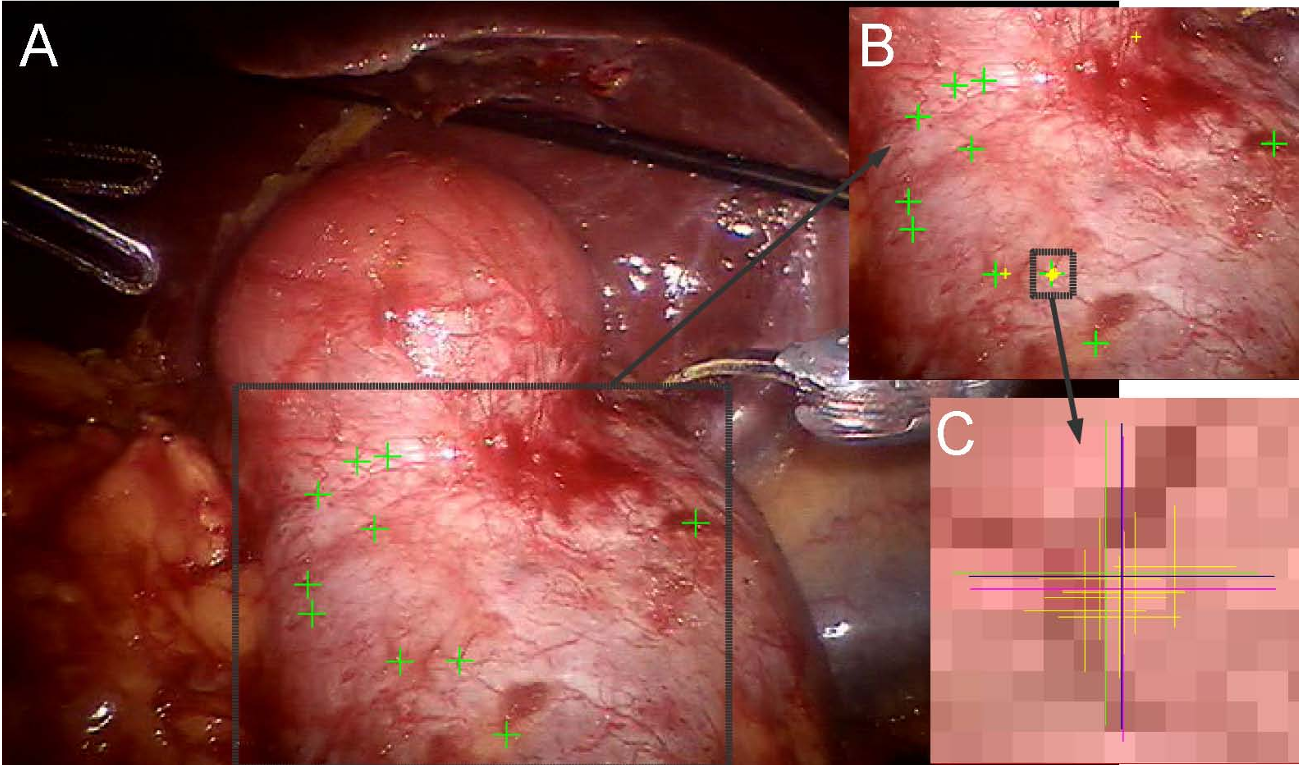 Figure 1: (A) Full endoscopic view. (B/C) Zoomed-in views showing the ground truth (green), raw crowd noise (yellow), and the clustered result (pink).
Results: Crowd vs. Expert
The results were striking. When redundant annotations were processed through the cluster analysis, the error dropped to 1.1 px.
| Metric | Raw Crowd | Clustered Crowd | Medical Experts |
|---|---|---|---|
| Median Error (px) | 2.0 | 1.1 | 1.4 |
| Max Error (px) | 430.8 | 125.0 | 94.1 |
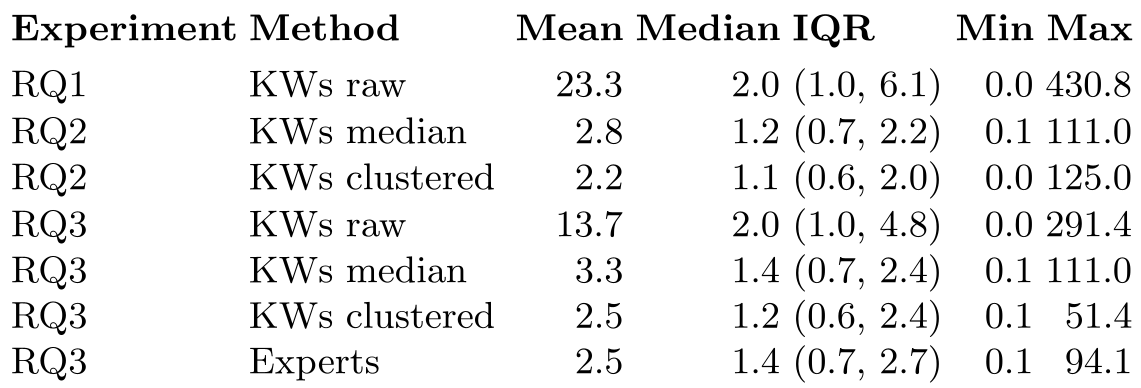
Shockingly, the clustered crowd was more accurate than 4 out of 5 medical experts. While experts had lower variance (fewer wild outliers), the aggregated crowd consensus was closer to the reference "golden" standard. Furthermore, the crowd generated 10,000 labels in less than 24 hours—a feat impossible for a small team of busy surgeons.
Critical Insight: Why Does This Work?
The success of this method hinges on Inductive Bias in human vision. Finding a "similar-looking spot" between two images is a general cognitive task that doesn't require a medical degree. By leveraging redundancy (n=10 per point) and robust statistical filtering (GMM), the idiosyncratic errors of individuals are cancelled out, leaving behind a highly accurate consensus.
Limitations & Future Outlook
While excellent for point-correspondence, the authors note that:
- Verification is needed: A verification task where workers rate existing points could further refine quality.
- Task Limits: While non-experts excel at visual similarity, they might still struggle with tasks requiring high-level diagnostic judgment (e.g., classifying a specific tumor type).
- Future Potential: This approach has already shown promise in segmenting surgical instruments, paving the way for "foundation datasets" in surgical robotics without the "expert tax."
Takeaway
This paper is a blueprint for scaling medical AI. It proves that with the right statistical "cleanup" tools, we can stop treating experts as data entry clerks and start using the global crowd to build the next generation of computer-assisted surgery.