
Crowdsourcing in Your Pocket: Transforming Smartphones into Distributed Problem Solvers
14818_Crowdsourcing with Smartphones.
The paper "Crowdsourcing with Smartphones" explores the shift from Web-based to mobile crowdsourcing, introducing a comprehensive taxonomy of the field. It presents three novel applications (SmartTrace+, Crowdcast, and SmartP2P) and the SmartLab testbed, a 40-device Android cloud for large-scale research into location-based services and similarity search.
TL;DR
Crowdsourcing is moving from the desktop to the pocket. This paper defines the landscape of Mobile Crowdsourcing, introducing a taxonomy that distinguishes between active participation and background "opportunistic" sensing. By leveraging the SmartLab testbed, the authors demonstrate three breakthrough applications that solve complex location-based problems while achieving up to 100x efficiency gains in energy and 10x gains in speed over traditional methods.
Problem & Motivation: Beyond the Desktop
Traditional crowdsourcing (like Wikipedia or Amazon Mechanical Turk) relies on users sitting at desks, making conscious efforts to contribute. However, smartphones offer something far more potent: uibiquitous sensing.
The challenge? Mobile devices are constrained by:
- Energy Scarcity: GPS and 3G/4G radios are power-hungry (see Table 2).
- Privacy Fears: Users are hesitant to share their real-time location and trajectory history.
- Scale and Testing: It is practically impossible for researchers to test massive-scale mobile apps without a dedicated infrastructure.
Methodology: The Hybrid Intelligence
The authors categorize the field into Web-extended (standard tasks on mobile) and New Applications (tasks only possible due to mobile sensors). The core innovation lies in their hybrid architecture and three specific implementations:
1. SmartTrace+: Privacy-Aware Trajectory Search
Instead of sending raw GPS data to a server, SmartTrace+ computes matching scores locally. It enables "trajectory similarity" queries (e.g., "how many people took this bus route?") without compromising individual privacy.
2. Crowdcast: Near-Real-Time Neighborhood Sensing
This framework solves the Continuous All k-Nearest Neighbor (CAkNN) problem. It uses a stateless, parameter-free technique to tell users who their nearest neighbors are in real-time, facilitating local micro-blogging or emergency SOS beacons.
3. SmartP2P: Energy-Optimized Social Search
SmartP2P treats the mobile crowd as a social peer-to-peer network. When searching for information (e.g., "is there a pharmacy nearby?"), it uses Multi-Objective Pareto Optimization to select a routing tree that minimizes energy and time while maximizing the recall rate of search results.
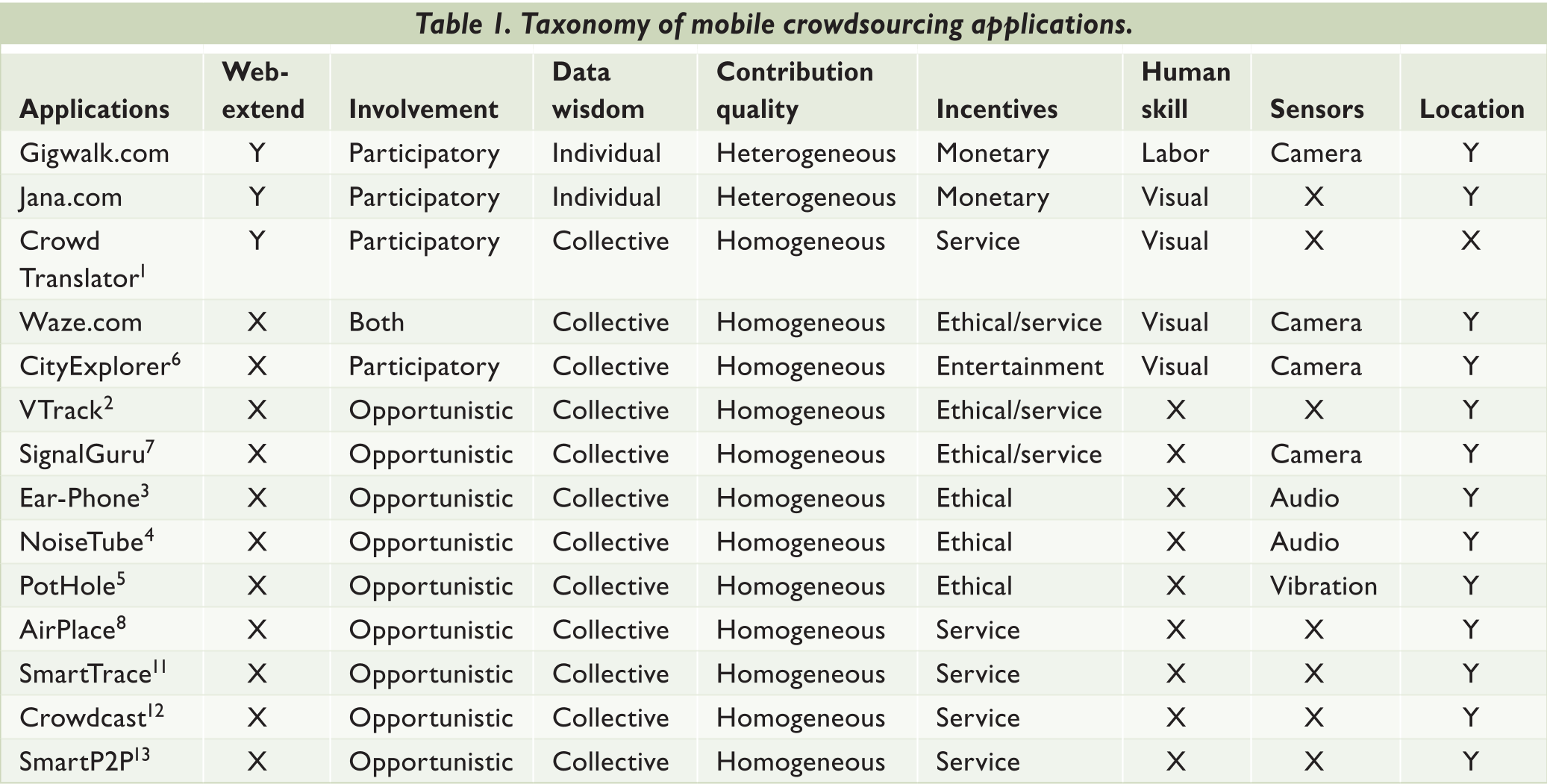 Table 1: The proposed taxonomy classifying mobile applications by involvement, sensing, and incentives.
The "Laboratory in the Cloud": SmartLab
To validate these theories, the authors built SmartLab. Located at the University of Cyprus, it consists of over 40 real Android devices and emulated nodes. Researchers can remotely upload APKs, run scripts via a Web-based interface, and capture energy consumption data in real-time. This bridges the gap between small-scale lab tests and uncontrollable "in-the-wild" deployments.
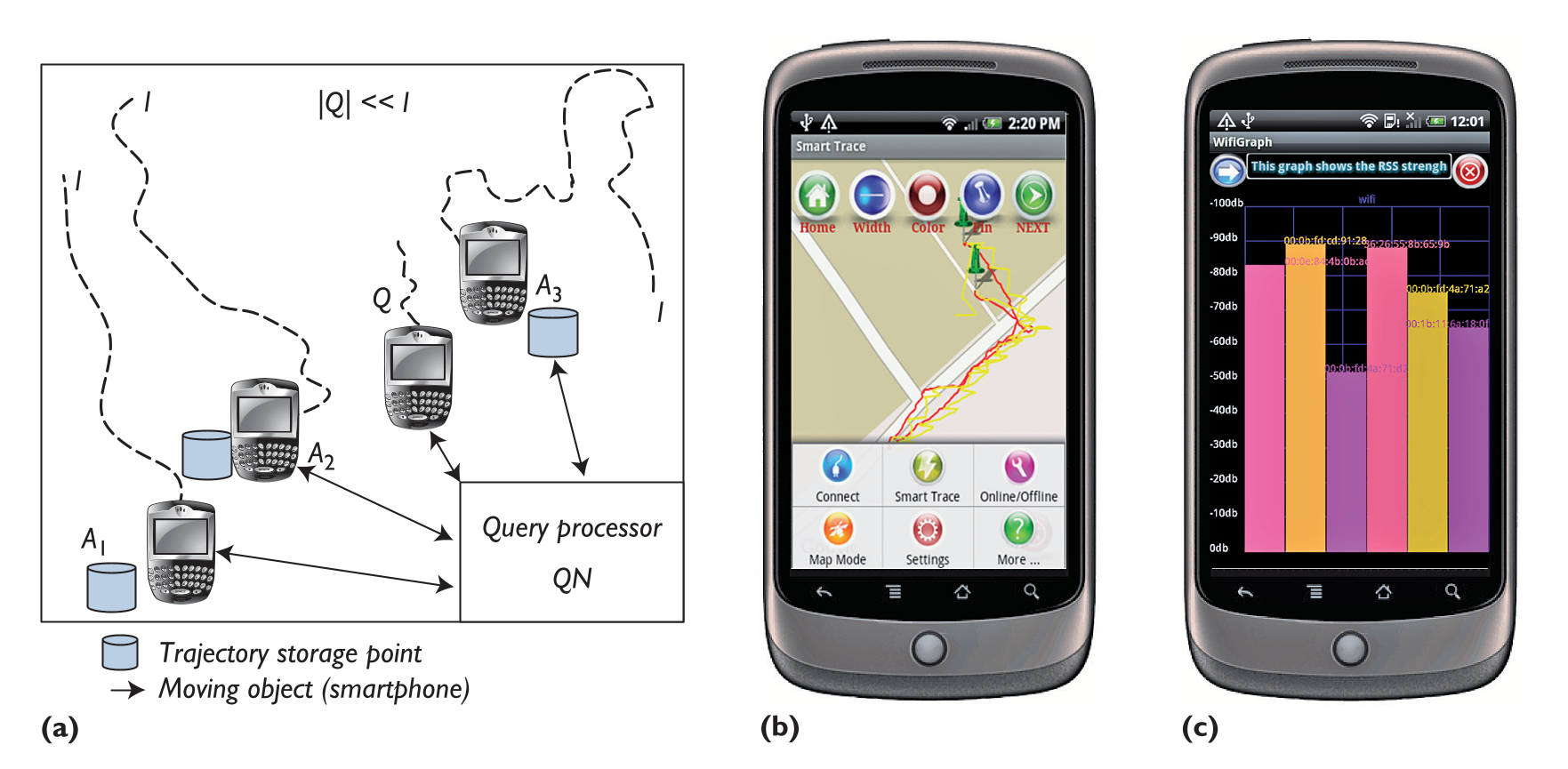 Figure 1: SmartTrace+ architecture and its implementation on both outdoor (GPS) and indoor (Wi-Fi) environments.
Experiments & Results: Massive Efficiency
The results from the SmartP2P and Crowdcast deployments on SmartLab are striking:
- Recall Rate: Successfully retrieved 95% of relevant data across the peer network.
- Energy Efficiency: SmartP2P consumed two orders of magnitude less energy (100x reduction) than competitive centralized baselines.
- Latency: Query response times were reduced by 10x.
The authors also provided a granular power profile for smartphones (Table 2), showing that while GPS uses ~275mW, 3G data transfers can spike to 900mW, justifying the need for the sparse, local-first communication strategies used in their apps.
Critical Insight & Conclusion
The paper argues that the "killer app" for mobile crowdsourcing isn't just one service, but the transparency of the contribution. By moving from Participatory (forcing the user to do something) to Opportunistic (sensors working in the background), we can build noise maps, pothole detectors, and traffic signal advisors seamlessly.
Future Work: The authors predict a shift toward "Expertise-based task assignment," where tasks are pushed specifically to users whose sensor data or interests match the problem, further optimizing the global quality of the "Crowd-generated data."