
Scaling Security with the Crowd: A Deep Dive into Vulnerability Discovery Models
Crowdsourcing Software Vulnerability Discovery: Models, Dimensions, and Directions
This paper provides a comprehensive taxonomy of crowdsourced software vulnerability discovery (Bug Bounty programs). It classifies existing practices into three distinct models—Direct, Platform-managed, and Contest—and identifies eight critical dimensions to analyze the efficacy and risks of these security initiatives.
TL;DR
As software complexity outpaces internal security teams, "crowdsourced vulnerability discovery"—commonly known as bug bounties—has shifted from a niche hackathon activity to a mission-critical security strategy. This paper deconstructs how organizations can effectively harness the "wisdom of the crowd" while navigating the treacherous waters of IP protection and legal risks.
Perspective: Why Manual Audits are Failing
The "security gap" is widening. Modern systems aren't just siloed codebases; they are mosaics of third-party APIs, cloud services, and legacy libraries. The paper identifies a fundamental asymmetry: attackers only need to find one hole, while defenders must plug them all. By shifting from a fixed team of experts to a fluid, global crowd of Security Professionals (SecPros), organizations can achieve a higher volume of output and expertise diversity that internal IT departments simply cannot match.
The Three Pillars of Crowdsourced Security
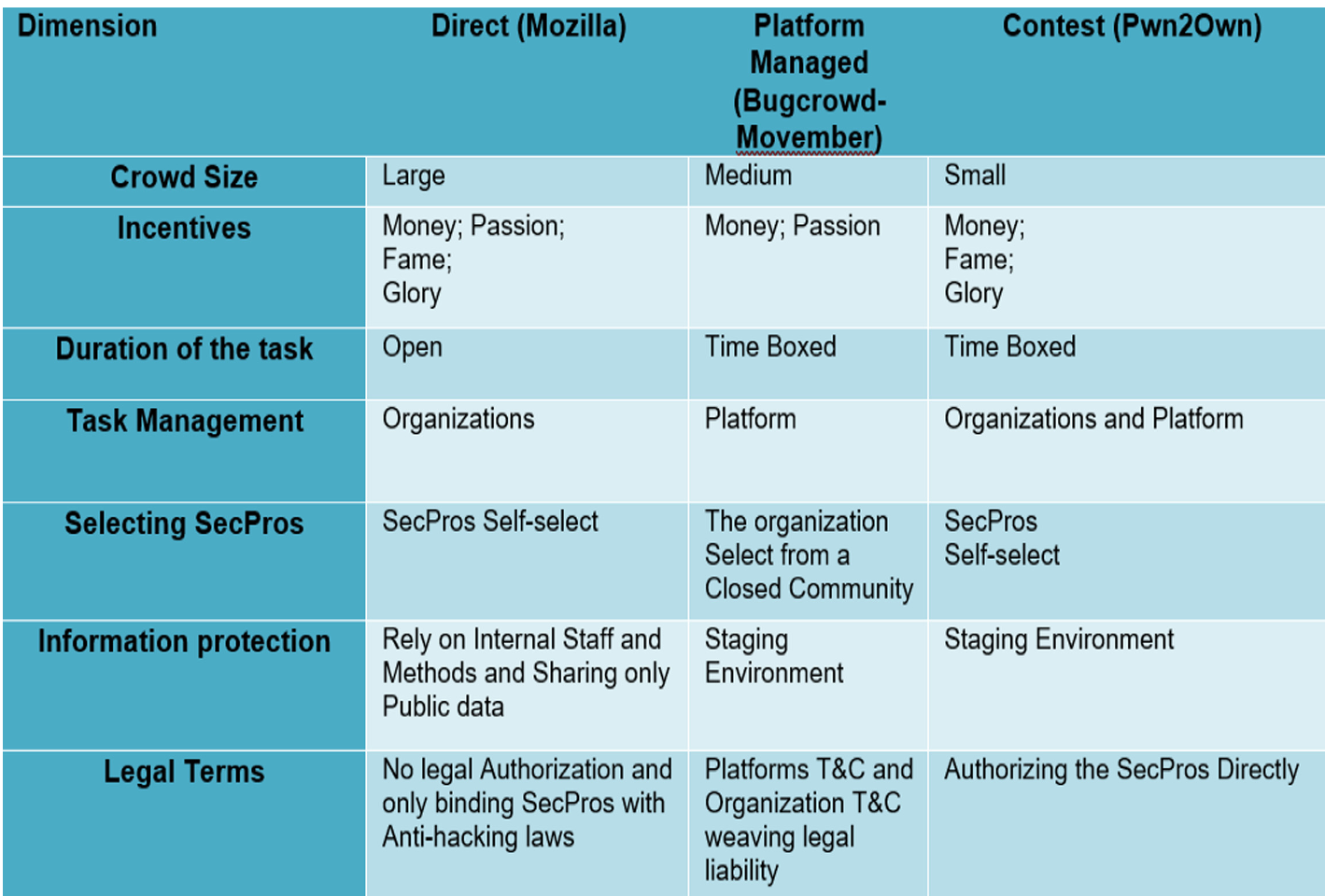
The authors categorize the landscape into three primary operational models, each with distinct trade-offs:
- Direct Vulnerability Discovery: The organization (e.g., Mozilla, Facebook) hosts the program themselves. It offers maximum control but requires immense internal resources to triage reports.
- Platform-Managed (The Rise of the Middleman): Platforms like Bugcrowd and HackerOne act as aggregators. They provide the "Trust Layer"—vetting researchers, managing payments, and providing staging environments.
- Cyber Security Contests: High-intensity, time-boxed events (e.g., Pwn2Own). These are excellent for branding and intense discovery but can lead to "bug hoarding" where researchers wait for the event to disclose critical flaws.
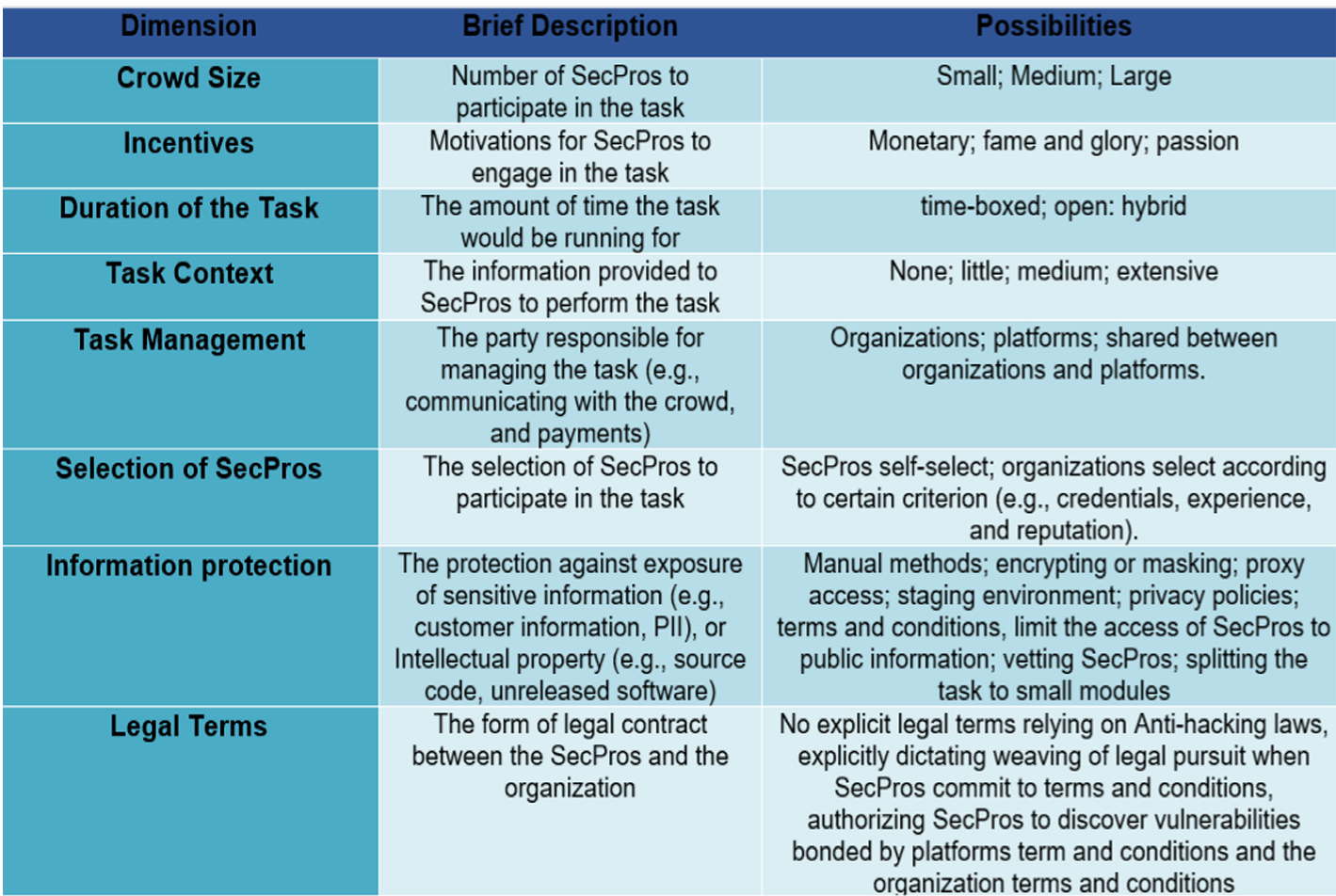
Cracking the Code: The 8 Dimensions of Success
The core contribution of this paper is its 8-dimensional framework. Two dimensions stand out as particularly critical for modern CISOs:
1. Information Protection vs. Context
This is the "Security Researcher's Paradox." To find deep logic flaws, SecPros need context (source code, documentation). However, sharing this increases the risk of Intellectual Property (IP) theft. The paper suggests Task Decomposition—breaking a system into micro-modules so no single researcher sees the "big picture," effectively mitigating the impact of a potential leak.
2. Legal Terms & The Anti-Hacking Wall
Without clear legal "Safe Harbor" statements, researchers risk prosecution under anti-hacking laws. The paper highlights that mature models now explicitly waive legal pursuit if researchers adhere to disclosed terms, turning potential adversaries into authorized allies.
Critical Insight: The "Quality" Bottleneck
A recurring theme in the paper is the burden of Noise. A large crowd generates a large number of reports, many of which are duplicates or out-of-scope. The authors propose a future where NLP and Machine Learning pre-screen reports.
Intuition: If an AI can determine a report's quality before it reaches a human engineer, the ROI of crowdsourcing increases exponentially.
The Road Ahead: Hybrid Intelligence
The paper concludes by pointing toward Human-Machine Collaboration. While machines are great at scanning for known patterns (e.g., buffer overflows), humans excel at understanding business logic and creative exploit chaining. The next generation of vulnerability discovery won't just be a "crowd," but a "cyborg" ecosystem where automated tools handle the reconnaissance, allowing SecPros to focus on high-impact vulnerabilities.
Takeaway for Researchers & Practitioners
- For Practitioners: Don't build your own platform unless you are a tech giant. Use managed platforms to offset the management and legal overhead.
- For Researchers: Focus on semantic behavior. Building a reputation on these platforms is becoming as valuable as a traditional security certification.
Reference: Al-Banna, M., et al. (2026). Crowdsourcing Software Vulnerability Discovery: Models, Dimensions, and Directions. Published in the context of advanced security collaborative systems.