
SITS: Transforming Urban Mobility via Swarm Intelligence and Crowdsensing
Crowdsourcing and Stigmergic Approaches for (Swarm) Intelligent Transportation Systems
2018-01-01
Summary
Problem
Method
Results
Takeaways
Abstract
The paper introduces Swarm Intelligent Transportation Systems (SITS), a novel framework that integrates Mobile Crowdsensing (MCS) with Ant Colony Optimization (ACO). It proposes a modified ACO algorithm (MoCSACO) designed for real-time, traffic-aware vehicle routing using distributed mobile devices as autonomous agents.
## Executive Summary
**TL;DR**: This paper introduces **Swarm Intelligent Transportation Systems (SITS)**, a paradigm shift that moves away from centralized traffic management toward a decentralized, nature-inspired collective. By deploying a modified **Ant Colony Optimization (ACO)** algorithm across a **Mobile Crowdsensing (MCS)** infrastructure, the authors enable vehicles to "communicate" traffic conditions via digital pheromones, effectively balancing urban traffic loads in real-time.
**Academic Positioning**: This work bridges the gap between bio-inspired metaheuristics and modern IoT architectures. It moves beyond simple data collection (Crowdsensing) to active distributed problem-solving (Swarm Intelligence).
## Problem & Motivation: The Latency of Centralization
Traditional Intelligent Transportation Systems (ITS) operate in "silos." Every application reinvents the wheel for data collection, processing, and communication. This leads to:
* **Wasted resources**: Multiple apps on one device performing redundant sensing.
* **Scalability bottlenecks**: Centralized Cloud backends crumbling under the data weight of high-density urban populations.
* **High Latency**: In NP-hard problems like vehicle routing, the time taken to upload data and download instructions is often too long for "hit-and-run" traffic jams.
The authors' insight is simple yet profound: Why rely on a central brain when a "swarm" of smartphones and vehicles can optimize the system locally through **Stigmergy**?
## Methodology: Digitzing the "Ant Trail"
The core contribution is **MoCSACO** (Modified Crowdsensing ACO). In nature, ants leave chemical trails (pheromones) to mark the shortest path to food. In SITS, mobile devices act as ants.
### 1. The Mathematical Foundation
The probability of a vehicle choosing a specific road segment ($j$) from its current location ($i$) toward a destination ($d$) is calculated using:
$$p _ {i \xrightarrow {j} d} = \frac { au_ {i j} ^ {\alpha} \cdot \eta_ {i \xrightarrow {j} d} ^ {\beta}}{\sum_ {l \in N _ {i} ^ {k}} ( au_ {i l} ^ {\alpha} \cdot \eta_ {i \xrightarrow {l} d} ^ {\beta})}$$
Where:
* $ au$ is the **Pheromone intensity**: A digital value representing how many successful agents have used this road recently.
* $\eta$ is the **A-priori attractiveness**: Calculated using the **A* Algorithm**, representing the physical road length or base speed limit.
* $\alpha$ and $\beta$ balance the weight of historical "social" data ($ au $) vs. static map data ($ \eta $).
### 2. Architecture Comparison
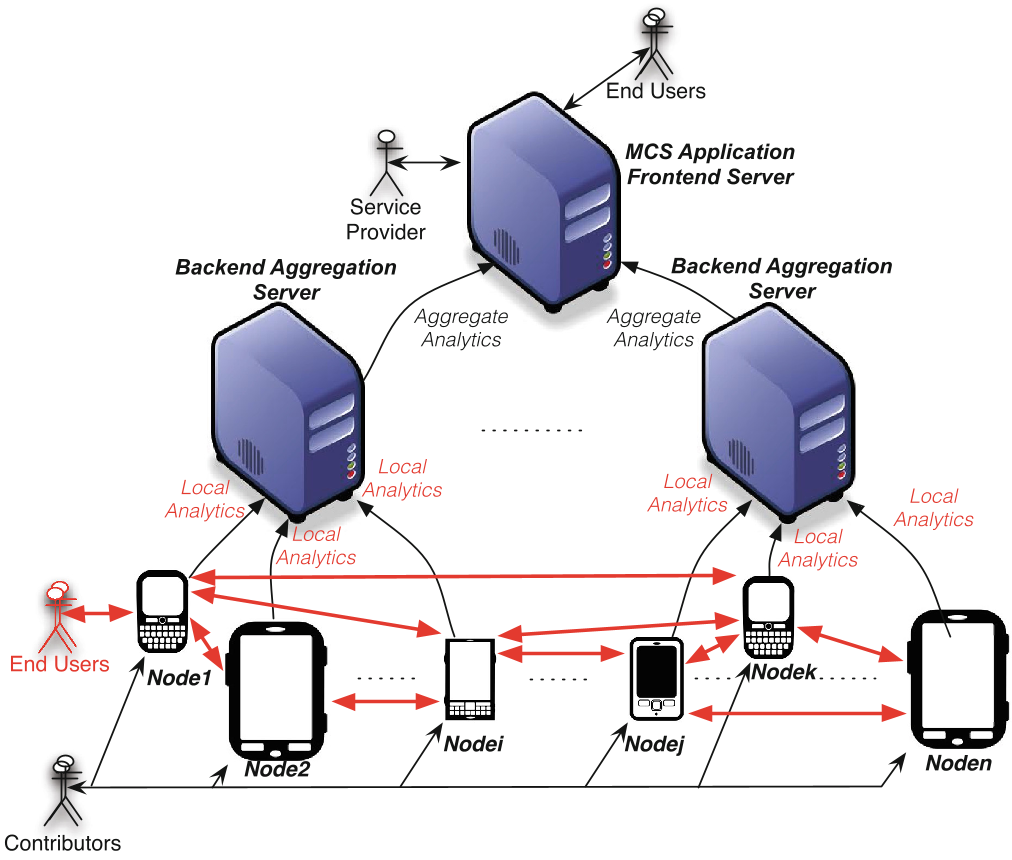
*As shown in Fig 1., the SITS approach introduces local activity and collaborative optimization (marked in red), bypassing the backend for immediate local coordination.*
## Experiments & Results: Easing the Gridlock
The system was tested using traffic data from downtown Messina, Italy. The evaluation focused on whether the "pheromone" logic actually helps distribute traffic.
* **Scenario A ($\alpha=0$)**: No pheromones. Drivers follow the shortest physical path. Result: Massive congestion on main arteries (bimodal distribution).
* **Scenario B ($\alpha=-1$)**: Pheromones active. As an arc becomes "congested," its cost increases, and pheromone updates push newer "ants" to explore underutilized side streets.
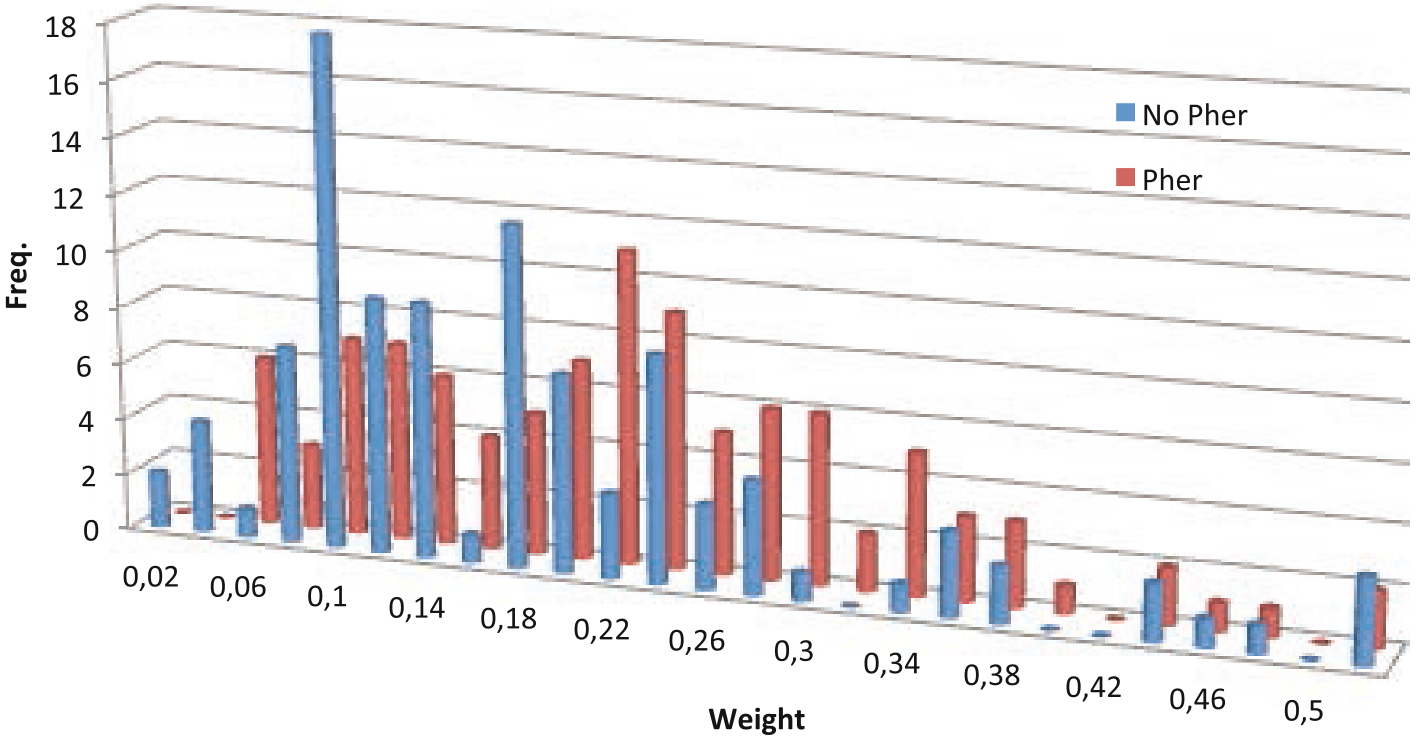
*Fig 4. clearly shows that with pheromones (SITS), the traffic intensity (probability mass function) shifts toward a more balanced, bell-shaped distribution, preventing the extreme "high-intensity" spikes seen in the standard model.*
## Critical Analysis & Conclusion
### Takeaway
SITS proves that **Stigmergic collaboration** is a viable alternative to complex centralized scheduling. By treating every smartphone as a node in a massive, distributed computer, we can solve NP-hard routing problems through emergent behavior.
### Limitations & Future Work
* **Real-world Adoption**: The study relies on simulations. In reality, convincing users to participate in an opportunistic sensing network requires robust privacy and incentive mechanisms (e.g., blockchain or gamification).
* **Network Stability**: The reliance on MANETs (Mobile Ad-hoc Networks) assumes devices are close enough to communicate. In sparse areas, the "pheromone" dissemination might break down.
Future research should investigate how **Deep Learning** can be integrated into the local analytics layer to predict pheromone evaporation rates even more accurately during extreme weather or accidents.