
Optimizing the "Last Mile": A Crowdsourcing-Based Path Selection Model for Takeout Delivery
Optimization Model of Takeout-Delivery Process Based on Concept of Crowdsourcing
This paper presents a Crowdsourcing-Distribution Path-Optimization Model designed to minimize distribution costs and time delays in food delivery services. By utilizing a Genetic Algorithm (GA), the study optimizes order allocation and route planning for crowdsourced personnel in a dispatch-based "Internet+" environment.
TL;DR
As global food delivery platforms face surging demand, this paper introduces a specialized path-optimization model that treats crowdsourced delivery as an integrated resource allocation problem. By balancing route distance with strict timeout penalties using a Genetic Algorithm, the authors achieve a solution that significantly reduces delivery delays while maintaining low personnel costs.
Background: The Crowdsourcing Shift
The "Internet+" era has transformed takeout from a luxury to a daily necessity. However, the sheer volume of orders during peak hours (e.g., 11:00 AM – 1:00 PM) creates a logistics bottleneck. Crowdsourcing—outsourcing tasks to a distributed network of non-professional drivers—offers a flexible solution, but only if the Dispatch Mode (allocating orders to drivers centrally) is optimized for efficiency.
Problem & Motivation: Beyond Simple Distance
Why is delivery optimization so hard? It’s not just about the shortest path. In the real world, a delivery person must:
- Pickup first, deliver second: The pair-wise constraint of the restaurant and the customer.
- Handle time windows: Food quality degrades, and customers lose patience.
- Manage multiple orders: A driver might carry 5-8 orders at once, each with different priorities.
Previous works often focused solely on distance. This paper argues that timeout duration is a critical "cost" that must be quantified alongside fuel/electricity costs to provide a commercially viable solution.
Methodology: The Core Engine
The authors propose a multi-objective optimization model aimed at minimizing the total "Global Cost."
1. The Cost Function
The objective function is a weighted sum of:
- Distance Cost: Calculation of kilometers traveled scaled by vehicle depreciation and power consumption.
- Time Cost: A progressive penalty mechanism where delays over 15 minutes (severe timeouts) are charged at double the rate of normal delays.
- Reward Incentives: Adjustments based on the number of successfully completed orders.
2. Genetic Algorithm (GA) Implementation
To solve the NP-hard nature of the Vehicle Routing Problem (VRP), the authors used a Genetic Algorithm with a unique strategy:
- Integer Coding: Representing orders as sequences.
- Pair-wise Insertion: Ensuring that a pickup point () always precedes the delivery point () in any generated chromosome.
 Fig 1: The logical flow shows how order allocation acts as the foundation for the subsequent route optimization phase.
Experiments & Results
The model was tested using real-world coordinate data (via Google Maps) for 60 orders in a high-density area.
Key Metrics:
- Environment: 60 Orders, 10 Delivery People (1:6 Ratio).
- Travel Distance: The optimized total distance for the fleet was 96.33 km.
- Timeout Control: Despite the high load, serious delivery timeouts were limited to just 3.15 minutes, proving the model's ability to prioritize urgent orders effectively.
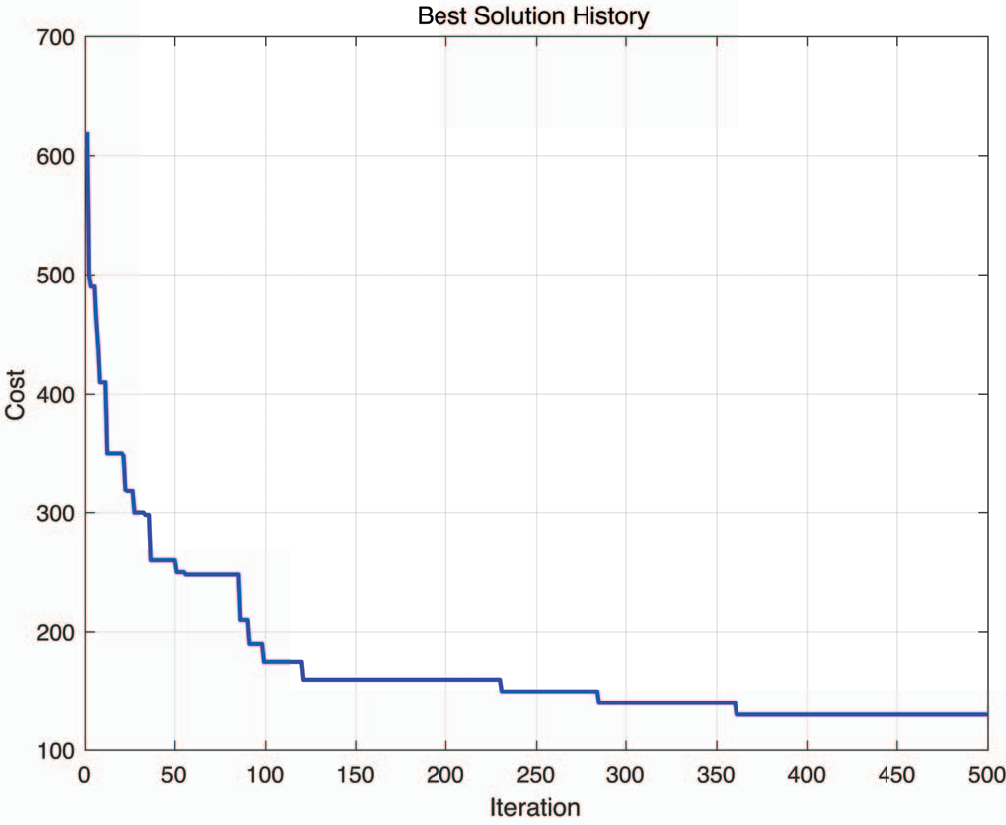 Fig 2 (Placeholder): The iterative graph shows how the total cost drops sharply and stabilizes around the 360th generation.
Critical Insight & Conclusion
The true value of this work lies in its holistic cost definition. By translating "minutes of delay" into "CNY cost," the model allows platform operators to fine-tune the balance between speed and profitability.
Limitations: The model assumes a constant delivery speed and ignores the variable "waiting time" at restaurants. In future work, incorporating real-time traffic data and dynamic restaurant preparation times would make this model even more robust for metropolitan deployment.
Takeaway for Industry: For O2O platforms, the key to efficiency isn't just "more drivers," but the algorithmic intelligence to minimize the overlap of routes and maximize the "utility" of every trip.