
The Enterprise Telework Ecosystem: Scaling Business through Crowdsourcing and Web 3.0
Crowdsourcing in Telework as a New Scalable Business Model
The paper proposes the "Enterprise Telework Ecosystem" (ETE), a scalable business model that integrates Web 3.0, Semantic Web technologies, and Crowdsourcing. It demonstrates how splitting complex telemarketing and data management tasks into "Microwork" can create highly responsive, DaaS-based (Data-as-a-Service) business architectures.
TL;DR
The rapid acceleration of global information flow has rendered traditional, centralized business models obsolete. This paper introduces the Enterprise Telework Ecosystem (ETE), a framework that synthesizes Web 3.0 (Semantic Web) technologies with Crowdsourcing to create a hyper-scalable business model. By decomposing complex telemarketing and data acquisition into "Microwork," businesses can achieve unprecedented agility and accuracy.
Background & Motivation: Moving Beyond Static Data
The authors argue that the "wisdom of the crowds" often risks becoming the "madness of the mobs" without a structured backbone. Prior business models failed to ensure data objectivity and urgency. The motivation for this research is to build a "reflective intelligent system"—one that doesn't just collect data but understands the semantics of client profiles to drive sales efficiency.
Methodology: The Semantic "Virtual Assembly Line"
The core of the ETE model is the integration of human intelligence with machine-readable metadata. The authors breakdown the methodology into a modular "virtual assembly line":
- Web Mining & Search: Using Web 3.0 principles to identify useful, original data across the web.
- Semantic Structuring: Utilizing RDF (Resource Description Framework) and OWL (Web Ontology Language) to ensure data is not just stored, but contextually linked.
- Microwork Execution: Business processes are split into micro-tasks:
- Data Searchers: Find client profiles.
- Data Actualizers: Verify and update information.
- Auditors: Use crowdsourcing to perform quality control on recorded calls and data accuracy.
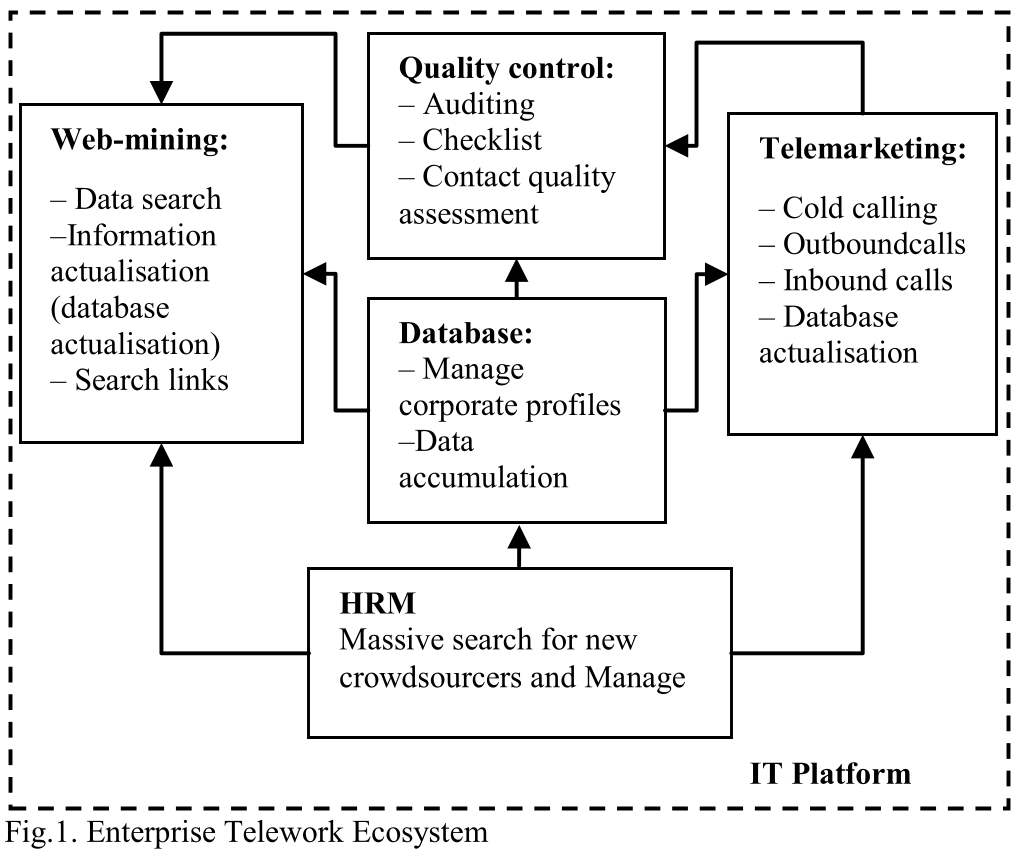 Figure 1: The audit and feedback loop within the Enterprise Telework Ecosystem.
Scaling via Crowdsourcing
A pivotal insight of this work is the concept of Elastic Scalability. Unlike traditional firms limited by office space and local labor, the ETE model uses a global pool of teleworkers.
- Social Impact: The model empowers disabled individuals, stay-at-home parents, and workers in developing nations by providing access to the global labor market.
- Operational Agility: The authors cite LiveOps as a benchmark. While traditional call centers take days to ramp up, the LiveOps crowdsourced model responded to the Hurricane Katrina relief effort within hours.
Technical Results & Industry Impact
The authors highlight the success of companies like Jigsaw and Marketing Telesystems LLC. Jigsaw utilized this crowdsourced DaaS (Data-as-a-Service) model to build a directory of 17 million B2B contacts through the contributions of over a million community members.
By applying Web Mining to telemarketing, firms achieved:
- Precision Targeting: Detailed content analysis of recorded calls.
- Individualized Proposals: Automated formation of products based on semantic data.
- Cost Optimization: Massive reduction in rent and internal HR overhead.
Final Analysis: From Crowdsourcing to "Noossourcing"
The paper concludes with a vision for the future: Noossourcing (from the Greek noos, meaning mind). As the professionalism of online communities matures, we will move from simple task completion to the management of "expert online societies."
Critical Takeaway: The value of a modern enterprise is no longer its physical assets, but its ability to orchestrate decentralized human intelligence through a semantic technological layer. However, the authors admit a significant limitation: the current crowdsourced pool often suffers from high irresponsibility, suggesting that future research must focus heavily on automated reputation and quality management systems.
Keywords: Web 3.0, Semantic Web, Crowdsourcing, Telework, Scalable Business, DaaS