
Leveraging Crowdsourcing for Sub-Verse Thematic Annotation of the Qur’an
Leveraging Crowdsourcing for the Thematic Annotation of the r'an
This paper introduces a crowdsourcing-driven framework for the thematic annotation of the Qur'an at the sub-verse level. By leveraging Amazon Mechanical Turk (AMT) alongside an ontology-based workflow, the authors achieve high-precision semantic labeling of complex Arabic text, addressing both explicit and implicit thematic assertions.
TL;DR
This research tackles the challenge of annotating the Qur'an with high thematic granularity. By implementing a crowdsourcing workflow on Amazon Mechanical Turk, the authors moved beyond simple verse-level categorization to "sub-verse" level annotations. Their method successfully handles both explicit mentions and complex implicit rhetorical themes, achieving up to 96% reliability and proving that crowd-human computation can scale specialized knowledge engineering tasks.
Context: Why Traditional NLP Fails Here
The Qur’an represents a high-stakes domain for knowledge engineering. Unlike standard news text, Qur’anic Arabic is densely packed with morphology and rhetoric. Existing datasets like QuranyTopics provide thematic hierarchies, but they are limited to the verse level.
The problem? Many verses are long (up to a full page), covering multiple distinct themes. Automated NLP often misses "implicit" assertions—where a theme is present through context or expression rather than specific keywords. The authors argue that while experts are scarce, a "qualified crowd" can provide the necessary semantic bridge.
Methodology: The Ontology-Crowd Hybrid
The core of this work is a structured workflow that translates ontological requirements into human-executable tasks.
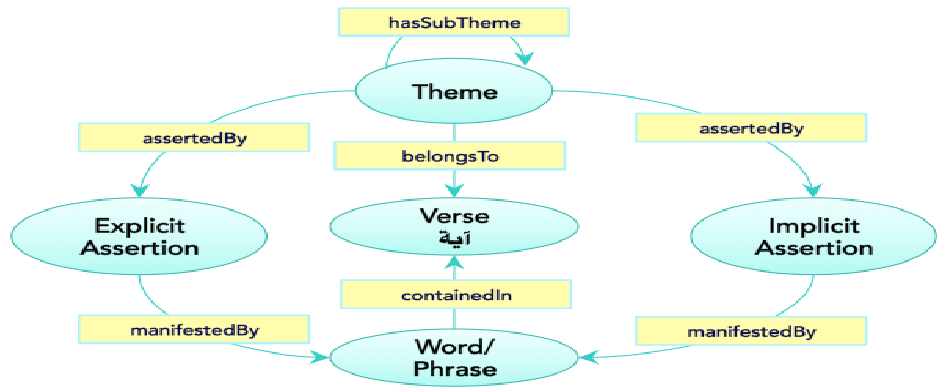
1. The Knowledge Model
The authors designed an ontology to capture the relationship between verses, sub-verse segments, and themes (explicit vs. implicit). This schema ensures that the data collected is "Linked Data" compatible.
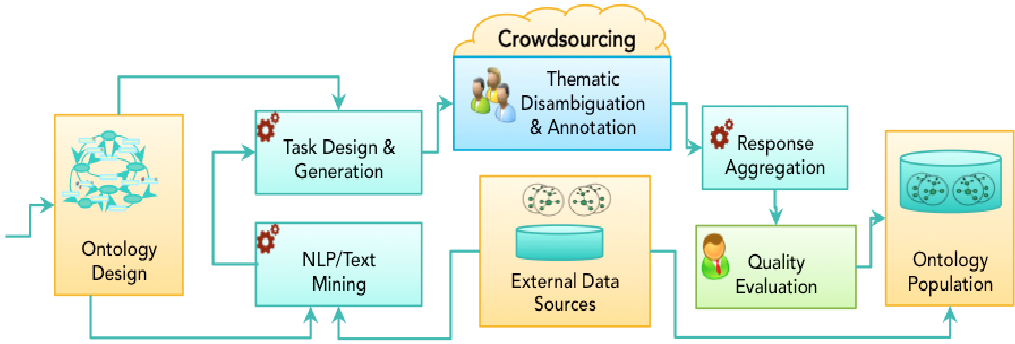
2. The Workflow Engine
The workflow involves:
- Task Generation: Dynamically creating "Human Intelligence Tasks" (HITs) based on candidate verses from the Semantic Qur'an dataset.
- Disambiguation: Asking the crowd if a highlighted word truly represents a theme in that specific context.
- Annotation: Users identify specific "phrases" within a verse that imply a theme.
- Aggregation: Using statistical measures and a "Confidence Level" (Very High to Very Low) provided by workers to filter quality.
Experiments & Results
In a pilot study using the AMT sandbox, the authors gathered approximately 12,000 submissions.
- Explicit Assertions: Easier for the crowd, resulting in a 96% approval rate.
- Implicit Assertions: Much more difficult, requiring deep language understanding, yet still achieved a 81% approval rate.
- Scalability: The study successfully disambiguated 3,500 verse-theme pairs, a feat that would have taken months for a small team of experts.
The authors noted that implicit tasks had lower engagement, likely because they required higher cognitive load and were presented in Arabic, narrowing the pool of available workers on a global platform like AMT.
Critical Insight & Future Outlook
This paper serves as a blueprint for knowledge intensive domains. It demonstrates that the "Intelligence" in Artificial Intelligence doesn't always have to come from an algorithm; it can come from a structured "crowd" guided by a formal ontology.
Future Directions: The authors aim to incorporate a "second-tier" expert review for tasks where the crowd shows high disagreement. As we look at this from a 2026 perspective, the obvious next step is a Human-in-the-loop system where LLMs provide the first draft of sub-verse annotations, and the crowd—as described here—acts as the validator.
Conclusion
By breaking down the "expert" barrier, this research opens the door for thematic mapping of other classical manuscripts and specialized legal or medical domains where context is king and "sub-document" granularity is required for true semantic understanding.