
Crowdsourcing Thousands of Specialized Labels: The Bayesian Active Training Revolution
Crowdsourcing Thousands of Specialized Labels: A Bayesian Active Training Approach
The paper introduces a Bayesian active training and assignment framework designed to crowdsource thousands of specialized, domain-specific labels (e.g., plant species). By combining a Convolutional Neural Network (CNN) with adaptive worker training and skills-aware task assignment, the system achieves a SOTA annotation accuracy of nearly 90% in large-scale experiments.
Executive Summary
TL;DR: This paper tackles the "expert bottleneck" in crowdsourcing. While we can easily ask the crowd to identify a "cat" vs. a "dog," asking them to identify one of 1,000 specific plant species is nearly impossible. The authors solve this by treating the crowd not as a static resource, but as a trainable, dynamic system. Using a combination of CNN-driven priors, adaptive quizzes, and a novel Bayesian inference model, they transformed a task where humans normally have a 2% success rate into one with 90% accuracy.
Background Positioning: This work bridges the gap between Computer Vision (CNNs) and Human-Computer Interaction (Crowdsourcing). It moves beyond simple "majority voting" into a sophisticated "Expert-in-the-loop" ecosystem, establishing a new SOTA for high-cardinality classification.
The Problem: The Curse of Dimensionality in Expertise
In professional domains like botany or medicine, the number of labels is massive. This creates two fatal flaws for traditional crowdsourcing:
- The Learning Wall: A human cannot memorize 1,000 species.
- The Sparsity Trap: Bayesian models typically require a "confusion matrix" of size . With 1,000 classes, that's 1,000,000 parameters per worker. Most cells will remain empty (sparse), making the model statistically weak.
Methodology: How to Build an "Expert" Crowd
The authors propose a collaborative pipeline where the Machine (CNN) and the Human (Annotator) assist each other.
1. Active User Training (The Pedagogy)
Instead of teaching all species, the system uses Monte-Carlo sampling based on CNN predictions to create small, 6-12 species quizzes. If the CNN thinks an image is either Species A, B, or C, it generates a quiz specifically helping the user distinguish those three.
2. Skills-Aware Task Assignment
The system treats assignment as a global optimization problem. Using a greedy heuristic, it assigns "easy" tasks to beginners and reserves experts (those with high accuracy on specific, difficult clusters) for the most ambiguous cases. This maximizes the worker's satisfaction and the system's information gain.
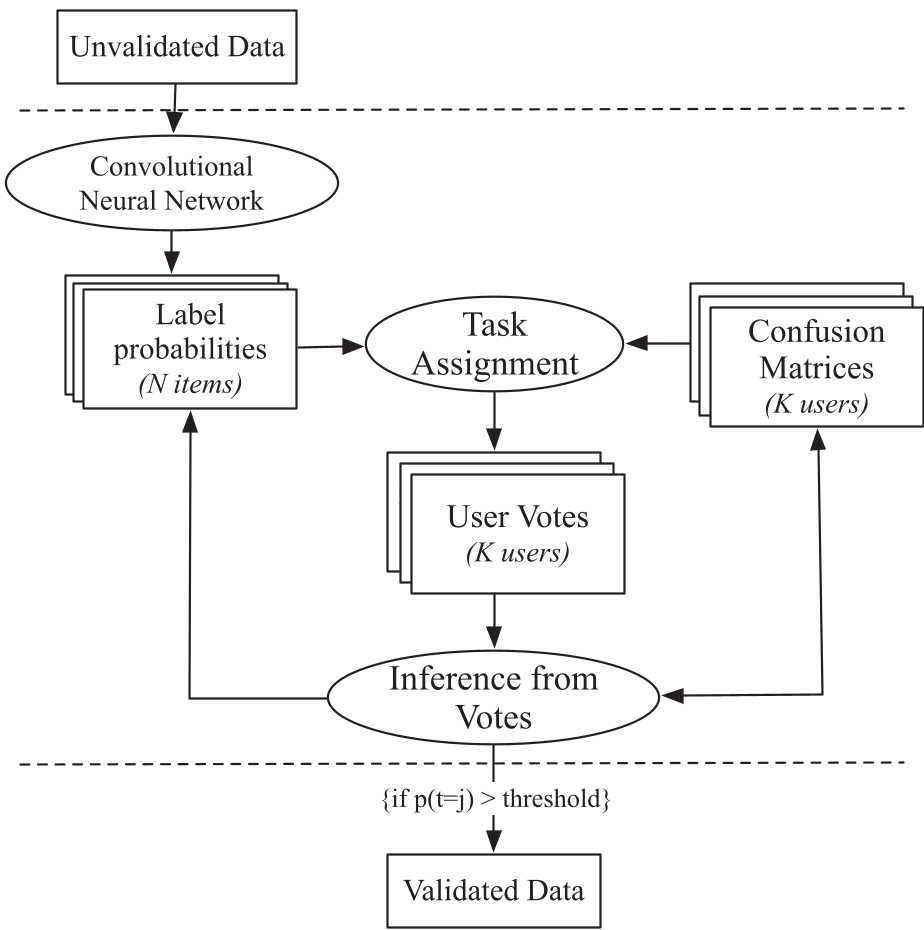 Figure: The system view showing the interplay between the CNN, Active Training, and Inference modules.
3. Bayesian Inference with Partial Knowledge
The authors improved the VIBCC (Variational Independent Bayesian Classifier Combination) model. Since workers only know a few species, the system has "partial knowledge." They used Laplace's Method (Taylor series expansion) to approximate the posterior of non-conjugate Gamma-Dirichlet branches, effectively "filling in the blanks" of what a worker might know about unencountered species.
Experiments: Turning Beginners into Pros
The authors launched The Plant Game, a live platform with over 1,000 players.
- Individual Growth: As shown in the "Success rate per quiz" chart, users' accuracy increased significantly within just 30-90 questions.
- Crowd vs. AI: The "Plant Game" (Human + AI) reached 98% precision, far outstripping the standalone CNN's 85%.
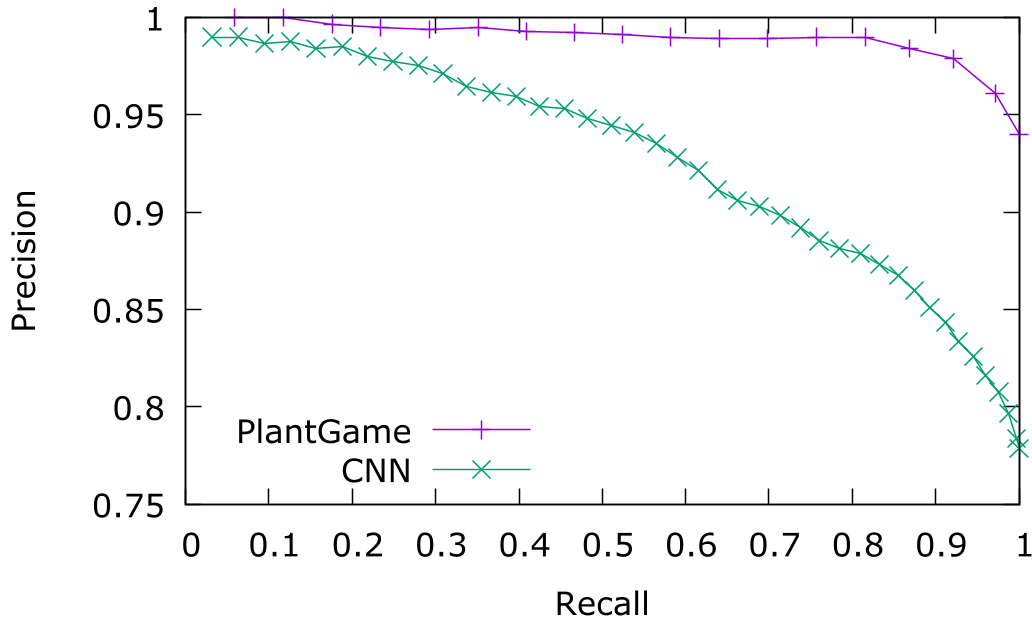 Figure: The Identification success rate across different user expertise levels. Notice how beginners, once trained, perform almost as well as self-proclaimed experts.
Critical Insight & Conclusion
The genius of this paper lies in dimensionality reduction via context. By narrowing the "Hypothesis Space" for each human at the right time, the system bypasses the limits of human memory.
Potential Limitation: The current model assumes labels are mutually exclusive. In many complex domains, a hierarchical taxonomy (Family -> Genus -> Species) exists. Future work could integrate this hierarchy to shrink the search space even further.
Takeaway: If you have a complex labeling task, don't just "hire experts." Build them using adaptive AI-driven training.