
Crowdsourcing Trust: Securing CPCS with Intelligent Mobile Edge Computing
Crowdsourcing Mechanism for Trust Evaluation in CPCS Based on Intelligent Mobile Edge Computing
This paper introduces a novel crowdsourcing-based trust evaluation mechanism for Cyber-Physical and Cloud Systems (CPCS), leveraging Intelligent Mobile Edge Computing (IMEC). It utilizes Mobile Edge Users (MEUs) to perform fine-grained trust assessments of sensor nodes and proposes two incentive mechanisms—TIM and QTIM—to ensure honest participation and high-quality data reporting.
TL;DR
Trust evaluation in Cyber-Physical and Cloud Systems (CPCS) often fails due to the "distance gap" between the cloud and the edge. This paper proposes a Mobile Crowdsourcing (MCS) framework where everyday edge users (smartphones, laptops) act as trust evaluators. By combining a hierarchical trust model with a Quality-Aware Incentive Mechanism (QTIM), the authors ensure that participants are rewarded only for honest, high-effort evaluations, effectively weeding out malicious actors.
The "Distance Gap" in IoT Security
In traditional CPCS architectures, trust evaluation is stuck between two extremes:
- The Centralized Bottleneck: A remote cloud center tries to manage thousands of nodes but lacks fine-grained, real-time insights due to network latency and distance.
- The Decentralized Fragment: Sensors evaluate their own neighbors, but limited battery and compute power make them easy targets for sophisticated attacks.
The authors' insight is to bridge this gap using Mobile Edge Users (MEUs). These users are close to the action (physical proximity to sensors) and possess the compute power to perform reasoning that sensors can't.
Methodology: Hierarchical Trust & Incentives
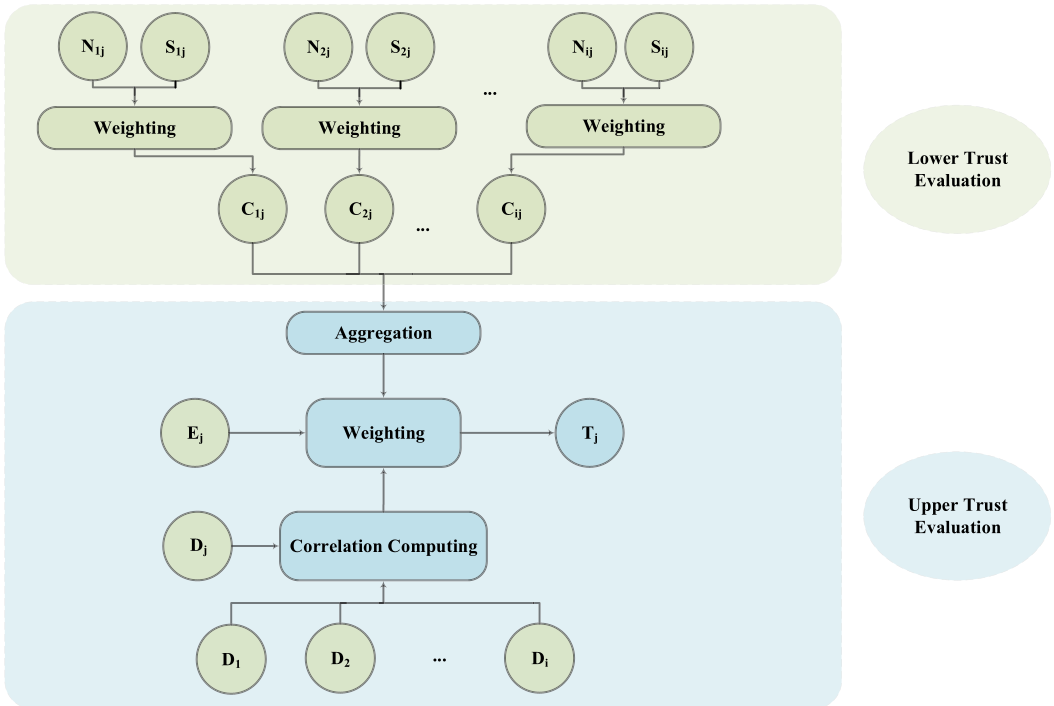
1. The Trust Reasoning Engine
The framework evaluates sensor nodes across three dimensions:
- Communication Behavior: Analyzing packet success rates and flooding thresholds.
- Energy Status: Monitoring consumption rates to detect nodes that might be compromised or dying.
- Data Content: Using statistical variance to see if the reported data "makes sense" compared to neighbors.
2. The Incentive Game (QTIM)
How do you stop a user from just "guessing" the result to collect a reward? The paper introduces Quality-Aware Trustworthy Incentive Mechanism (QTIM). It is based on a Reverse Auction where:
- Users bid their cost and evaluation radius.
- The cloud selects a winner set that maximizes "performance-price ratio."
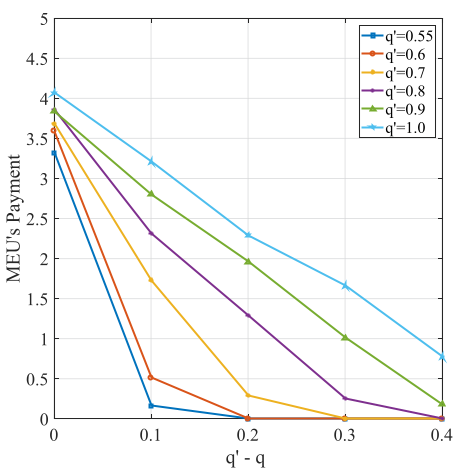
- Crucially, the payment is dynamic. If a user's report deviates significantly from the aggregated consensus of other MEUs, their payment drops to zero.
Experimental Performance
The authors validated their model using a 1000-sensor network simulation.
Key Findings:
- Cost Efficiency: As the number of available MEUs grows, the total cost to the cloud decreases because the system can select more "cost-effective" winners.
- Security Resilience: As more MEUs evaluate a single node, the "Cloud's Evaluation Error Rate" drops significantly, even if some MEUs are malicious.
- Incentive Alignment: Trustworthy users who put in the effort were shown to earn significantly more (up to 800% more) than "lazy" users who reported fake data.
Critical Insight & Future Outlook
The beauty of this work lies in treating Trust as a Commodity. By applying "Network Economics" to security, the authors move away from static rules and toward a dynamic, self-correcting market of trust.
Limitations: The current model assumes that the "majority" of MEUs are honest. If a specialized collusive attack occurs where 51% of MEUs report the same lie, the data aggregation could fail.
Future Work: The next frontier involves Privacy Preservation. How can an MEU evaluate a sensor's data without actually "seeing" sensitive information? Integrating Differential Privacy or Trusted Execution Environments (TEEs) would be the natural evolution of this architecture.
Takeaway
For developers of Smart City and Industrial IoT systems, this paper proves that edge intelligence isn't just for data processing—it's a critical infrastructure for decentralized security.