
Crowd4City: Bridging the Urban Gap Through Usability-Driven Crowdsourcing
Crowdsourcing Urban Issues in Smart Cities: A Usability Assessment of the Crowd4City System
The paper introduces Crowd4City, a geosocial network designed to bridge the gap between citizens and urban authorities through crowdsourcing. The study focuses on evaluating the system's effectiveness using a rigorous three-stage usability assessment based on ISO 9241, achieving an average compliance rate of approximately 80%.
TL;DR
As cities grow increasingly complex, traditional top-down management fails to keep pace. Crowd4City is a specialized geosocial network that empowers citizens to report urban issues—ranging from potholes to security risks—directly via a map-based interface. This paper moves beyond simple "feature listing" by subjecting the platform to a rigorous ISO 9241 usability audit, proving that a well-designed UX is the "secret sauce" for sustainable smart city participation.
Context: Why "Good Enough" Isn't Enough for Smart Cities
The concept of "Citizens as Sensors" (VGI) is not new, but many previous implementations have withered away. Why? Because existing tools like FixMyStreet or Wikicrimes often focus on a single niche or suffer from cluttered interfaces that demotivate users. In the world of geosocial networks, if the UI is a hurdle, the network dies. The authors of Crowd4City argue that usability is a survival metric, not just a design preference.
Methodology: The Core of Crowd4City
The system architecture follows a clean MVC (Model-View-Controller) pattern, utilizing PostgreSQL/PostGIS for robust spatial data handling.
1. Spatial Intelligence
Unlike basic reporting tools, Crowd4City allows users to define issues using points, lines, or polygons. This provides high-fidelity data: a "pavement defect" is a point, but "poor lighting" might be a line (a street), and "noise pollution" could be a polygon (a neighborhood).
2. Solving Visual Overload
To prevent the "map pollution" that occurs when hundreds of reports overlap, the system introduces Marker Clusters. These are dynamic pie charts that group nearby complaints by category, allowing for a high-level thermal view of city health without losing granularity.
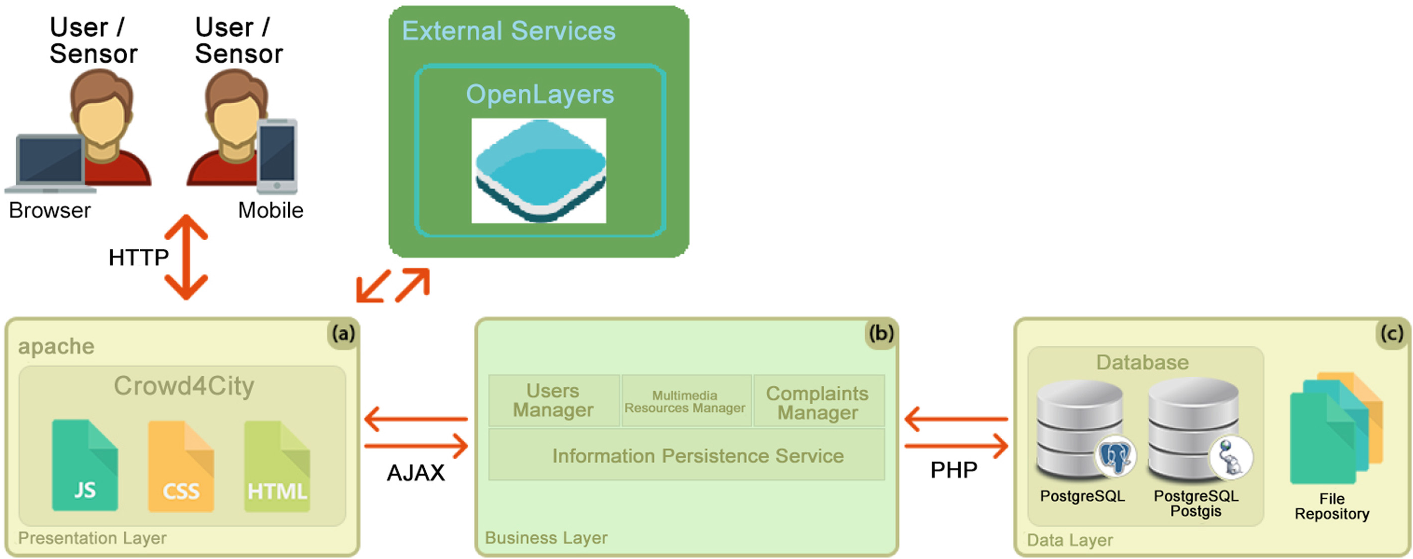 Figure 1: The MVC-based architecture of the Crowd4City system.
Validating Usability: The Three-Stage Assessment
The authors didn't just build the tool; they pressure-tested it using a three-pronged academic approach:
- Behavioral Monitoring: 30 volunteers performed 6 core tasks (registration, reporting, filtering) while being recorded via screencast and webcam to capture "micro-frustrations."
- Psychometric Surveys: Using the Bailey and Pearson satisfaction model, the authors quantified user sentiment.
- ISO Conformity: A rigorous check against ISO 9241 (Parts 14, 16, and 17) to ensure ergonomic and interaction standards.
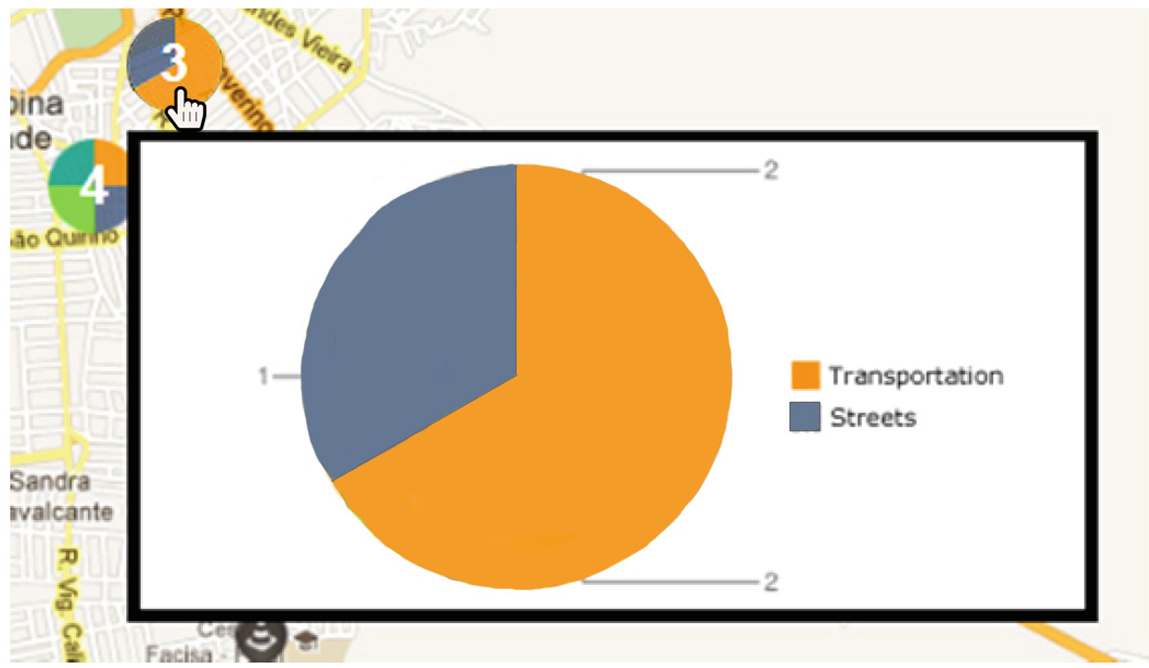 Figure 2: Marker clustering using pie charts to prevent interface pollution.
Experimental Results & Insights
The findings were overwhelmingly positive but highlighted a common pitfall in academic software: Error Recovery.
- Satisfaction: The score of 0.520 indicates "Very Satisfied" users.
- Adherence: The system hit 81.57% adherence for menu and direct manipulation dialogues.
- The Critical Gap: While 78% of users found the workflow logical, 54% found error messages "neither easy nor hard" to understand. This identifies a key area for improvement: making system feedback as intuitive as the map interface itself.
| Standard | Applicable Recs (Ar) | Successfully Adhered (Sar) | Adherence Rate (%) |
|---|---|---|---|
| ISO 9241 Part 14 | 38 | 31 | 81.57% |
| ISO 9241 Part 16 | 38 | 31 | 81.57% |
| ISO 9241 Part 17 | 59 | 45 | 76.27% |
| Table 1: Summary of ISO 9241 conformity levels. |
Critical Analysis & Future Outlook
The Crowd4City project successfully demonstrates that smart city tools must be built with a human-centered approach. However, the authors admit a limitation: the system currently operates in a vacuum.
Future Work includes:
- Social Integration: Pulling data from Facebook and Twitter to meet users where they already "hang out."
- Official Linkage: Connecting the platform directly to NGOs and government dashboards to ensure that citizen reports result in actual physical repairs.
The ultimate takeaway for the Industry: In the "Smart City" era, the citizen is the most valuable sensor, but only if the interface doesn't get in the way of the insight.