
Crowdsourcing Visual Detectors: Turning Viewers into Data Annotators
CrowdsourcingVisualDetectorsforVideoSearch
This paper presents a framework for crowdsourcing video fragment-level annotations by integrating automated concept detection with a social tagging interface. Using a 3-month field study of a concert video search engine, the authors demonstrate that an active user community can provide highly reliable feedback to refine automated visual detectors without financial compensation.
TL;DR
Researchers from the University of Amsterdam successfully bridged the gap between automated video analysis and human intelligence. By building a concert video search engine for rock enthusiasts, they proved that a dedicated community can provide fragment-level labels as accurate as experts. With a 67% agreement threshold, crowdsourced feedback achieved a 98% accuracy rate, offering a scalable way to train better AI models for video search.
Background: The Fragment Gap
Searching for a specific moment in a video—like a guitar solo or a close-up of a drummer—has historically been a manual, tedious task. While automated "Concept Detectors" exist, they are often brittle. The researchers identified a symbiotic opportunity: users want to find specific fragments, and AI needs more training data to identify them. The core question was whether users would provide this data for free and if that data could be trusted.
The Case Study: Pinkpop Festival Archive
The team developed a search engine containing 32 hours of footage from the Pinkpop festival. They targeted 11 specific concepts, including "Singer," "Drums," and "Audience."
Methodology: The In-Video Browser
The "secret sauce" was the In-Video Browser. Instead of asking users to fill out boring forms, the system integrated feedback into the viewing experience:
- Visual Cues: Colored dots on a timeline represent AI-detected fragments.
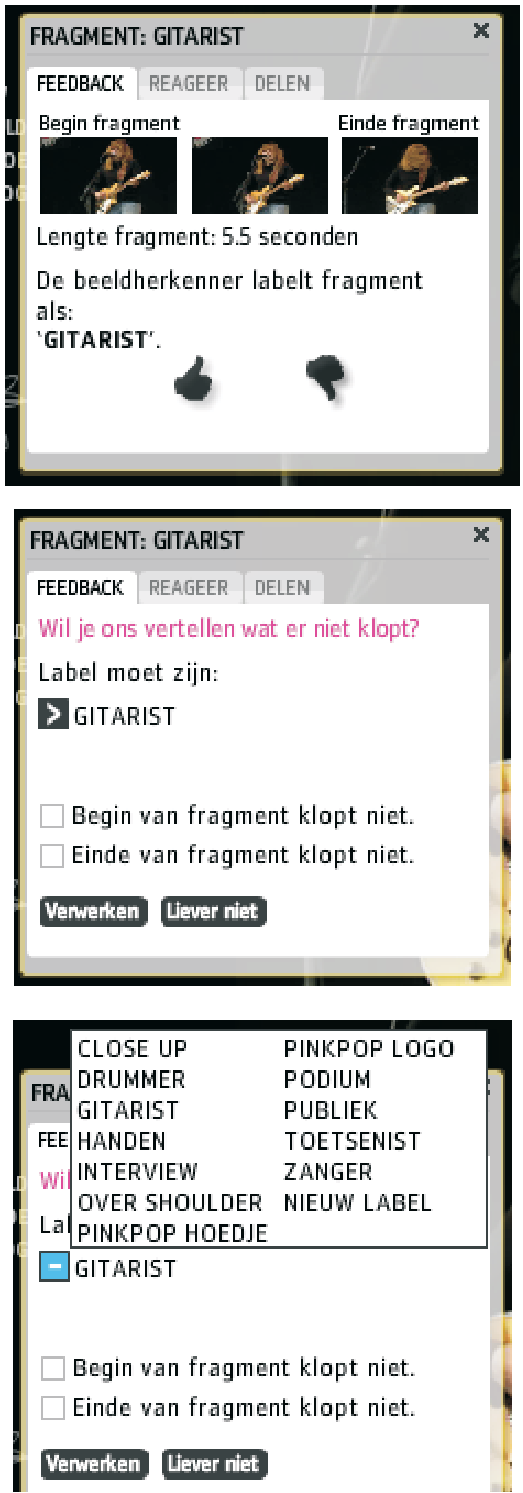
- Low Friction: Clicking a dot jumps to the fragment; a simple "Thumbs Up/Down" overlay appears without stopping the video.
- Contextual Evidence: The window displays thumbnails of the start, middle, and end frames to help users decide quickly.
Experiments & Key Findings
The study ran for three months, attracting nearly 10,000 visitors.
1. User Incentive: Do they care?
Interestingly, 10% of users contributed feedback—a high rate for online communities. The "Singer" and "Audience" concepts received the most attention, likely because they are the most recognizable and frequent elements in concert footage.
2. Quality vs. Quantity: The 67% Rule
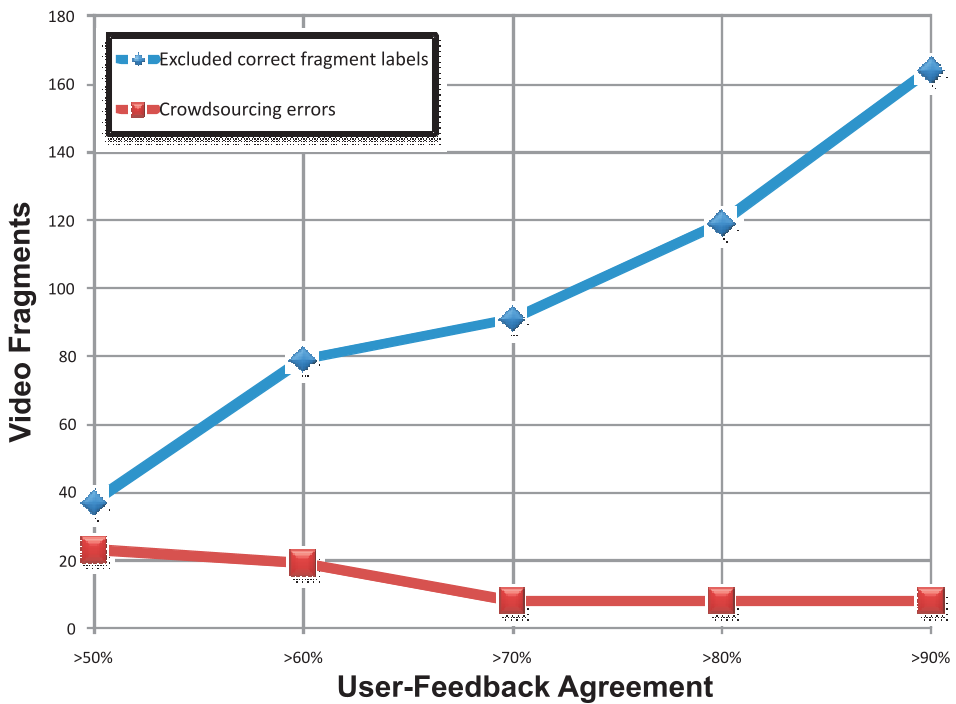
The most critical technical challenge was filtering "noisy" or incorrect tags. By comparing crowd feedback against expert ground truth, the researchers found that:
- Simple Majority (51%): Captured many fragments but included 23 errors.
- High Threshold (80%): Was extremely accurate but discarded too much valuable data.
- The Sweet Spot (67%): By requiring a two-thirds agreement among the crowd, the system retained 422 reliable fragments with an error rate under 2%.
Critical Insight & Future Outlook
This work demonstrates that intrinsic motivation (the desire to find and share cool concert moments) is a powerful substitute for financial micro-payments (like Amazon Mechanical Turk).
The real value of this research lies in its potential for Incremental Learning. Imagine a system where the AI suggests a label, the crowd corrects it, and the AI immediately retraining on that new, high-quality data. While this paper was written in 2011, its principles are more relevant than ever in the era of Large Language Models (LLMs) and RLHF (Reinforcement Learning from Human Feedback), where high-quality human preference data remains the rarest and most expensive resource in AI development.
Limitations
The study focused on a very specific niche (concert enthusiasts). Whether this level of "free" participation carries over to more mundane or technical video domains remains an open question. Furthermore, the study did not explore how to handle malicious "trolls" intentionally providing wrong labels.
Conclusion
Crowdsourcing isn't just about getting work done cheap; it's about building a loop where automated systems and human communities make each other smarter. For video search engines, the "Wisdom of the Crowds" is the key to unlocking the thousands of hours of unindexed video sitting in archives today.