
Crowdsourcing Without a Crowd: How Bayesian Logic Saves Citizen Science
Crowdsourcing Without a Crowd: Reliable Online Species Identification Using Bayesian Models to Minimize Crowd Size
The paper introduces an incremental Bayesian consensus model for species identification in citizen science, specifically implemented in the BEEWATCH program. By leveraging a dynamic feedback loop that re-evaluates label quality after each submission, the method achieves SOTA-level accuracy while significantly reducing the required crowd size.
TL;DR
In a world where biodiversity is declining, we need data faster than experts can provide it. This paper introduces an incremental Bayesian model that allows small groups of 3–5 non-experts to identify complex bumblebee species with the same accuracy as professional taxonomists. By modeling how humans make mistakes, the algorithm "squeezes" maximum information out of every single click.
The Problem: The Expert Bottleneck
Citizen science projects like BEEWATCH are victims of their own success. When thousands of photos of rare bumblebees pour in, a handful of experts simply cannot keep up with verification.
Current crowdsourcing solutions usually rely on Majority Voting, which works fine if you have 50 people looking at a "cat vs. dog" photo. But bumblebee identification is hard—some species look nearly identical, and the average volunteer only gets it right 59% of the time. Waiting for 10+ people to vote on a single photo is too slow and wastes precious volunteer energy.
Methodology: The "Species+User" Bayesian Insight
The core philosophy of this paper is that not all mistakes are equal. If someone confuses a "Garden Bumblebee" with a "Heath Bumblebee," it tells the system something specific about the visual features of the photo.
The Architecture of Logic
The authors developed two models based on Bayes' Rule in odds notation:
- Model 1 (Species Model): Adjusts weights based on how "confusable" a species is.
- Model 2 (User+Species Model): Learns which users are experts and which are prone to specific errors.
Instead of waiting for a fixed number of votes, the model treats every new label as incremental evidence. It recalculates the probability of the identity after every single submission. Once the probability hits a threshold (e.g., 90%), the system stops asking for more labels and closes the case.
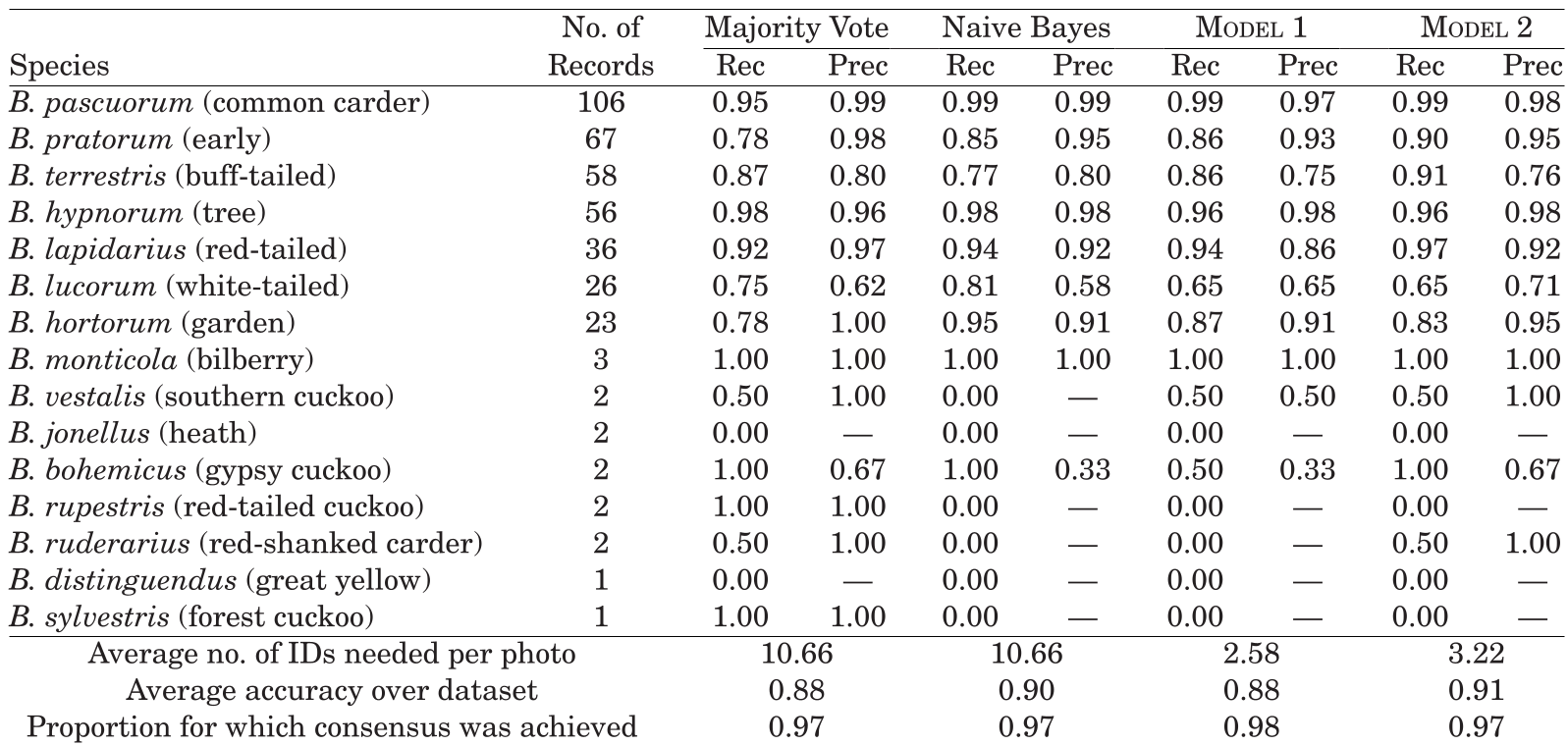 Table 1: Performance metrics showing high accuracy with minimal user IDs.
Experiments & Results
The researchers tested their models on a dataset of 1,613 photos of 22 UK bumblebee species.
- Efficiency: While traditional Naive Bayes or Majority Voting used all 10 available labels, the incremental Model 2 reached a high-confidence consensus with only 3.2 users.
- Accuracy: In clean datasets, Model 2 achieved 91% accuracy, effectively matching the performance of taxonomic experts who themselves ranged between 85-87% accuracy in photo-based trials.
- Noise Filtering: The system proved robust at identifying "Not a Bumblebee" photos or poor-quality images that were simply unidentifiable.
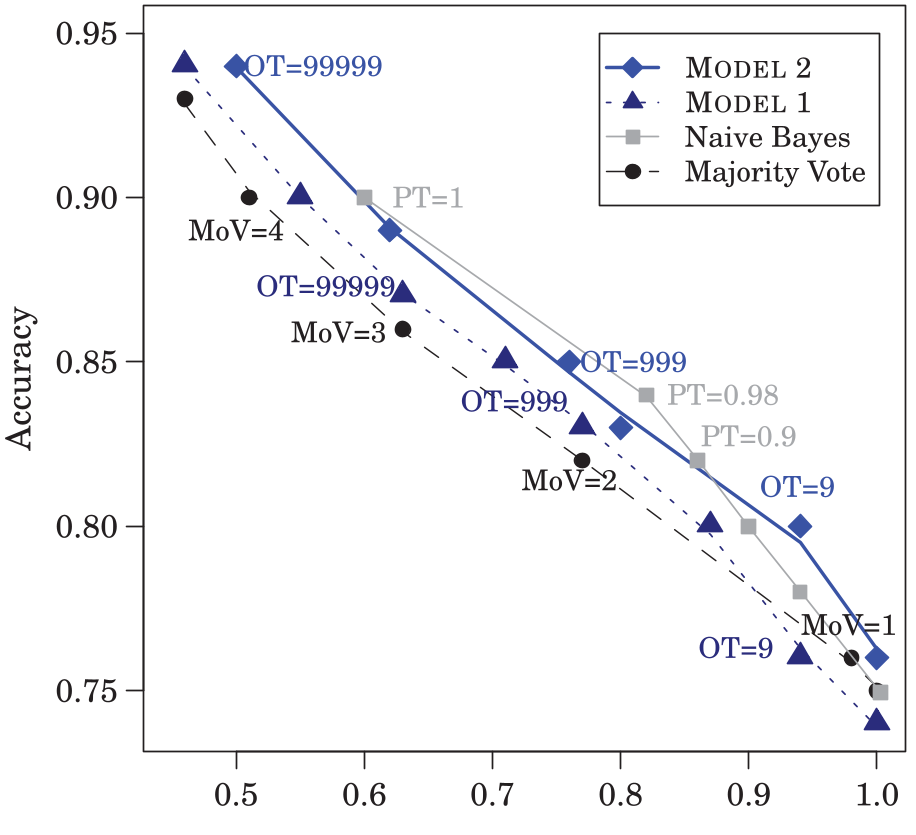 Figure 3: Showing how the Bayesian model (Model 2) maintains higher consensus rates at higher accuracy thresholds compared to Majority Voting.
Critical Insight: Modeling Human Bias
The real "secret sauce" here is Laplace Smoothing. In high-cardinality tasks (22 species), many users have never seen certain species. Without smoothing, the math would "break" if a user made a mistake the system hadn't seen before. By combining global species confusion data with individual user history, the model creates a robust net that catches human error and turns it into statistical certainty.
Conclusion & Future Outlook
This paper proves that we don't need a "crowd" for crowdsourcing—we just need a smart group. By moving from simple voting to incremental Bayesian updating, citizen science projects can scale up by 300% without hiring a single extra expert.
Limitations: The model struggles slightly when distinguishing "Species X" from "Unidentifiable Photo" because photo quality is random and doesn't follow the same visual "similarity" rules as biological species. Future work could integrate Computer Vision (AI) to pre-filter image quality before the humans even see it.