
CSE: Optimizing 5G Content Spreading via Entropy-Aware Influencer Selection
CSE: A Content Spreading Efficiency Based Influential Nodes Selection Method in 5G Mobile Social Networks
The paper introduces Content Spreading Efficiency (CSE), a novel algorithm for identifying influential spreader nodes in 5G Mobile Social Networks (MSNs) to optimize Device-to-Device (D2D) data offloading. Evaluated using the SIR model on real-world datasets, CSE consistently outperforms traditional centrality measures in information dissemination speed and reach.
TL;DR
To tackle the exploding traffic load in 5G networks, researchers are turning to D2D (Device-to-Device) offloading. The success of this strategy hinges on finding the "super-spreaders." This paper proposes Content Spreading Efficiency (CSE), a method that combines weighted degrees, clustering coefficients, and neighbor entropy to find the most efficient nodes for disseminating popular content.
Problem & Motivation: Why Degree Centrality is Not Enough
In a 5G Mobile Social Network (MSN), not all "connected" users are equal. A user might have many friends (High Degree) but rarely interact with them (Low Weight/Frequency). Traditional metrics fail here:
- Degree Centrality (DC): Blind to the quality/frequency of links.
- Betweenness Centrality (BC): Computationally prohibitive for millions of 5G devices.
- Eigenvector Centrality (EC): Often fails to capture the local dynamics of mobile movement.
The authors argue that an "elite" spreader needs not only many neighbors but neighbors who are themselves well-positioned and frequently reachable.
Methodology: The CSE Framework
The core innovation of CSE lies in its multidimensional approach. It calculates a node's influence by looking at three layers:
- Weighted Local Structure: It doesn't just count neighbors; it normalizes the degree and the weight (contact times) of the node and its immediate friends.
- Neighbor Weight Entropy (): This is a critical addition. It measures how "random" or "distributed" the contact weights are. A node with a fair distribution of weights among neighbors has a higher chance of spreading content reliably across different social circles.
- Sigmoid-based Clustering: Using a Sigmoid function, the algorithm captures nonlinear relationships in node importance, emphasizing nodes that bridge clusters.
 Formula 10 & 12: Showing the aggregation of weighted degree and entropy to form the final CSE score.
Experiments & Results
The authors validated CSE using the SIR (Susceptible-Infected-Recovered) model on two famous datasets: MIT Reality Mining and Infocom 2006.
Key Findings:
- Individual Impact: When picking the "Rank 1" node, CSE matched the performance of BC and DC, but as the rank increased (Rank 2-4), CSE consistently identified nodes with better spreading trajectories than all baselines.
- Group Performance: In MSNs, content is often pushed to a set of nodes. In the Infocom dataset, pushing to the Top-4 nodes selected by CSE resulted in the fastest network-wide infection rate.
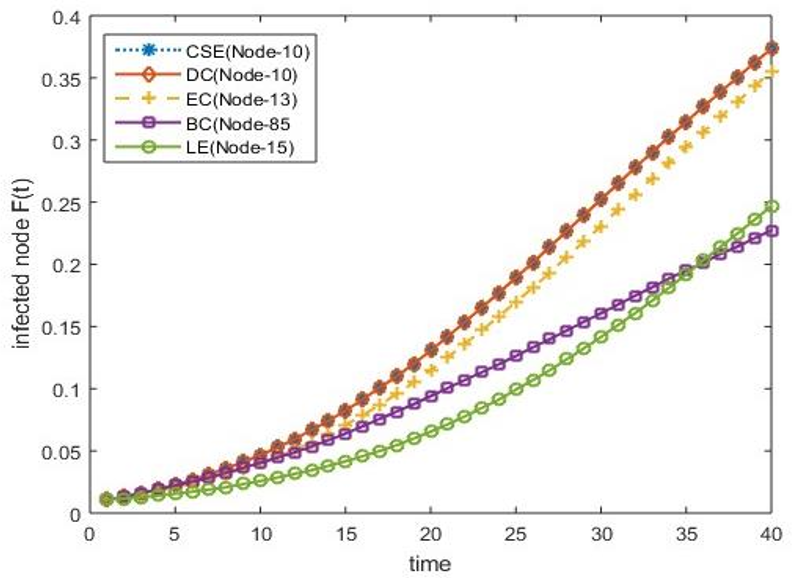 Figure 1: Comparison of spreading efficiency. You can see CSE (and sometimes DC) reaching the peak infected population faster than LE (Local Entropy) or BC.
Critical Analysis & Conclusion
The CSE algorithm is a significant step toward practical D2D offloading. By considering the efficiency of the link (entropy) rather than just the existence of the link, it aligns more closely with real-world social behavior in 5G environments.
Limitations:
- Temporal Dynamics: While the paper uses "contact times," it doesn't fully account for the temporal order of contacts, which can drastically change spreading paths.
- Battery/Incentives: The paper assumes influential nodes are willing to spread content; in reality, incentive mechanisms are needed.
Future Outlook:
The authors hint at integrating Artificial Intelligence (AI) to better predict user behavior. The next frontier will likely be combining CSE-style graph metrics with deep reinforcement learning to adaptively select spreaders in real-time as network conditions change.
Takeaway: Effective 5G offloading requires a "socially-aware" network architecture. CSE provides the mathematical foundation to identify the true conduits of information.