
CSF: Fusing Heterogeneous IoT Big Data Through Crowdsourced Intelligence
CSF: Crowdsourcing semantic fusion for heterogeneous media big data in the internet of things
The paper introduces CSF (Crowdsourcing Semantic Fusion), a novel framework for integrating heterogeneous media big data in IoT environments. It leverages collective human intelligence via crowdsourcing to bridge the "semantic gap" between low-level data features and high-level human understanding, achieving state-of-the-art retrieval precision across cross-modal datasets.
TL;DR
In the era of the Internet of Things (IoT), we are drowning in data but starving for knowledge. The CSF (Crowdsourcing Semantic Fusion) framework addresses this by combining the accuracy of human cognition with the scale of big data processing. By using a specialized task recommendation algorithm and a Spark-driven fusion engine, it transforms messy, cross-modal social media into a searchable, high-precision knowledge base.
The "Efficiency vs. Accuracy" Paradox
In the domain of media retrieval, researchers have long faced a binary struggle. Manual tagging provides the best context but is impossible to scale to the billions of files generated in IoT. Conversely, automatic feature extraction (Deep Learning, etc.) is fast but often misses the "Why" behind the content—a phenomenon known as the Semantic Gap.
The authors of CSF propose a middle path: Crowdsourcing. By treating social media users as a massive, distributed "biological CPU," we can extract high-quality semantics if—and only if—we can manage the noise and heterogeneity they produce.
Methodology: The Architecture of CSF
The CSF framework is divided into three critical subsystems: Extraction, Fusion, and Storage.
1. Intelligent Task Recommendation
To prevent "user fatigue" and ensure quality, CSF doesn't just broadcast tasks. It uses a historical topic determination algorithm (leveraging Wikipedia's categorical graph) to match specific media files to users who have a demonstrated interest in that niche.

2. Multi-modal Normalization and Fusion
How do you fuse a user's sketch of an image, an audio snippet, and a text comment? CSF normalizes all inputs into a unified <key-value> structure. It employs Latent Semantic Analysis (LSA) to reduce dimensions and eliminate non-principal components (noise), ensuring that the semantic objects represent the "essence" of the data without redundant overhead.
3. Distributed Memory Computing
Processing massive semantic graphs requires high I/O throughput. CSF utilizes Apache Spark to perform in-memory analysis, avoiding the bottleneck of traditional disk-based databases. Semantic information is stored in HBase, ensuring that even if the host file is moved, the semantic metadata remains synchronized.
Experimental Insights
The effectiveness of the system was tested using 50,000 documents across two datasets (Categorized and Uncategorized).
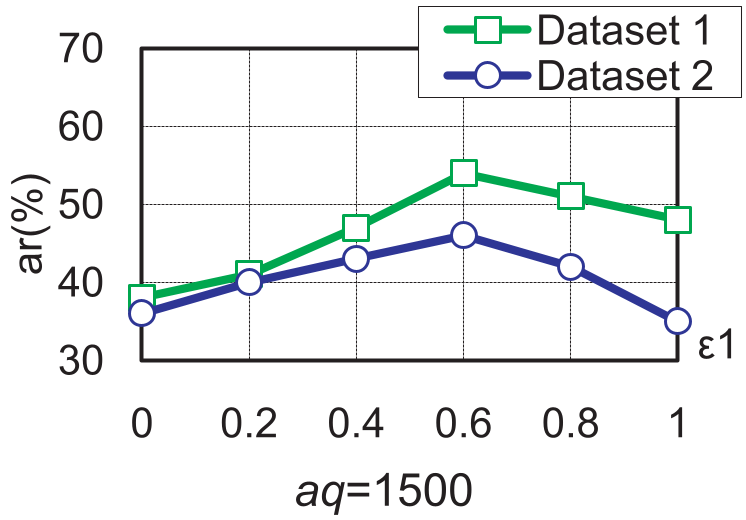
Key Finding 1: The Sweet Spot of Interest. As shown in the Task Recommendation graph, an interest threshold () of 0.6 provides the highest annotation rate. Randomly assigning tasks () results in poor engagement, while being too restrictive (higher ) limits the pool of available workers.
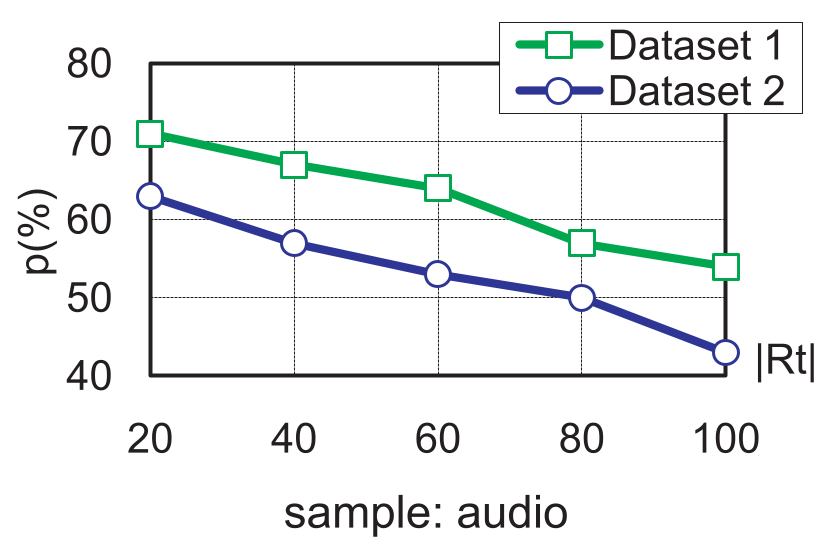
Key Finding 2: Precision Gains. The "Semantic Refinement" algorithm is the hero of the results section. By identifying and pruning "noisy" or low-weight annotations over a 24-hour cycle, the retrieval precision increased significantly as the dataset grew.
Critical Analysis & Conclusion
CSF demonstrates that the future of IoT isn't just "smarter machines," but smarter ways to integrate Human Intelligence (HI) into the data pipeline.
Takeaways:
- Normalization is Key: Bridging text, audio, and video requires a unified binary structure before fusion.
- Refinement Matters: Crowdsourced data is inherently noisy; iterative weight adjustment (Algorithm 3 & 4) is mandatory for SOTA precision.
- Scalability: The use of Spark/HBase proves that crowdsourcing frameworks can handle "Big Data" scales if the backend is optimized for in-memory computation.
Limitations: The system still relies on active user participation. Future work might benefit from "hybrid intelligence," where Large Language Models provide the initial semantic draft, and the crowd merely verifies or refines it, further reducing time costs.