
Cultural Data Sculpting: Beyond the Desktop in Digital Humanities
Cultural Data Sculpting: Omnispatial Visualization for Cultural Datasets
This paper introduces "Cultural Data Sculpting," a pioneering framework for omnispatial visualization of large-scale cultural datasets using the AVIE (Advanced Visualization and Interaction Environment) system. It details four major projects—ranging from museum collections and archaeology to Buddhist canons—that utilize 360-degree stereoscopic 3D environments to enable collaborative, embodied interrogation of complex information.
TL;DR
Researchers at City University of Hong Kong and their international partners are moving data analysis out of the 24-inch monitor and into a 360-degree, 3D "theater of knowledge." By using the AVIE (Advanced Visualization and Interaction Environment), they transform heterogeneous cultural archives—from ancient Buddhist texts to laser-scanned tombs—into immersive "sculptures" that users can navigate via physical movement and gesture.
The "Small Screen" Bottleneck
For decades, the Digital Humanities have been trapped in a 2D paradigm. Whether it's a spreadsheet of museum artifacts or a "Word Cloud" of a text corpus, the limitations are clear:
- Occlusion: Data points hide behind one another.
- Resolution Limits: You can only see a fraction of 50 million data points at once.
- Disembodiment: We "click" data instead of "experiencing" it.
The authors argue that higher cognition—the kind needed to find hidden patterns in history—requires Omnispatial Visualization.
Methodology: The AVIE Ecosystem
The core of this research is the AVIE theatre, a cylindrical projection space 10 meters in diameter. It provides a 12-channel stereoscopic system that tracks the user's position, allowing the data to react to the body.
Key Technical Strategies:
- Recombinatory Search: Instead of static results, the system re-authors the data in real-time. In T_Visionarium II, 24,000 video clips are tagged with metadata (emotion, color, scene) and redistributed across the 360-degree screen based on user queries, creating a "spatial montage."
- Blue Dots Abstraction: For the Tripitaka Koreana (52 million glyphs), each character is abstracted into a "blue dot." This allows scholars to visualize the "shape" of a 1,000-year linguistic tradition, identifying clusters and "ring compositions" that are invisible in standard text readers.
- Sonification: Attaching audio to abstract visual elements to reinforce spatial relationships.
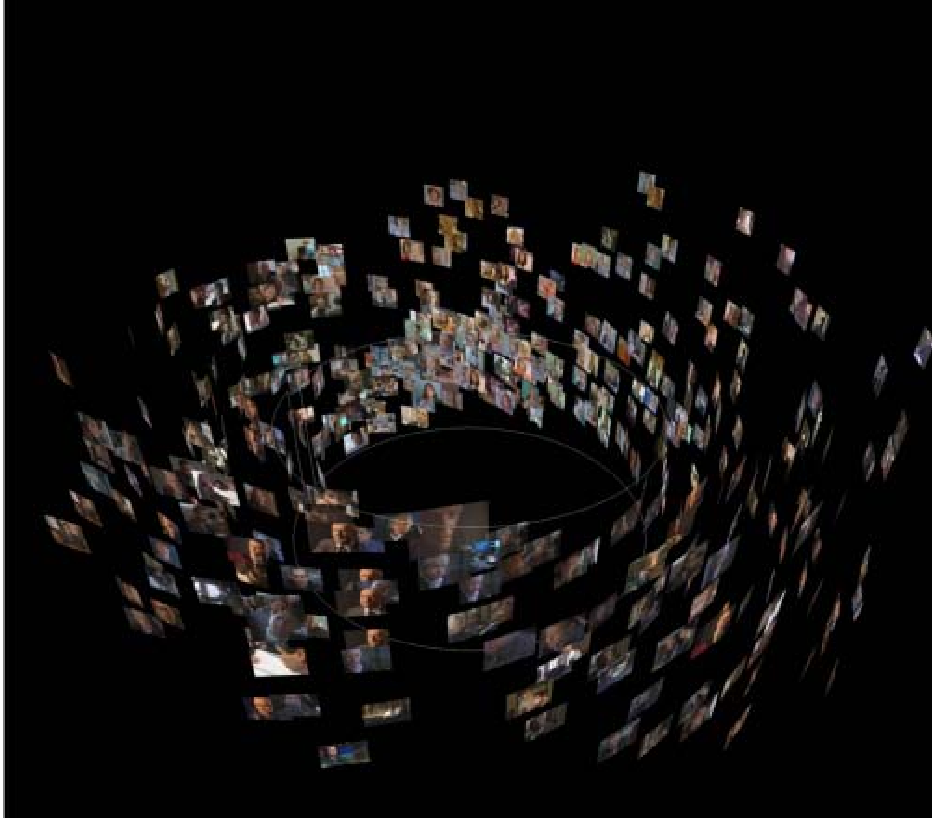 Figure: The Datasphere in T_Visionarium II, showcasing thousands of simultaneous video streams.
Case Study: Rhizome of the Western Han
This project brings "Cyber-archaeology" to life. By combining high-resolution laser scans of tombs in Xian, China, with 3D object viewers, researchers can inhabit archaeological data at a 1:1 scale. The user doesn't just look at a map of a tomb; they stand inside it, manipulating virtual artifacts through gesture-based interaction.
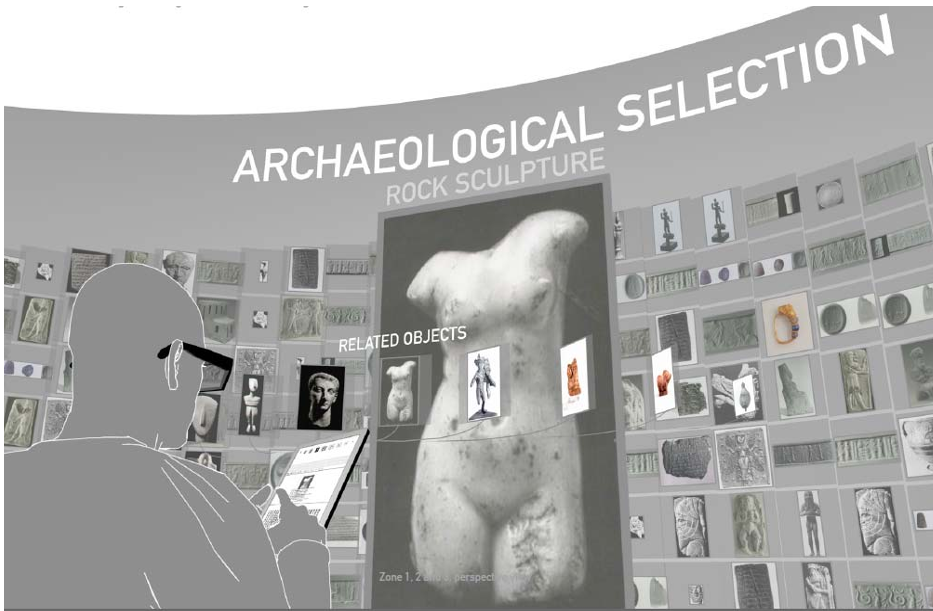 Figure: 3D data distribution of cultural datasets inside the AVIE environment.
Impact and Results
The "Cultural Data Sculpting" approach has proven its ability to handle massive scale:
- Museum Victoria: Successfully navigated a collection of 100,000+ records.
- Buddhist Canon: Visualized patterns across 52 million glyphs.
- Enhanced Cognition: Qualitative feedback suggests that immersion promotes "lateral thinking," allowing researchers to see connections across time and space that traditional linear databases obscure.
Critical Insight: Data as an Event
The most profound takeaway from this work is the shift from Archive to Event. Instead of the museum archive being a static place where items are stored, it becomes a "Data Sculpture"—a dynamic, temporary arrangement of history that emerges only through the interaction of the user.
Limitations & Future Work
The primary hurdle remains the availability of hardware. While AVIE is a landmark, such setups are rare. The future of this field likely lies in translating these omnispatial strategies to more accessible VR/AR headsets (like the Apple Vision Pro of today) while maintaining the collaborative, multi-user immersion that AVIE facilitates.
Takeaway
Digital Humanities is no longer just about digitizing books; it's about architecting experience. By "sculpting" data in 3D space, we allow the human brain to use its natural spatial navigation skills to solve historical mysteries.